
Administrator
04 May 2026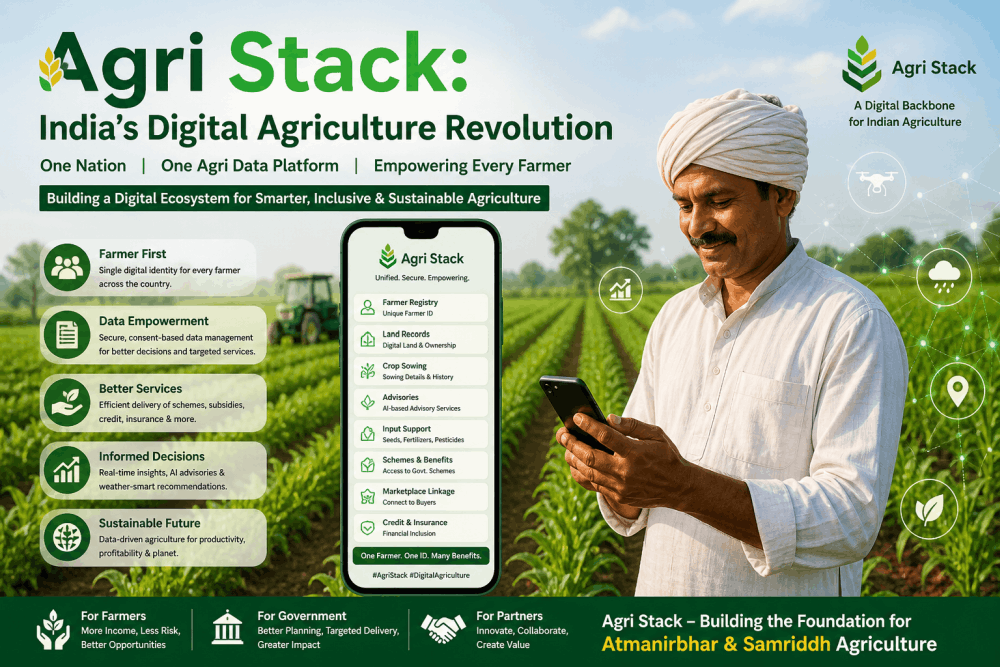
Agriculture sector continues to be the backbone of Indian economy engaging around 46 % of its workforce. Concerted efforts have been taken by Government in last decade to raise farmers income through multi-pronged strategy of increasing production/productivity, crop diversification, reducing cost of cultivation, improving price realization of agri-produce, climate resilience and risk mitigation.
Seamless, transparent and efficient delivery of various services or benefits to farmers, through the centrally sponsored or central sector schemes is a priority for the Government, whether at the federal or State level.
The essential requirement to assess the entitlement of any cultivator (whether owner, leaseholder or sharecropper) for any scheme benefit is the total agriculture land ownership and the history of crop sown on that land. However, huge variations in the land administration across the country pose a major challenge.
Recognising the importance and criticality of a standardised farmer database that captures vital information related to ownership and sowing, updated dynamically with strong consent mechanism, the Government launched Digital Agriculture Mission in the year 2024.
One pillar of the mission- the Agri Stack is now emerging as a quiet but powerful transformative pillar of this mission. It comprises of three registries- farm , farmer and crop sown. Agri Stack signals a new chapter in India’s agricultural journey - one that aligns closely with the hon’ble Prime Minister’s vision of Viksit Bharat by 2047.
Farm registry comprises database of geo-referenced agriculture plots, each assigned a unique farm ID. In the second layer, each land owning farmer is being provided with a unique farm ID with essential information related to each plot owned along with the share in case of co-ownership.
The data is dynamically linked to the Record of Rights so that any change in ownership due to inheritance, sale etc gets updated in the farmer registry. The third layer comprises of details of crop sown on each plot, obtained through a Digital/Technologically driven crop survey conducted in each crop season after the sowing is completed.
The Union government has partnered through Memoranda of Understanding with 35 States and Union Territories onboarded. The Mission is being implemented through a strong Centre–State collaboration, using State-of-the-art technology while ensuring complete inclusion.
Agri Stack is a federated database where ownership lies with States/UTs but is accessible to Union Government for delivery of services and data analytics. It seeks to create a verified digital identity for every farmer, link it to precisely mapped land parcels, and record what crops are grown in each season.
The Stack enables rule-based, automated service delivery across schemes and geographies, without requiring farmers to repeatedly prove their identity, land ownership, or crop details. The access of farmer related information is through a robust consent mechanism, ensuring strict adherence to provisions of Privacy and Data Protection related laws.

*Author
From paper records to digital foundation
For decades, agricultural administration relied heavily on paper-based records and manual survey, which was often a source of harassment to citizens and even corruption. Agri Stack represents a transformational shift away from this legacy. By digitising farmer identities and linking them with land and crop data, it creates a reliable, up-to-date picture of Indian agriculture.
A key milestone in this journey has been the creation of more than 9 crore crore farmer IDs till date. These digital identities act as a single source of truth, enabling farmers to access multiple services without repeated verification, reducing the transaction costs. For government agencies, they reduce errors in beneficiary identification and help ensure that benefits reach the intended recipients.
The disclaimer, however, is that Agri Stack is primarily to empower farmers for availing various scheme benefits, but not a replacement of land records or certificate of land ownership, even though its dynamic linkage with Record of Rights ensures authenticity.
Digital crop surveys: real-time crop insights
In 2025-16, 24 States conducted the digital crop survey in nearly 30 crore plots across more than 600 districts using mobile devices, geotagging and satellite support. This marks a significant departure from traditional survey methods that were often slow and prone to inconsistencies/errors.
This data improves yield estimation, procurement planning and market forecasting. It also strengthens disaster preparedness by enabling early identification of crop stress due to droughts, floods or pests. For farmers, better data translates into timely and crop specific advisories and quicker support if things go wrong.
An ecosystem built on cooperation and inclusion by design
Recognising the diversity in land administration across the country, the Architecture has an inbuilt flexibility to tailor it as per the local needs while maintaining the common standards to ensure interoperability, enabling seamless data exchange across states and central systems.
To illustrate, there are States where land records have not been updated for decades and name of forefathers continue. While concerted attempts are being made to ensure updation of land records, but in the interim, successor farmers cultivating land still recorded in the names of deceased owners can have their farmer ID generated, after verification by revenue department, ensuring continuity of benefits.
Wherever, State laws permit and States agree, sharecroppers and tenant farmers can also be onboarded for availing specific scheme benefits, with robust owner-authorisation mechanisms.
In the North-Eastern States, where community ownership dominates, geo-coordinate-based certification allows inclusion without disrupting customary practices.
How will it benefit the farmers?
For farmers, the common digital layer translates into fewer forms, fewer visits to local offices, and greater transparency in accessing government schemes and services. Credible digital records with dynamically updated details of land holdings and cropping history enables banks and insurers assess risk and design products tailored to farmers’ needs.
Agri Stack has the potential to strengthen farmer collectives. Verified data can help Farmer Producer Organisations (FPOs) aggregate produce, negotiate better prices and access working capital more easily.
Land data integrated with crops sown and soil health has the potential to unleash a transformation in agriculture extension as now tailored advisories can be designed and disseminated. At very low cost. Farmers can receive personalised guidance on optimal sowing times, irrigation schedules, nutrient application and pest management based on local conditions.
How will the governance and policy process be impacted ?
Agri Stack provides opportunity to reform governance processes and foster evidence based data driven policy making. Policymakers have access to accurate and timely data to track cropping patterns, anticipate supply-demand gaps and intervene in a timely manner to prevent price volatility.
Once a farmer’s identity, land holding, crop sown is verified digitally, transactions related to subsidy disbursal in cash or kind, crop insurance, procurement, or credit etc can be processed digitally and seamlessly.
The Aadhaar enabled payment gateways ensures transfer of benefit to the intended beneficiary. The reformed system enhances transparency and accountability by creating a clear digital trail for public expenditure.
It has been observed that Ministries at Federal and State level, and in some cases, even various divisions in a specific Ministries have developed their own farmer databases for scheme implementation.
Agri Stack breaks such self-created silos by developing a common but universal digital layer allowing agriculture, animal husbandry, fisheries, cooperatives, revenue, food, fertiliser, credit, and insurance systems to work using the same verified data.
This not only improves operational efficiency, but also reduces the burden on farmers to register on multiple portals for availing various scheme benefits.
Several States have gone ahead to successfully implement use cases of Agri Stack. Chhattisgarh used the Agri Stack to seamlessly register farmers for MSP based paddy procurement during last kharif. Madhya Pradesh used the database for its Price Deficiency based support to Soyabean farmers under PMASHA. Maharashtra is using Agri Stack for all its DBT based benefits including Disaster Relief.
Catalysing innovation
AgriStack’s open, standardised architecture provides an ecosystem for innovation, especially using artificial intelligence. As the Stack matures, there are opportunities for Startups to build applications that combine crop data, weather forecasts and market prices into user-friendly tools.
Finance Minister in her recent public discourses highlighted Agri Stack as “next big thing from India “ and “ Next UPI like revolution”. As India moves ahead towards atmanirbharta and becoming the global food basket, Agri Stack is a forward-looking reform where data empowers farmers, technology strengthens governance and collaboration drives progress.
*The Author is Secretary, Department of Agriculture & Farmers’ Welfare, Government of India. He is a senior Indian Administrative Service Officer( 1989) batch with extensive leadership experience in governance, adminstration.
If you value our journalism, consider making a voluntary contribution to help us continue bringing news, stories and information to our readers.
Scan the QR code to contribute

Every contribution, big or small, is appreciated.