
Administrator
17 May 2026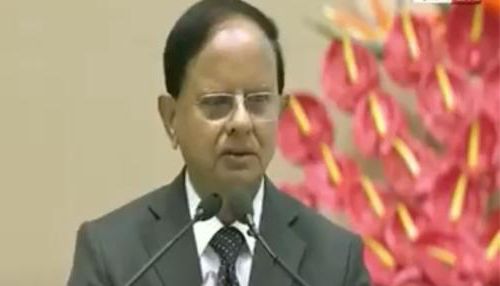
Dr. P.K. Mishra, Principal Secretary to the Prime Minister, on Saturday ( May 16, 2026) addressed the 20th Annual Convocation of the National Institute of Bank Management (NIBM) in Pune, Maharashtra. Expressing his delight at joining the ceremony, he warmly congratulated the Batch of 2024-26 and the Gold Medal winners.
He emphasised that the graduates are entering the professional world during a pivotal era where banking extends far beyond simple commerce. “Convocation ceremonies are milestones of achievement, but they are also moments of transition,” remarked Dr. Mishra.
Reflecting on NIBM’s five-decade legacy as the apex banking think-tank, Dr. Mishra highlighted the critical importance of institutional excellence. He noted that while traditional banking focused merely on mobilising savings, the contemporary landscape demands a broader focus on national opportunity. He urged the graduating class to internalise this evolving scope. “In the coming days, you need to see banking and finance in a much broader sense, as an architecture of inclusion, opportunity, trust and national development,” he stated.
Discussing traditional economics, Dr. Mishra explained that finance historically operated as a quiet enabler in the background. He pointed out that linkages between the real economy and finance were poorly understood, often leaving the less privileged excluded from formal institutional support. He affirmed that this skewed credit availability adversely affected livelihoods. “Credit is an important element of economic activity, livelihood generation and well-being of citizens,” he affirmed.
Touching upon rural credit disparities, Dr. Mishra detailed how early economic theories failed to resolve the predominance of informal moneylenders. He observed that contrasting views, from monopoly theories to competitive market models, could not ensure cheap priority credit for the poor. “By the 1990s, economists realised neither view fully explained ground realities, such as moneylenders successfully charging exceptionally high rates even when cheaper institutional alternatives existed,” he stated.
Sharing insights from his own 1990s research, Dr. Mishra explained that information asymmetry and enforcement problems historically made formal rural lending costly and heavily reliant on collateral. He noted, however, that technology has fundamentally solved this structural difficulty. “The modern application of technology has drastically reduced these information costs, effectively mitigating historical market asymmetries,” he remarked.
Dr. Mishra asserted that integrating finance with digital identity and mobile connectivity has dismantled long-standing barriers to reach the population at scale. He showcased the JAM Trinity (Jan Dhan, Aadhaar, and Mobile) and the Direct Benefit Transfer (DBT) architecture, noting they have transferred over ?50 lakh crore while saving ?4 lakh crore in systemic governance.
He described these tools as a fundamental bridge to economic identity. “A digital payment system is not merely technology. It is a bridge between informality and formal economic participation, between exclusion and opportunity, between invisibility and economic identity,” he noted.
Underscoring the Unified Payments Interface (UPI) as a prime example of democratisation, Dr. Mishra pointed out its growth to over 24,000 crore annual transactions. He added that this mass interoperable system generates vital data trails, allowing those without traditional collateral to build credit histories.
He highlighted that technology is fundamentally changing who can access financial services. “Countries across the world are now studying India's digital public infrastructure architecture with great interest. India is helping shape global thinking on inclusive digital finance,” he stated.
Dr. Mishra further emphasised that financial inclusion must translate into productive economic opportunities through schemes like the Pradhan Mantri Mudra Yojana, which has sanctioned over ?40 lakh crore. He noted that programs like PM SVANidhi and PM Vishwakarma ensure tailored growth for marginalised artisans, freeing them from exploitative informal credit. He remarked that no society can realise its potential if entrepreneurship is constrained.
“These multifaceted initiatives, firmly anchored by foundational elements like Jan Dhan and Aadhaar, owe their existence to sound policymaking and the exceptionally strong political will of the Prime Minister," he stated.
Integrating finance with social security, Dr. Mishra cited Ayushman Bharat and various PM pension schemes as vital for building resilience against medical or crop failures. He explained that this synergy ensures financial access supports long-term human development. He cautioned, however, that the next phase must move beyond mere access toward sustained economic participation. “Financial resilience, the ability of a family to absorb shocks without falling apart, is therefore not a peripheral concern,” he asserted.
Looking toward the future, Dr. Mishra warned that modern financial systems must remain anchored in the real economy to reliably serve MSMEs, farmers, and women-led enterprises. He cautioned that in an era of AI and cyber threats, technological innovation must be balanced with ethical responsibility and public trust. He noted that finance must combine accountability with ethical principles. “Finance creates its greatest value when it strengthens the productive capacity of society rather than becoming detached from it,” he remarked.
Addressing the young graduates directly, Dr. Mishra implored them to carry a larger public purpose into their corporate careers. He urged them to be active builders of inclusive institutions and steadfast custodians who safeguard the banking system's integrity.
He encouraged them to remember the human element behind every digital transaction to help foster a prosperous India. “The finest financial professionals are those who combine technical excellence with human understanding,” emphasised Dr Mishra.
Shri Sanjay Malhotra, Governor, Reserve Bank of India; Prof. Partha Ray, Director, National Institute of Bank Management (NIBM) , senior faculty members, economists and bankers were present on this occasion.
If you value our journalism, consider making a voluntary contribution to help us continue bringing news, stories and information to our readers.
Scan the QR code to contribute

Every contribution, big or small, is appreciated.