
Administrator
03 March 2026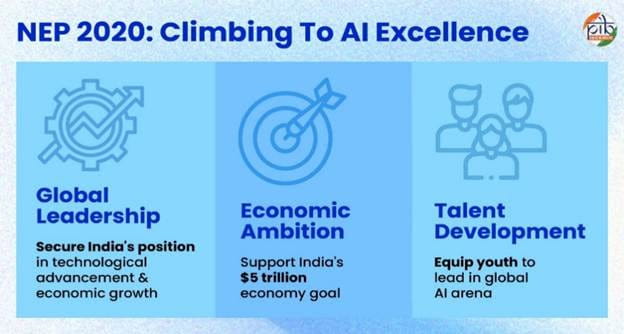
India appears to be positioning itself as a global AI powerhouse, with rapid growth across the sector. In 2024, 89% of new startups were AI-powered, and 87% of the enterprises are actively employing AI.
This is just the beginning – the Indian AI market is expected to grow at a rate of 25%-35% through 2027. To support this growth, India, which had an AI talent pool of 600,000-650,000 in 2024, needs over 1.25 million AI professionals by 2027, at a 15% CAGR, according to NASSCOM.
Various initiatives and policies of the government are addressing the monumental shift in the labour market disrupted by AI. The National Education Policy (NEP) 2020 recognises AI's potential for economic growth, solving educational challenges, enhancing teacher capabilities, and personalising learning – and emphasises the importance of AI-learning across all educational levels. The IndiaAI Mission (launched in March 2024) aims to make India a global AI leader by fostering innovation across government, institutions, startups, private sector, and academia.

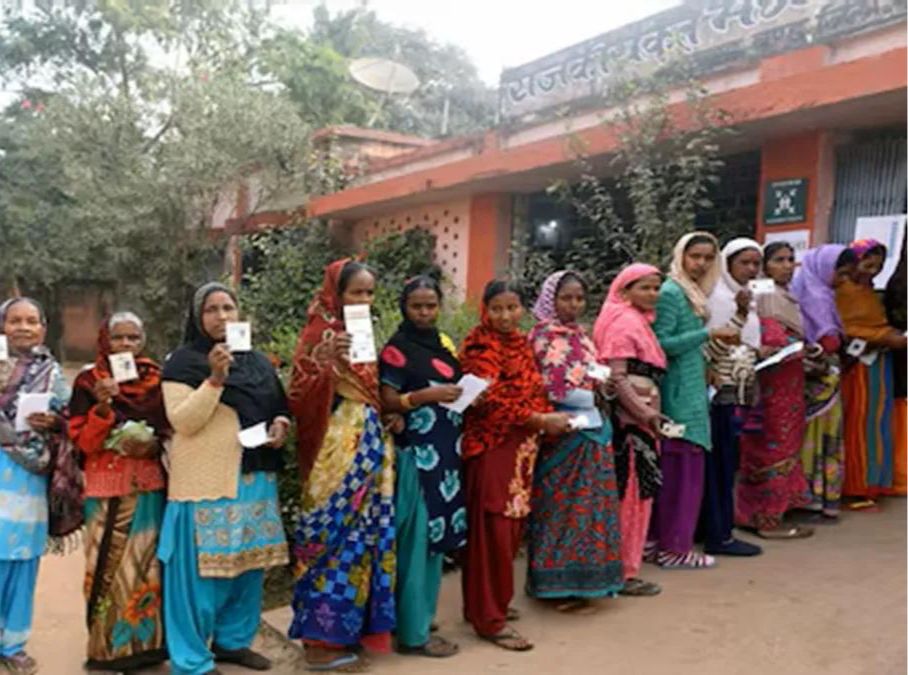
Central to this strategy is democratising technology—ensuring AI tools and digital platforms reach remote villages, tribal areas, and underserved communities, bridging the digital divide. This comprehensive approach aligns with the Viksit Bharat 2047 vision, positioning India as an inclusive global AI leader.
National Education Policy 2020 on AI
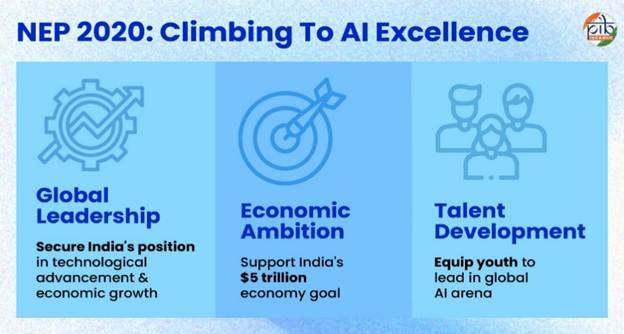
The NEP acknowledges that AI, big data and machine learning will transform labour markets and drive innovation. To ensure that the youth can cope with these monumental shifts, the NEP emphasises the importance of learning about AI, computer science/data science, along with other subjects for multidisciplinary education.
The policy aims to equip students in these subjects for economic success and greater opportunities.
As education is in the Concurrent List, NEP 2020's recommendations influence both Union and State/Union Territory education policies and support the government's push to position India as a global AI leader.
AI Initiatives in School Education
The Ministry of Education has integrated AI into school curricula across India through CBSE and NCERT, starting with grades 9, under National Education Policy (NEP) 2020 and National Curriculum Framework (NCF) 2023.
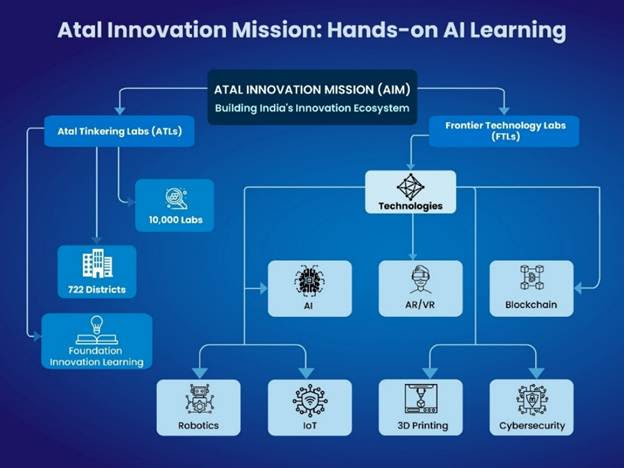
Currently, CBSE offers a 15-hour AI skill module from Class VI onwards and AI as an optional subject in Classes IX-XII. NCERT has incorporated AI content in Class XI Computer Science and Informatics Practices textbooks and used AI/ML to translate Grade 1-2 textbooks into 22 Indian languages.
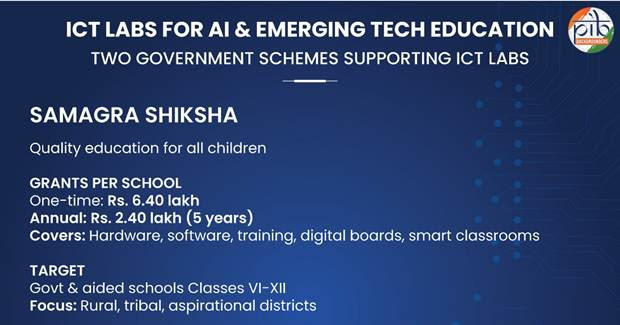
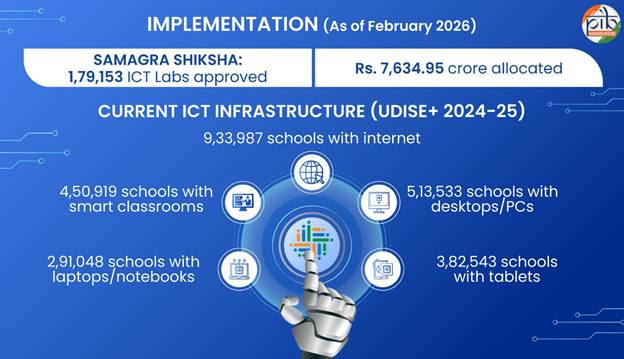
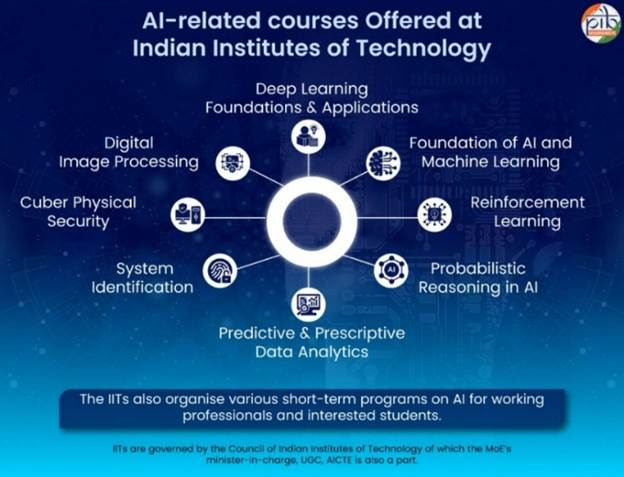
AI-Courses for Students and Educators
DIKSHA Platform
DIKSHA (Digital Infrastructure for Knowledge Sharing), a Ministry of Education initiative, uses AI for inclusivity: AI-based keyword search in videos and read-aloud feature for visually impaired students. The DIKSHA mobile app is available for teachers and also for students and parents. The app is loaded with engaging learning material that fits the needs of the prescribed school curriculum.
SOAR Initiative
The Ministry of Skill Development and Entrepreneurship launched SOAR (Skilling for AI Readiness) to build AI awareness and skills for classes 6–12 students and educators. Program includes three 15-hour student modules and one 45-hour "AI for Educators" teacher module.

"AI for Educators" Module:
The module trains teachers to understand AI curriculum and pedagogy, use AI tools effectively in classrooms, promote inclusivity for diverse learners, create educational AI projects, and teach responsible AI ethics.
SWAYAM Platform
The Ministry of Education's SWAYAM (Study Webs of Active Learning for Young Aspiring Minds) platform offers 110+ free AI courses from IITs and IISc, with 41.2 lakh+ students enrolled.
AI in Higher Education

University Grants Commission (UGC): The 2022 undergraduate curriculum includes AI, 3D machining, big data analysis, machine learning, drone technologies, and deep learning with applications in health, environment, and sustainable living.
All India Council for Technical Education (AICTE):
Perplexity Partners with AICTE
Perplexity, an AI-powered search engine has partnered with AICTE to provide support to 40 million students of 14,000 institutions through digital distribution via AICTE’s various communication channels, faculty training session and pilot launches in Centres of Excellence. There is also student access to the Perplexity website/app through institutional onboarding. The purpose of the project is for students to explore how AI tools can support research, innovation and real-world applications. This project aligns with the NEP’s emphasis on experiential learning.
IIT Madras Bharat Bodhan AI Conclave 2026
Ministry of Education, Government of India, is inviting participants who have developed credible and research-backed AI solutions with demonstrated measurable outcomes to part in the IIT Madras Bharat Bodhan AI Conclave 2026 which will take place on February 12-13 in New Delhi. The call is open to solution providers, academic and research institutions, government bodies and other stakeholders from across India and abroad.
Submissions are invited across four priority verticals:
1. AI for School Education,
2. AI for Higher Education,
3. AI for Skilling and Workforce Readiness, and
4. AI Research and Deep Technology.
Research and Development
The government is supporting research and development in AI through various initiatives or schemes.
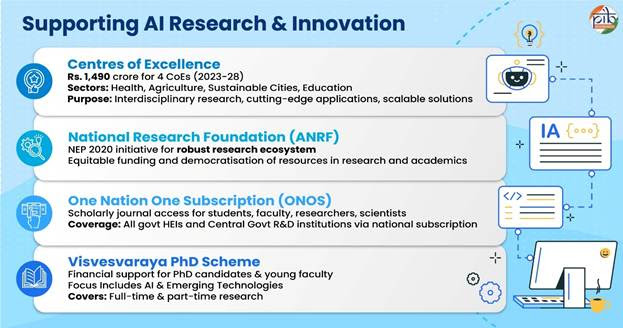
IndiaAI and Meta established the Center for Generative AI, Srijan (सृजन) at IIT Jodhpur and launched the YuvAi Initiative (with MeitY and AICTE) to advance open-source AI in India. The program targets 100,000 students and developers (aged 18-30) over three years to develop AI solutions for healthcare, education, agriculture, smart cities, and financial inclusion.
Key Components:
1. Gen AI Resource Hub (courses, case studies, open datasets)
2. LLM for Young Developers Course (designed by Meta)
3. Master Training Activation Workshops (foundational AI concepts)
4. Unleash LLM Hackathons (mentoring, seed grants, market support for top ideas)
5. AI Innovation Accelerator (supporting 10 student-led startups with incubation and visibility).
IndiaAI Mission’s Educational Goals
IndiaAI Mission (launched in March 2024) is laying the foundation for India’s AI sector development. The initiative has been allocated a budget of ₹10,371.92 crore over five years. It provides computing infrastructure for developing AI models, creates datasets for training, and develops practical applications across sectors including education.
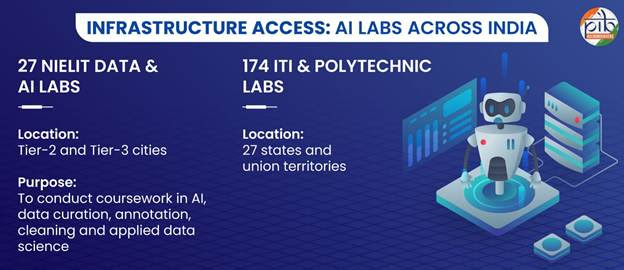
IndiaAI’s initiatives supporting AI-centric education and AI-research are:
AI is helping children with learning disabilities bridge their learning gaps through various applications:
Existing Solutions:
Prototype Stage:
Idea Stage:
The Government is funding R&D projects at premier institutions like IITs to build AI tools.
Indian educational institutions are also working on IndiaAI Application Development Initiative. Selected projects are:
DeepFlood: Rapid Flood Inundation Mapping
The details of the selected projects developed by teams from Indian educational institutes under “Safe & Trusted AI” Pillar are:
Responsible AI Projects
Skilling in AI
To equip India's workforce with AI and digital capabilities, the government has launched comprehensive skilling initiatives spanning students, industrial trainees, professionals, and government officials. These programs combine foundational AI literacy with advanced technical training.
|
Programme |
Implementing Agency |
Target/Scale |
Key Features |
|
Pradhan Mantri Kaushal Vikas Yojana (PMKVY) 4.0 |
Ministry of Skill Development and Entrepreneurship (MSDE) |
36,584 trained in AI (as on June 30, 2025); 45% women |
Short-Term Training (STT) and Recognition of Prior Learning (RPL); AI Career for Women Initiative launched in April 2025 (targeting 8,000 girls over 2 years) |
|
SkillSaksham Program |
MSDE + Microsoft (MoU Aug 2024) |
200 Industrial Training Institutes (ITIs); 10,000+ candidates targeted; 8,500+ already trained |
1,200 hours AI training + 400 hours Advanced AI in ~15 National Skill Training Institutes (NSTIs) under Craftsmen Training Scheme (CTS) |
|
iGOT Karmayogi Bharat Platform |
Mission Karmayogi |
Government officials |
Digital learning platform offering courses in AI, data analytics, and digital transformation |
|
FutureSkills PRIME |
Government + NASSCOM |
16.29 lakh+ enrolled/trained |
500+ courses, 2,000+ digital fluency pathways in AI, Big Data, Cloud Computing; aligned with National Occupational Standards (NOS) and National Skills Qualification Framework (NSQF) |
|
YUVA AI For All |
IndiaAI Mission |
Target: 1 crore citizens |
Free, self-paced foundational AI course (4–4.5 hours) for students, youth, professionals, parents, senior citizens |
Conclusion
India's comprehensive AI education strategy—aligned with NEP 2020 and the IndiaAI Mission—spans curriculum integration from primary to higher education, teacher capacity building, infrastructure development, skilling initiatives, and research Centres of Excellence. The approach extends beyond urban centres to tribal and aspirational districts, democratising technology access across all communities. These initiatives position India as a global AI leader while ensuring inclusive socio-economic development, embodying Welfare for All, Happiness for All (Sarvajanam Hitaya, Sarvajanam Sukhaya).