Administrator
27 June 2026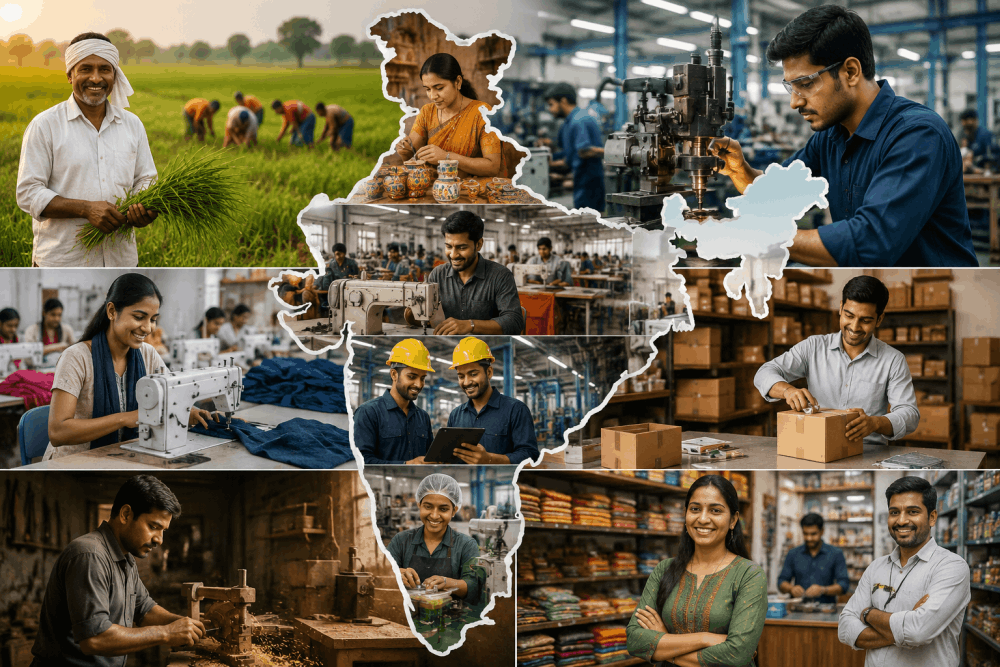
Everybody knows that MSMEs are playing a pivotal role in driving India's economic growth and industrial development. However, what lies behind headlines is their expanding role in the Indian economy today.
Aware of it, the Government claims to have revised the definition of MSMEs with effect from 1 April 2025. Based on investment and annual turnover, it has made efforts to provide enterprises greater room to expand while continuing to benefit from policy support.
Take a glance at this fact.


Official data accessed by JharkhandStateNews.com revealed this.The January 2026 data shows that the sector contributes about 31.1% in GDP, 35.4% in manufacturing output and 48.58% in exports. With more than 38.9 crore people employed, MSMEs are the second-largest source of employment after agriculture.
Beyond economic indicators, MSMEs are nurturing a vibrant entrepreneurial culture across the country. The sector has emerged as a gateway for first-generation entrepreneurs, women-led enterprises and youth-led ventures, particularly in semi-urban and rural areas. This transformation is being reinforced by a series of enabling reforms. Initiatives such as the digital Credit Assessment Model and enhanced equity support to SIDBI are expanding their access to formal finance.

A Year of Transformation
The year 2025-26 marked a significant chapter in India's MSME growth story. It witnessed several landmark achievements that strengthened India's MSME ecosystem across formalisation, credit access, technology adoption, grievance redressal and market development.
Formalisation Reaches New Heights
Expanding Access to Credit
Khadi and Village Industries& Coir Sector Scale New Heights
Responsive and Technology-Driven Governance

Improving Market Access
Together, these milestones reflect the continued efforts to build a more competitive, innovative and future-ready MSME ecosystem.
Empowering the Udyami with Policies & Initiatives
At the heart of India's MSME success story lies a strong ecosystem of policy support and institutional interventions. Through initiatives focused on entrepreneurship and enterprise development, the Government is enabling millions of businesses to unlock new opportunities and contribute to economic growth.

PM Vishwakarma
PM Vishwakarma provides end-to-end support to artisans and craftspeople engaged in 18 traditional trades. The scheme has emerged as a major catalyst for artisan empowerment, through skill training, toolkit support, digital transactions and marketing assistance.The target of 30 lakh beneficiary registrations, originally planned for four years, was achieved within just two years.
The Scheme’s Transformative Multi-Dimensional Impact:
|
PM Vishwakarma Transforming Lives of Artisans of Nagaland
|
A Scheme for Promotion of Innovation, Rural Industry and Entrepreneurship (ASPIRE)
The ASPIRE Scheme promotes entrepreneurship and livelihood generation in rural areas through skill development, incubation and support for micro-enterprises.With 109 approved Livelihood Business Incubators (LBIs) as of June 2026, the scheme has strengthened rural entrepreneurship and inclusive growth:
Prime Minister's Employment Generation Programme (PMEGP)
The flagship credit-linked subsidy scheme promotes self-employment through the establishment of micro-enterprises in the non-farm sector. Under the Scheme, Margin Money (Subsidy) is provided to beneficiaries availing loan from banks for setting up new enterprises.
Since June 2025, its reach expanded further with application facilities being introduced in 19 regional languages excluding English and Hindi.Since its inception (as on May 2026), the scheme has supported:
MSME Champions Scheme
The MSME Champions Scheme supports enterprises in becoming more innovative, sustainable and globally competitive. It enables MSMEs to improve productivity, adopt global best practices and strengthen their position in domestic and international markets.
The scheme's impact is reflected across its three pillars:

Self- Reliant India (SRI) Fund
While many MSMEs have the potential to grow, access to equity capital often remains a challenge.
Launched under the Aatmanirbhar Bharat package, the SRI Fund is a Fund of Funds (FoF) initiative aimed at providing equity support to promising MSMEs. It is helping them overcome funding constraints, scale operations and attract further investment. The Budget 2026–27 has provided an additional ₹2,000 crore to augment the Self-Reliant India Fund. This ensures continued access to risk capital for micro and small enterprises while supporting their growth and expansion. Notably, the SRI Fund has assisted 761 MSMEs by way of investment worth ₹2,851 crore (as of May 2026).
Promotion of MSMEs in North Eastern Region and Sikkim
The scheme for Promotion of MSMEs in NER & Sikkim continues to play an important role in expanding the MSME ecosystem in the North East. As on December 2025, 73 projects have been approved to enhance manufacturing, testing, packaging, skilling and innovation infrastructure. During 2025 , eight new infrastructure projects were approved across Assam and Meghalaya. The scheme involves a total project cost of ₹114.37 crore with Government assistance amounting to ₹89.60 crore. These investments are helping create a stronger foundation for enterprise-led growth in industrial estates and tourism infrastructure.
National SC-ST Hub (NSSH)
The NSSH is helping entrepreneurs from Scheduled Caste and Scheduled Tribe communities access markets, build capacities and participate more actively in public procurement.
The scheme's impact is increasingly visible:
|
Rigtech Infra’s Rise: A Story of Innovation, Support and Growth
|
Micro and Small Enterprises Cluster Development Programme (MSE-CDP)
The scheme seeks to strengthen the productivity and competitiveness of MSEs through cluster-based development by providing Government grants for establishing Common Facility Centres (CFCs) and upgrading infrastructure in industrial estates and clusters.
The scheme has delivered significant progress in cluster-based development:
Scheme of Fund for Regeneration of Traditional Industries (SFURTI)
India’s traditional industries carry deep cultural and economic value. Yet artisans often face challenges such as, limited access to modern tools, and weak market linkages that restrict income growth and scalability.
SFURTI responds to these structural gaps by organising artisans into well-supported clusters. It organises traditional artisans into clusters for improved competitiveness, product development and sustainable income generation.
Over time, the scheme has established a strong national footprint, with 513 clusters approved across the country, benefiting 3.03 lakh traditional artisans. A total of 376 clusters are currently functional as of June 2026. In 2023-24 alone, 18 new clusters became operational, benefiting 11,810 artisans across 11 States.
Raising and Accelerating MSME Performance (RAMP)
Supported by the World Bank, the RAMP Scheme aims to improve MSMEs' access to markets, finance and technology. The scheme is strengthening the MSME ecosystem through reforms, institutional capacity building and greater Centre-State collaboration:
Technology Centres
The Technology Centres function as hubs for skill development, technology support and innovation. Through a network of Tool Rooms, Technology Centres, and Extension Centres, they foster industry-ready talent. The agenda is to support upskilling and reskilling of the workforce to meet emerging industry requirements.
By combining technology, skilling and industry support, the Technology Centre network is helping MSMEs innovate, modernise and compete in an increasingly technology-driven economy.
Shaping the Future Through Enterprise
The progress of India's MSME sector reflects a larger national transformation underway. Expanding access to finance, technology, skills, infrastructure and markets is enabling enterprises to become more productive, competitive and resilient. As the sector continues to evolve, its growing contribution to employment, innovation and economic growth will further strengthen India's development journey. It will also help lay the foundations of a more inclusive, self-reliant and developed India.
If you value our journalism, consider making a voluntary contribution to help us continue bringing news, stories and information to our readers.
Scan the QR code to contribute

Every contribution, big or small, is appreciated.
 Smt. Villi, a basket maker from Zunheboto, Nagaland, strengthened her traditional craft through skill training under the PM Vishwakarma Scheme. She also availed a collateral-free loan of ₹1 lakh to purchase raw materials and expand her enterprise. As a result, her monthly income rose by around 40% to nearly ₹15,000. Her journey highlights how PM Vishwakarma is helping artisans enhance skills, grow their businesses and secure better livelihoods while preserving traditional crafts.
 With support from the National SC-ST Hub (NSSH), Rigtech Infra (OPC) Pvt. Ltd. in Ranchi secured a ₹25 lakh subsidy in 2023 to upgrade its manufacturing capabilities. The investment enhanced productivity and quality, helping the enterprise win government tenders worth ₹15.75 lakh from Rail Vikas Nigam Limited in 2025. Today, the company records an annual turnover of ₹4–5 crore and supports 16 jobs.