
Administrator
15 September 2026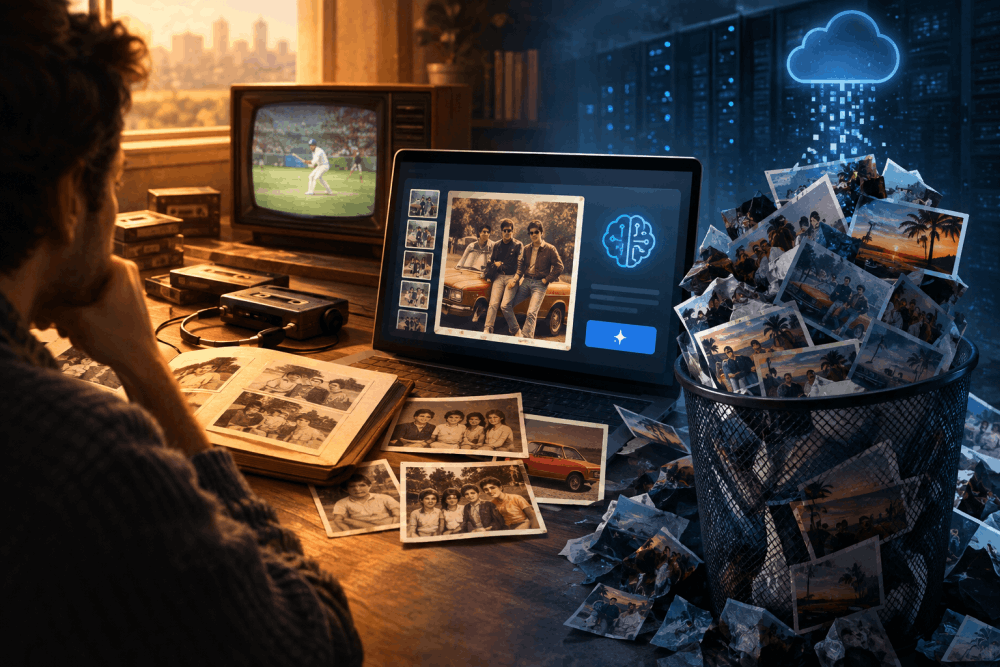
*AI-generated image
AI-generated photographs and videos recreating the 1980s have taken social media by storm. From retro family portraits and old-fashioned homes to vintage cars, scooters, streets and cinematic scenes, artificial intelligence can now produce remarkably convincing images of a past that may never have existed.
The trend is entertaining, creative and, for many people, deeply nostalgic. But behind the warmth of faded colours and film-grain aesthetics lies a less comfortable question: What does it cost to manufacture this nostalgia at massive scale?
The answer involves more than electricity bills or data centres. It raises questions about the environment, digital waste, historical memory, creativity and our relationship with reality.
The environmental cost nobody sees
Generating an AI image may appear almost effortless. A user enters a prompt, waits a few seconds and receives a finished picture. The physical infrastructure required to produce it is anything but effortless.
AI systems run on powerful computer processors housed in data centres that consume electricity and require cooling. The growing use of AI is contributing to rising demand for data-centre infrastructure and electricity in several parts of the world.
A single AI-generated image is obviously not going to transform the climate. The concern is scale.
Millions of users can generate multiple versions of the same image, discard most of them and try again. Video generation requires even greater computational resources. When billions of such requests are processed, the cumulative demand becomes significant.
There is also a water dimension. Some data centres use water-based cooling systems, while electricity generation can itself have a water footprint. The environmental impact therefore extends well beyond the screen on which the final image appears.
From digital convenience to digital waste
The digital world has created an unusual form of waste: content that occupies resources even though nobody may ever look at it again.
A person might generate 30 versions of an imagined 1985 family photograph, select one, create five animated versions of it and then move on to another trend.
The discarded images may never be viewed again. Yet computational resources have already been consumed to create them, and digital infrastructure is required to store, transfer and display the resulting content.
This is the paradox of AI-generated media: because creating something is almost effortless, we increasingly produce things without first asking whether they need to exist.
Are we recreating history or manufacturing it?
The 1980s AI trend also presents a more subtle problem.
An AI-generated image labelled “Ranchi in 1985” or “an Indian family in 1987” can look remarkably authentic. It may contain the right-looking clothes, architecture, vehicles, furniture and photographic imperfections.
But authenticity of appearance is not the same as historical authenticity.
The building may never have existed. The vehicles may be from different periods. The clothing may combine styles from several decades. The location may be an AI-generated mixture of visual patterns learned from thousands of photographs.
In other words, AI can create something that looks like a memory without that event ever having happened.
That distinction matters.
The danger of synthetic memories
Human memory is already imperfect. Photographs, family stories, films and physical objects help us reconstruct the past.
AI introduces another layer: synthetic visual memories.
Imagine a person seeing a convincing AI-generated photograph of an Indian family celebrating Diwali in 1986. The scene may resemble photographs from their childhood so closely that it triggers genuine memories.
But the picture itself is fictional.
As these images become increasingly common, the boundary between “this happened” and “this looks like something that happened” can become harder to recognise, particularly for younger generations who did not experience the period themselves.
AI could therefore become not only a tool for recreating the past, but a powerful tool for creating our perception of the past.
When real photographs begin to look fake
There is an equally serious problem on the other side.
As synthetic images become increasingly realistic, people may begin to doubt genuine photographs.
A real photograph can be dismissed as AI-generated simply because it looks unusual or improbable. Conversely, a fabricated photograph may be accepted because it looks sufficiently realistic.
This creates a dangerous environment in which visual evidence loses some of its authority.
The problem is no longer simply that people can create convincing fake images. It is that society may gradually become less certain about what genuine visual evidence looks like.
The loss of photographic meaning
Photography historically carried a powerful connection to reality.
Someone had to be present. Something had to exist in front of the camera. The photograph could be edited, staged or manipulated, but there was generally a physical event behind it.
Generative AI breaks that connection.
A photograph can now depict a place where nobody stood, people who never met, an event that never happened and a moment that never existed.
That is a profound cultural change.
The image remains visually convincing, but its relationship with reality has changed.
Are we making nostalgia too perfect?
There is another irony in the trend.
The real 1980s were not cinematic.
Old photographs were often poorly framed. Colours faded unevenly. People blinked. Backgrounds were messy. Cameras produced accidental imperfections. Houses were ordinary. Streets were sometimes dusty and chaotic.
AI, however, tends to transform the past into an aesthetically pleasing version of itself.
The result can be a kind of “perfect nostalgia” — a past reconstructed according to what people today believe the past should have looked like.
Over time, that may flatten the complexity of history.
The real past contained poverty and prosperity, boredom and excitement, beauty and ugliness, technological limitations and remarkable human creativity. A stylised AI version can easily reduce all of that to warm colours, vintage clothes and film grain.
The algorithm is turning nostalgia into a commodity
Social media adds another layer to the problem.
AI makes content extremely cheap to produce, while social platforms reward content that attracts attention.
Nostalgia happens to be exceptionally good at doing that.
An old-looking photograph can make people stop scrolling, remember their childhood, tag friends and share the post. That engagement encourages creators to produce more of the same.
The result is an emerging cycle:
AI makes content cheap → more content is produced → social media amplifies it → nostalgia generates engagement → creators produce even more AI content.
Nostalgia is no longer merely a personal emotion. It is becoming an industrialised form of digital content.
AI itself is not the enemy
None of this means that generating an AI image is inherently wrong.
Using AI to explore history, create art, visualise an imagined scene or entertain friends can be perfectly reasonable.
The problem is not one image.
The problem is scale, waste and the absence of reflection.
Before generating dozens of disposable images, users can simply ask: “Do I really need this?”
Creators can also clearly label fictional reconstructions as AI-generated rather than presenting them as genuine historical photographs.
And platforms, technology companies and AI developers have a larger responsibility to make the environmental costs of large-scale generation more transparent and to reduce unnecessary computational consumption.
Preserving memories without manufacturing them
Perhaps the most important lesson from the current nostalgia trend is that technology should help us preserve history, not quietly rewrite it.
Old photographs, family albums, letters, newspapers, home videos and personal stories have something that AI-generated images cannot provide: a genuine connection to a real moment.
An AI reconstruction can be beautiful.
A genuine, imperfect photograph of your grandparents standing outside their old house may be far more valuable.
The challenge for the digital age is therefore not to stop creating.
It is to remember that not everything that can be generated needs to be generated, and not everything that looks like a memory is actually one.
The 1980s may be coming back on our screens, but we should be careful not to let artificial nostalgia replace the imperfect reality that made those memories meaningful in the first place.
If you value our journalism, consider making a voluntary contribution to help us continue bringing news, stories and information to our readers.
Scan the QR code to contribute

Every contribution, big or small, is appreciated.