
Administrator
10 December 2025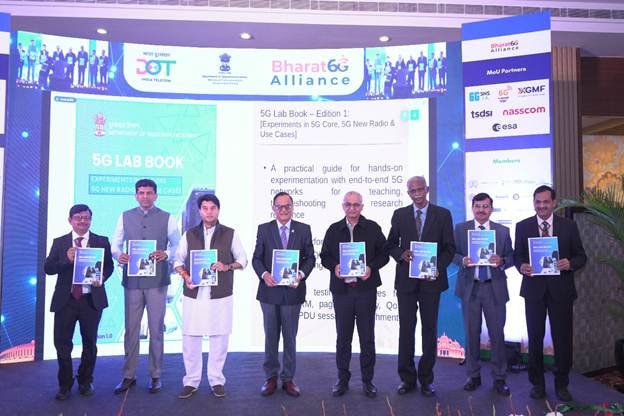
The Government has approved ₹1-lakh-crore Research, Development and Innovation (RDI) Fund under the Department of Science & Technology.
The move marks one of India’s largest public research support frameworks.The fund is set to significantly boost frontier research in AI-native networks, semiconductors, photonics, sensing, cybersecurity and satellite–terrestrial integration—critical areas for future 6G development.
Unveiling of 5G Lab Booklets and Awards to Top Performers
To showcase the rapid progress of India’s 5G innovation ecosystem, the Union Minister of Communications, Jyotiraditya M. Scindia, released three booklets, documenting the establishment, performance and impact of the 100 5G Use Case Labs.
Together, these booklets highlight the evolution of the labs from infrastructure deployment to hands-on experimentation, prototype development and real-world applications, illustrating how the initiative has laid a strong, industry-aligned foundation for a vibrant research and innovation ecosystem.
The compendium “The 5G Use Case Lab: From Infrastructure to Innovation” captures the creation and successful operation of labs across higher-education institutions; the “5G Lab Book – Edition 1: Experiments in 5G Core, 5G NR & Use Cases” provides technical, experiment-oriented guidance for researchers and students working on end-to-end 5G systems; and the “5G Hackathon Book” showcases the nationwide innovation challenge conducted through the labs, featuring prototypes across sectors such as disaster management, healthcare, agriculture, industrial automation and security.

Following the release of the publications, Union Minister Shri Scindia conferred the Gradation Awards, recognising the best-performing 5G Use Case Labs under the “Excellent Category”.
Four institutions were specially honoured for exemplary innovation, societal impact and industry collaboration: Punjab Engineering College, for pioneering prototypes in agriculture, healthcare and security and for its strong support to student research and startups; Banasthali Vidyapith, for leadership in private 5G, MEC, AI and automation with solutions showcased at IMC across mining safety, surveillance, energy management and education; IIT Roorkee (AMRIT), for establishing national benchmarks in deep-tech 5G/6G R&D, including India’s first deployed RIS, private 5G-RIS systems, AI-edge solutions, patents and commercialisation; and Thapar University, for solution-driven innovations in transport safety, accessibility and public infrastructure, including V2X crash prevention, Braille-digital learning, track defect analytics and drone detection.
The Bharat 6G Alliance presented a detailed account of its ongoing efforts across seven Working Groups focusing on spectrum, devices and components, technologies, applications, sustainability, outreach and 6G use cases.
The Alliance informed the Apex Council that it has grown from its initial 16 founding members to over 84 organisations—including startups, academia, industry leaders, R&D institutions and Telecom Service Providers—demonstrating the expanding national commitment to indigenous 6G innovation.
The Alliance also shared updates on its recent international collaborations and joint initiatives with leading global 6G alliances, supported through multiple MoUs and cross-partner research engagements.