

Administrator
11 December 2025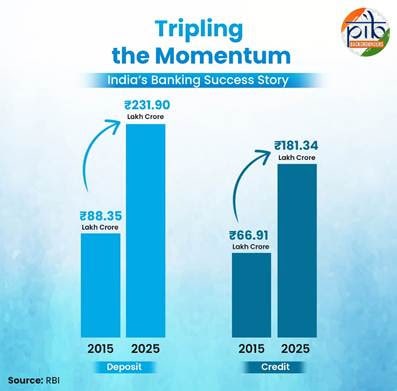
Introduction
Financial stability lies at the heart of a nation’s economic strength- and for India’s banks, it remains the unwavering north star. As the world’s fourth-largest economy, India’s financial sector has evolved into a resilient and dynamic force, ready to power the country’s growth ambitions and investment needs.
Over the past two and a half decades, India’s banking system has undergone a remarkable transformation- from the early days of ATM networks to the emergence of RTGS, NEFT, IMPS, and the revolutionary UPI, now extending its frontier to digital currency. This steady march of innovation has reshaped how India transacts, saves, and invests. Today, the banking sector stands stronger than ever- with robust capital and liquidity buffers, improved asset quality, and sustainable profitability. The resilience of public sector banks (PSBs) and scheduled commercial banks (SCBs), reflected in their high-quality capital, declining loan losses, and solid earnings, underscores their capacity to finance growth while withstanding shocks.
From Crisis to Confidence- The New Face of Indian Banking
After the Global Financial Crisis, which ended in early 2009, India’s strong fiscal and monetary stimulus helped cushion the impact. However, the following years saw the emergence of a “twin balance sheet” problem, marked by overleveraged corporates and mounting stress. Yet, what followed turned the challenge into an opportunity, eventually bringing India in the list of “Top Five”economies of the world.
Guided by the principle “never waste a good crisis”, in the last 10 years, a series of deep structural reforms began- aimed at restoring the long-term strength and stability of the financial system. Today, Indian banks are far more mature than they were a decade ago.

NPA Decline: An Upward Shift in the Quality
An asset becomes non-performing when it ceases to generate income for the bank. The rise in Non-Performing Assets (NPA) erodes profitability, as banks must allocate more capital to cover bad loans, leading to a credit crunch and constraining lending, thereby affecting overall economic growth.
As per Reserve Bank of India (RBI) data on domestic operations, aggregate gross advances of SCBs increased from ₹23.34 lakh crore as on 31st March 2008 to ₹61.01 lakh crore as on 31st March 2014. Aggressive lending practices during this period along with wilful default / loan frauds, economic slowdown, etc. were observed to be primary reasons for the spurt in the stressed assets.
As on 31st March 2014, stressed assets of SCBs were 9.8% of their loan book, while the restructured standard loans were 5.7%. Asset Quality Review (AQR), initiated in 2015 for clean and fully provisioned bank balance-sheets revealed high incidence of non-performing assets (NPAs). As a result of AQR and subsequent transparent recognition by banks, stressed accounts were reclassified as NPAs and expected losses on stressed loans, not provided for earlier under flexibility given to restructured loans, were provided for. Accordingly, the GNPA ratio of banks started rising and reached its peak in 2018 at 11.18%. GNPA ratios measure the asset quality of banks. Primarily as a result of transparent recognition of stressed assets as NPAs, as per RBI data on domestic operations, gross NPAs of SCBs rose from ₹2,51,054 crore (gross NPA ratio of 4.1%) as on 31stMarch 2014 and peaked to ₹9,62,621 crore (gross NPA ratio of 11.46%) as on 31st March 2018.
As a result of the Government’s strategy of recognition, resolution, recapitalisation and reforms, gross NPA ratio have since declined to ₹2,73,413 crore (gross NPA ratio of 2.79%) as on 31st March 2025. Further, as per RBI data on domestic operations, stressed assets, including restructured standard assets, as percentage of gross advances in SCBs has declined from 9.8% as on 31st March 2014 to 3.55% as on 31st March 2025.
Besides, GNPA ratios improved consistently from 2018-19, and reached its lowest level in last 20 years at 2.31% in end-March 2025. This can be attributed to strong macro-economic fundamentals boosting the Indian banking and non-banking financial sectors. Likewise, NNPA ratio also reached its lowest in last 20 years to 0.52% by consistently declining from its peak in 2018 at 6.1%, driven by stronger provision buffers. Sentiments remain positive as profitability indicators and NPA ratios continued to improve further, while capital adequacy ratio remained robust.
Gross NPAs of PSBs have been declining during the last five financial years- reducing from 9.11% to 2.58% between March 2021 to March 2025. Similarly, the NNPAs of PSBs declined to multi-year low at 0.52% in FY 24-25 from 1.24% in FY 22-23. This indicates sustained improvement in asset quality and risk management. The trend has been witnessed in the SCBs too, with a decline in both NPA and GNPA.

Bank Profitability on the Rise
The Indian banking industry has seen robust growth, driven by strong economic expansion, rising disposable incomes, growing consumerism, and easier credit access. Digital modes of payments, dominated by UPI, have grown by leaps and bounds over the last few years. As per the RBI, India’s banking sector is sufficiently capitalized and well-regulated. Notably, profitability of banks improved for the sixth consecutive year in 2023-24.
Public Sector Banks

Scheduled Commercial Banks (SCBs)

Besides, banks’ capital position remained satisfactory, as reflected in key parameters like leverage ratio (which measures the proportion of a bank’s Tier 1 capital to its total assets, serving as a safeguard against excessive risk exposure) and capital to risk weighted assets ratio(CRAR), defined as the ratio of total capital funds to risk-weighted assets. The leverage ratio for all SCBs was 7.9% in September 2024 (the range of 6 to 8% is generally considered prudent). PSBs are adequately capitalised, with their CRAR standing at 16.4% as of June 2025.
Strong credit expansion by Non-Banking Financial Companies (NBFCs), that offer services similar to banks, such as loans and investments, but do not possess a full banking license, was accompanied by further strengthening of their balance sheets, improvement in credit quality and profitability, and satisfactory capital buffers.
Factors Propelling Performance of India’s Banks
Comprehensive government initiatives with regards to stress recognition, asset resolution, re-capitalisation, have markedly strengthened the banking sector’s financial health and resilience. This was driven by a series of regulatory measures, which commenced over a decade ago-
Evolving Priorities in India’s Banking Landscape
Building on their strong financial performance and improved asset quality, Indian banks are now focusing on sustaining growth through innovation, inclusion, and strategic expansion. The following priorities outline the path ahead for strengthening the banking ecosystem and supporting India’s broader development goals:
Strengthen deposit mobilization through targeted drives, effective use of branch networks, and deeper outreach in semi-urban and rural areas to sustain strong credit growth.
Identify emerging commercial growth areas over the next decade to enhance profitability and maintain momentum in economic expansion.
Deepen corporate lending in productive sectors while upholding robust underwriting and risk management practices.
Advancing India’s Green Growth Agenda by scaling up lending to renewable and sustainable energy sectors. Develop tailored credit models to support new initiatives such as Small Modular Nuclear Reactors (SMR)announced in Budget 2025–26.
Broaden financial inclusion through key government schemes- PM MUDRA Yojana, PM Vishwakarma, PM Surya Ghar Muft Bijli Yojana, PM Vidyalaxmi, and Kisan Credit Card (KCC).
Focus on Agri credit under the PM Dhan Dhanya Yojana in 100 low-productivity districts with customised credit products to improve farm output and local economic growth.
Expand international presence by strengthening operations in GIFT City, supporting India’s global financial aspirations, and enhancing participation in the India International Bullion Exchange (IIBX).
Enhance customer experience through faster grievance redressal, user-friendly multilingual digital platforms, and clean, accessible physical branches in metro and urban centres.
Conclusion
India’s banking sector has transformed from a period of stress to one of strength and stability. With cleaner balance sheets, robust capital buffers, and record profitability, banks today are more resilient, efficient, and future-ready. Driven by reforms, digital innovation, and financial inclusion, the sector is powering India’s growth ambitions- financing infrastructure, supporting entrepreneurs, and advancing green and inclusive development.
As India moves toward becoming the world’s third-largest economy, its banks stand at the forefront- anchoring financial stability and fuelling the nation’s next decade of growth.