
Administrator
11 January 2026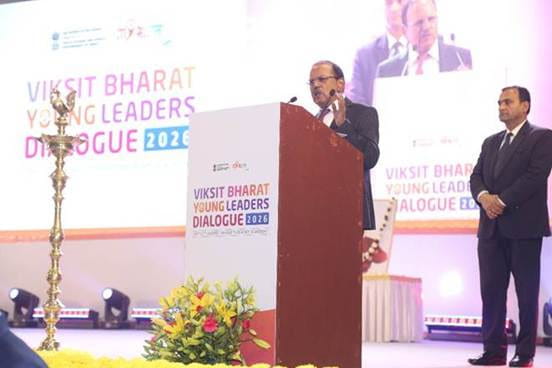
National Security Advisor Shri Ajit Doval has reflected on his own youth and spoken at length on the centrality of decision-making in shaping individual lives and the destiny of nations.
This he did while addressing the Day 2 of the Viksit Bharat Young Leaders Dialogue (VBYLD 2026),organised by the Ministry of Youth Affairs and Sports, commenced at Bharat Mandapam, New Delhi.
He underscored that the pace and direction of s person’s life are determined by the quality of decisions taken on a daily basis, urging young leaders to consciously cultivate this capability from an early stage.
Emphasising that the youth’s greatest strength lies in making the right choices, he called upon them to adopt a far-sighted, disciplined and implementation-oriented approach to decision-making if they are to lead India towards the goal of Viksit Bharat.
He also recalled the sacrifices made during India’s freedom struggle and stressed the importance of learning from history to build a resilient and self-confident nation.

Stressing that motivation is temporary but discipline is enduring, he advised young leaders to convert discipline into daily motivation and to act without delay.
He encouraged the youth to believe in themselves, and called upon them to adopt a five-year commitment to their decisions, asserting that unwavering willpower over time builds invincibility. Shri Doval also interacted with the young participants during an interactive question-and-answer session, where he shared insights on managing pressure and making sound decisions in critical situations.
In her Welcome Address, Dr. Pallavi Jain Govil expressed gratitude to the dignitaries and noted that the Dialogue marked the culmination of a five-month nationwide process involving nearly 50 lakh youth, resulting in the selection of outstanding young leaders from across all States and Union Territories. She emphasised that VBYLD is a platform to listen to youth voices and integrate their ideas into policymaking through a design-thinking, human-centric approach. The Viksit Bharat Run, held in 144 cities across the country with participation from the Indian diaspora, was a key initiative showcasing India’s soft power, she further added.
The inaugural session concluded with a Vote of Thanks by Shri Nitesh Kumar Mishra, Additional Secretary, Department of Youth Affairs, who expressed gratitude to the dignitaries on the dais, speakers, organisers and the young participants for their active engagement. He reaffirmed the Ministry’s commitment to nurturing youth leadership through sustained dialogue and participatory platforms such as the Viksit Bharat Young Leaders Dialogue and encouraged participants to make the most of the upcoming sessions.
After the conclusion of the plenary session, participants dispersed to their respective venues for in-depth thematic sessions organised around ten identified themes. The sessions were anchored by mentors who introduced the framework and objectives of each theme, followed by deliberations led by distinguished subject-matter experts. These interactions created a collaborative learning space, enabling participants to critically examine issues, exchange ideas, and benefit from expert guidance through focused discussions. The themes are as follows:
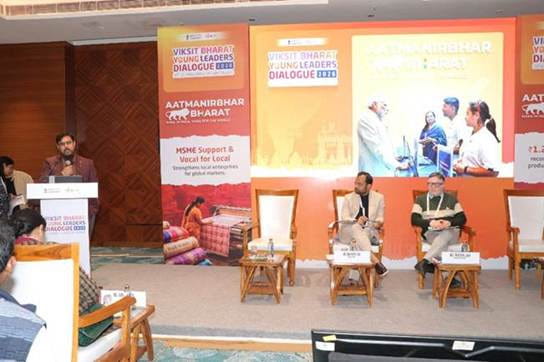
This track focused on Youth, Democracy and Governance, featuring a distinguished jury comprising Shri Hemang Joshi, Member of Parliament from Vadodara, and Ms. Bhakti Sharma, former Sarpanch and grassroots leader. Participants presented innovative governance models aimed at integrating youth into public administration through village-level action plans, problem-solving units with district administrations, policy and career labs, and structured civic engagement initiatives.
This track focused on advancing women as leaders of governance and nation-building, aligning with the vision of Viksit Bharat @2047. The session featured interactions with distinguished domain experts Ms. Chhavi Rajawat, India’s first MBA Sarpanch; Ms. Shreyasi Singh, Arjuna Awardee and Member of the Legislative Assembly; and Ms. Shagun Parihar, MLA from Kishtwar, at Bharat Mandapam.
This theme focused on the role of health, wellness, sports and indigenous knowledge systems in building a resilient and empowered India. The session featured interactions with eminent sportspersons Shri Leander Paes and Shri Pullela Gopichand, who highlighted the importance of holistic well-being by integrating physical fitness, mental health, discipline and India’s traditional practices such as yoga and meditation.
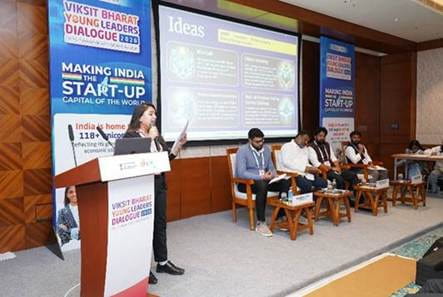
Under this theme, the young leaders presented their ideas and had an interactive session with the domain area experts, providing a platform for participants to engage directly with policymakers and industry practitioners on the broader startup ecosystem. The session featured Shri Harish Balayogi, Member of Parliament from Andhra Pradesh; Shri Kaivalya Vohra, Co-founder and Chief Technology Officer of Zepto; Shri Ramprasad Reddy, Minister of Youth Affairs and Sports, Government of Andhra Pradesh; and Shri Ravi Naidu, Chairperson, Sports Authority of Andhra Pradesh.
This track featured discussions on India’s growing global influence through soft power and cultural diplomacy. Distinguished speakers Shri Romalo Ram, a public servant associated with grassroots governance and community development; Ms. Palki Sharma, senior journalist and television anchor; Shri Satish Sharma, Cabinet Minister handling portfolios including Food, Civil Supplies & Consumer Affairs, Transport, Science & Technology, Information Technology, Youth Services & Sports, and ARI & Training in Jammu & Kashmir; and Shri Arpit Tiwari, Deputy Director, Nehru Yuva Kendra Sangathan, led the session and interacted with participants.
This track focused on celebrating India’s cultural heritage as a foundation for innovation and youth empowerment. The session was led by distinguished domain experts Shri Anil Sahasrabudhe, Chairman, National Educational Technology Forum and NAAC; Shri Vinay Sahasrabuddhe, academician , author and former Member of Parliament; and Shri Bala Sarda, Founder and CEO, VAHDAM India.
This track featured discussions on innovation-led growth and the role of youth in shaping India’s economic future. Domain experts Shri Sibabrata Das, Co-founder, Atomberg Technologies, and Shri Prateek Jain, Chief Operations Officer, Addverb, led the session and interacted extensively with participants.
This track focused on enhancing productivity through smart and sustainable agriculture, with discussions centred on addressing practical challenges in modernising Indian farming. Five shortlisted teams presented their refined ideas before a panel led by Shri Atul Patidar, expert in grassroots governance, and Shri Rajbir Singh, Deputy Director General (Agriculture Extension), Indian Council of Agricultural Research.
This session focused on “Building a Sustainable and Green Viksit Bharat”, highlighting the role of present-day actions in shaping a resilient and inclusive future. The discussions were led by Shri Malhar Kalambe, Founder, Beach Please India; Shri O. P. Choudhary, former civil servant from Chhattisgarh; and Shri Abhishek Manglick, Founder and CEO, Ecosense. The speakers emphasised that the vision of Viksit Bharat can be achieved only by embedding sustainability into daily life, governance and technological innovation, underscoring the pivotal role of youth as torchbearers in building a cleaner, greener and sustainable India.
Track 10 focused on preparing India’s youth for the evolving world of work. The session was led by Shri Anand Kumar, renowned educationist and founder of Super 30, and Shri Aniket Deb, public policy professional and researcher. The discussions emphasised that employability today extends beyond degrees to skills, adaptability and future readiness, with a focus on self-development, disciplined learning and navigating technological shifts such as Artificial Intelligence.
As part of the official programme, participants undertook visits to the Prime Ministers’ Museum and Library in two batches, where they gained a deeper appreciation of India’s leadership heritage and democratic evolution. This was followed by regrouping of participants as State teams and their departure to the residences of Union Ministers and Members of Parliament for dinner engagements, facilitating meaningful interaction, guidance and informal mentorship in an atmosphere of shared reflection and national service.
The second day of VBYLD 2026 concluded on a focused and forward-looking note, reaffirming the Government’s commitment to placing youth at the centre of India’s nation-building journey.
The rich deliberations across thematic tracks and the active engagement of young leaders with policymakers and domain experts further strengthened the Dialogue as a platform for ideas, leadership and participatory governance. VBYLD 2026 will culminate on 12th January 2026, with the Prime Minister interacting directly with young leaders from across the country.
Day 3 of the Dialogue will feature inspiring interactions with astronauts of the Indian Space Research Organisation (ISRO), continued theme-wise presentations, and a cultural celebration showcasing the spirit and diversity of Viksit Bharat.
*By Pawan Singh Faujdar/Rini/Anjelina