

Administrator
15 January 2026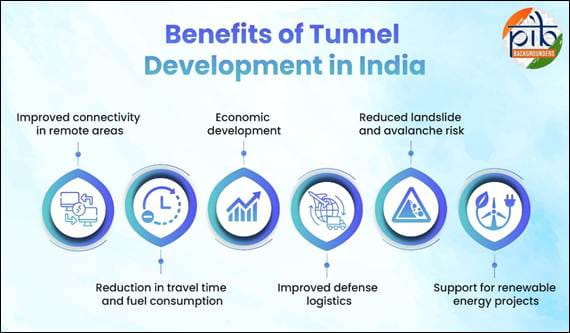
Carving Connectivity: The Story of India’s Tunnels
Tunnels in India represent more than infrastructure development; they reflect the nation’s determination to overcome geographical challenges. By cutting through mountains and terrain that once limited connectivity, tunnels have enabled year-round transportation. They have also improved access to remote regions and strengthened links between communities. From strategic Himalayan tunnels to urban metro networks, these projects are transforming how India moves people, goods, and resources. Built using modern engineering and innovative planning, tunnels play a vital role in economic growth, national security, and regional development. They are shaping a more connected and resilient country.
India’s tunnelling boom is being propelled by national highway expansion, alongside strategic border infrastructure, metro rail growth, bullet-train corridors, and all-weather connectivity initiatives in remote regions. As infrastructure scales up, tunnelling has become one of the fastest-growing construction domains.
Why Tunnel Infrastructure Matters More Than Ever
Tunnels are rapidly reshaping India’s developmental map, offering smarter, safer, and more sustainable alternatives to traditional transport routes. Their impact goes far beyond engineering. They catalyse regional development, enhance strategic preparedness, and improve the daily lives of millions.

India’s Evolving Tunnel Technology
Over the past decade, India’s tunnelling capability has transformed. It has progressed from traditional drill-and-blast methods to sophisticated technologies. This enables faster, safer, and more complex underground construction. Modern projects now rely on advanced geological mapping and real-time monitoring systems, allowing the engineers to construct longer and deeper tunnels even in harsh conditions.
Contemporary Indian tunnels are designed as high-tech, safety-integrated corridors equipped with engineered ventilation systems, emergency escape routes, fire-suppression units, LED lighting, CCTV surveillance, and centralised tunnel control rooms. This modernisation has significantly improved both operational reliability and disaster readiness.
Key Technologies Driving India’s Tunnel Revolution
India’s expanding infrastructure has given rise to a series of remarkable tunnels that redefine how people and goods move across the country. Each tunnel stands as a testament to innovation and problem-solving on a grand scale.
Atal Tunnel
Tucked beneath the snow-laden peaks of the Pir Panjal ranges, the Atal Tunnel stretches 9.02 km, providing a high-altitude passage that bypasses Rohtang Pass. Its completion has transformed connectivity, enabling seamless, year-round travel between Manali and the remote valleys of Lahaul‑Spiti. The tunnel’s strategic significance also lies in ensuring safe, reliable access for civilians and defence movement alike under challenging mountain conditions. It is officially recognised as the World’s Longest Highway Tunnel above 10,000 feet in 2022 by the World Book of Records UK. The tunnel has cut the Manali–Sarchu distance by 46 km and reduced travel time by four to five hours. Built in harsh Himalayan conditions where winter temperatures dropped to -25°C and the tunnel interior sometimes reached 45°C, its construction demanded exceptional resilience. Engineers faced fragile geology, Seri Nala seepage that once flooded the tunnel, heavy overburden, and intense snowfall, all of which were successfully overcome by the Border Roads Organisation's (BRO) dedicated Karmyogis.


Z-Morh/Sonamarg Tunnel
security measures. Developed in line with the Make in India and Skill India initiatives, the skill sets of local people were improved, and they were engaged for construction of this tunnel. The project generated employment for over 2,000 local workers, with nearly 94 percent of the workforce drawn from Jammu and Kashmir.
Tunnel T50 under USBRL Project

Tunnel T50, a 12.77-km engineering feat connecting Khari and Sumber in Jammu & Kashmir, stands as one of India’s longest transportation tunnel constructed under the Udhampur–Srinagar–Baramulla Rail Link (USBRL)project, forming a crucial rail lifeline between the Kashmir Valley and the rest of the country. Constructed using the New Austrian Tunnelling Method, it cuts through challenging geology ranging from quartzite and gneiss to phyllite, with engineers overcoming high-water ingress, landslides, shear zones, and jointed volcanic rock. The tunnel features a main tube paired with a parallel escape tunnel, linked every 375 metres for safety. Enhanced with CCTV cameras placed every 50 metres and monitored from a central control room, T50 is designed for secure, seamless rail operations.
approximately 105 km and 12 parallel escape tunnelstotaling about 98 km. Overall, 199 km of tunnelling has been completed against a total scope of 213 km. A major technological milestone of the project is the deployment of a Tunnel Boring Machine (TBM) in Himalayan geology for the first time in Indian Railways. It is used for the 14.8 km-long Tunnel T-8, where a successful breakthrough has been achieved. Advanced tunnelling techniques and continuous monitoring have been adopted to minimize ecological impact while ensuring safety and long-term stability. This makes the Rishikesh–Karnaprayag tunnels a defining example of high-altitude railway tunnelling in India.
Light At the End of the Tunnel
India’s tunnel infrastructure reflects a clear shift toward smarter and more resilient development. These projects solve long-standing connectivity challenges while supporting economic growth and national priorities. Advances in technology and execution have strengthened India’s ability to build safely in complex terrain. As new tunnels come into operation, they will continue to improve mobility, reliability, and regional integration. Together, they signal a future where geography is no longer a limitation to progress.