
Administrator
03 February 2026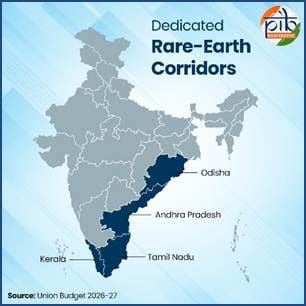
India is taking decisive steps toward self-reliance in critical materials by establishing a domestic ecosystem for Rare Earth Permanent Magnets (REPMs) - high-performance magnets essential for electric vehicles, wind turbines, electronics, aerospace, and defence. To support this goal, the government approved a ₹7,280 crore scheme to develop 6,000 MTPA of integrated REPM manufacturing capacity in November 2025, covering the full value chain from rare-earth oxides to finished magnets.
Complementing this, the Union Budget 2026–27 has announced the creation of Dedicated Rare Earth Corridors in Odisha, Kerala, Andhra Pradesh, and Tamil Nadu to promote mining, processing, research, and manufacturing. These initiatives align with the national priorities of Atmanirbhar Bharat, Net Zero 2070, and Viksit Bharat @2047, while positioning India as a key player in global advanced-materials value chains.
Strategic Importance and Resource Potential of Rare Earth Permanent Magnets in India
Rare Earth Permanent Magnets (REPMs) are among the strongest types of permanent magnets, known for their high magnetic strength and stability. Their compact size and powerful performance make them indispensable for advanced engineering applications such as electric vehicle motors, wind turbine generators, consumer and industrial electronics, aerospace systems, defence equipment, and precision sensors.
As India expands its manufacturing footprint in clean energy, advanced mobility, and strategic sectors, a reliable domestic supply of REPMs is critical. It not only reduces import dependence but also strengthens India’s competitiveness in global value chains for advanced materials.
India possesses a substantial reserve of rare-earth minerals, providing a strong foundation for downstream industries like REPM manufacturing.
Together, these reserves demonstrate India’s strong raw material base to support the establishment of an integrated REPM manufacturing ecosystem.
Need to Explore and Invest in the Sector - Although India has a strong rare-earth resource base, domestic production of permanent magnets is still at a developing stage, with imports mainly from China, meeting most of the demand (nearly 60–80% by value and 85–90% by quantity between 2022–25). With the consumption of Rare Earth Permanent Magnets expected to double by 2030 due to rapid growth in electric mobility, renewable energy, electronics, and defence applications, it is essential for India to expand domestic capability and invest in this sector to reduce import dependence and ensure long-term self-reliance.
Budget Push for Rare Earth Manufacturing and Corridors
The Union Budget 2026–27 has placed strong emphasis on building India’s self-reliance in critical materials by complementing the recently approved Rare Earth Permanent Magnet (REPM) Manufacturing Schemewith new corridor-based initiatives. Together, these measures create a comprehensive framework for strengthening domestic capacity, reducing import dependence, and positioning India as a global leader in advanced materials.
To strengthen India’s self-reliance in critical materials, the government on 26TH November, 2025, approved a major scheme for Rare Earth Permanent Magnets (REPMs). This initiative provides financial support and incentives to build a fully integrated domestic manufacturing ecosystem.
To complement the REPM scheme, the Union Budget 2026–27 announced Dedicated Rare Earth Corridors in Odisha, Kerala, Andhra Pradesh, and Tamil Nadu. These corridors will focus on mining, processing, research, and manufacturing, leveraging the mineral-rich base of these states. The initiative is expected to generate stronger local economies, enhance R&D capacity, and integrate India more deeply into global advanced‑materials value chains.

These corridors directly complement the existing presence of IREL (India) Limited in Odisha and Kerala.
IREL (India) Limited, formerly Indian Rare Earths Limited, has been operating under the Department of Atomic Energy since 1963. With a processing capacity of 10 lakh tonnes per annum, it produces strategic minerals such as ilmenite, rutile, zircon, sillimanite, and garnet. Importantly, IREL runs a Rare Earth Extraction Plant in Odisha and a Rare Earth Refining Unit at Aluva in Kerala, both of which align with the corridor initiative. By integrating IREL’s established facilities with the new corridors, the government aims to expand domestic rare earth capacity, foster advanced manufacturing, and accelerate India’s transition toward self-reliance and clean energy.
Rare Earth Development Aligned with National Goals
India’s recent policy measures reflect how rare earth development is being aligned with broader national priorities. The focus is not only on industrial growth but also on clean energy, defence, and strategic resource security.
Strengthening Global Mineral Partnerships
India’s rare earth and critical minerals strategy is not limited to domestic reforms; it is closely tied to international cooperation to build resilient supply chains.
v Multilateral Platforms
v Role of Khanij Bidesh India Limited (KABIL)
Conclusion:
India’s rare earth strategy is moving decisively toward self-reliance by combining strong domestic resource potential with targeted policy and financial support. The ₹7,280 crore REPM Manufacturing Scheme and the Union Budget 2026–27 announcement of Dedicated Rare Earth Corridors together create an integrated framework for mining, processing, research, and manufacturing. These measures reduce import dependence, strengthen clean energy and defence supply chains, and align with national priorities of Atmanirbhar Bharat, Net Zero 2070, and Viksit Bharat @2047. Complementary international partnerships and institutional reforms further ensure resilient access to critical minerals. With coordinated domestic and global initiatives, India is positioning itself as a reliable and competitive player in advanced materials value chains.