
Administrator
10 March 2026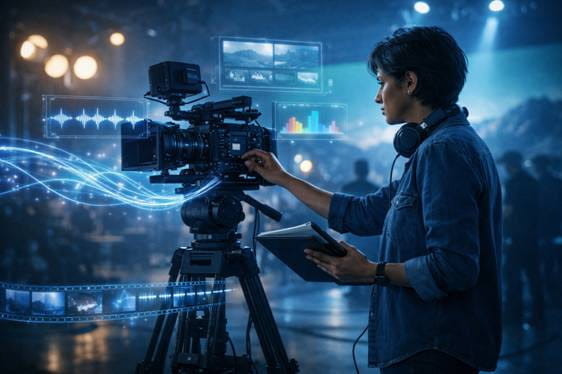
*AI-generated image
The Question in the Room
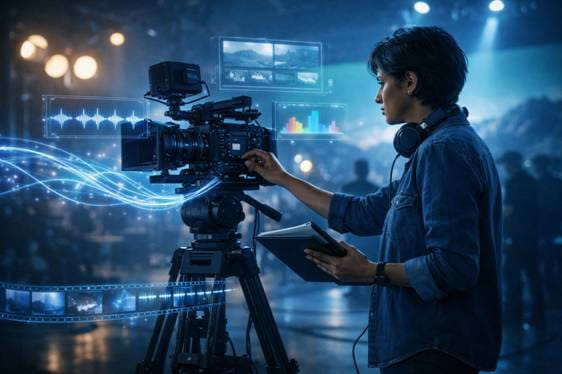
In the halls of Bharat Mandapam, at the India AI Impact Summit, the conversation around artificial intelligence moved beyond algorithms and computing power. It entered the territory of art. Filmmakers, writers, technologists and policymakers found themselves circling a question that felt both urgent and intimate: if machines can now write scenes, design frames and predict audience reactions, what remains uniquely human in cinema?
The debate was not framed in alarmist tones. Yet beneath the excitement around generative tools and intelligent systems lay a quieter concern. Cinema has always been more than production efficiency. It is memory, risk, identity and lived experience translated into moving images. When AI begins to participate in that process, the question is no longer about automation. It is about authorship.
What is unfolding is not a contest between human creativity and machine intelligence. It is a transition in how cinema is made. Artificial intelligence is beginning to handle breakdowns, visualisation, edits and data-driven insights, changing the pace and structure of production. Yet storytelling itself still draws from memory, culture and lived experience — qualities that technology can assist, but not originate. The conversation at the Summit reflected this evolving balance: not fear of disappearance, but curiosity about how authorship, scale and creative responsibility will be reshaped in the years ahead.

From Disruption to Reinvention
Cinema has always grown with technology, and almost every leap has arrived with doubt. Sound was once seen as the end of silent-era artistry. Colour was dismissed as spectacle. Digital cameras were criticised for lacking texture. Streaming platforms were predicted to weaken theatres permanently. Yet each shift expanded the grammar of storytelling. Creators adapted. The medium evolved.
Artificial intelligence marks the next inflection point. Unlike earlier transitions that changed format or distribution, AI is entering the creative workflow itself. Its strongest impact today lies in tasks that are repetitive, time-intensive or technically complex. Industry analysis suggests that generative AI can influence multiple stages of film and television production, particularly in pre-production and post-production, where it enhances efficiency and supports creative decision-making.

What does this mean in practice?
Across these applications, a consistent pattern emerges. AI accelerates execution, improves efficiency and expands scale. It analyses patterns. It automates repetition. It optimises distribution.
It does not originate lived experience, cultural nuance or emotional memory.
|
AI Meets Heritage: Mahabharat Reimagined
The series first premiered on WAVES OTT and was later telecast on Doordarshan, showing how technology was used not to replace tradition, but to present it in a form that speaks to today’s audiences. |
There is also a structural shift underway. As high-resolution cameras, content software and AI-enabled tools become more widely available, advanced production capabilities are no longer confined to major studios. AI-assisted planning and visualisation tools lower entry barriers and enable independent creators to experiment and compete at higher levels.
The reinvention, therefore, is not about replacing the storyteller. It is about transforming the infrastructure that surrounds storytelling.
India’s Creative Economy Meets Artificial Intelligence
For India, the conversation around artificial intelligence in cinema is not unfolding in isolation. It sits within a larger transformation of the country’s creative economy. India is one of the world’s largest producers of films, with a multilingual ecosystem that spans regional industries, streaming platforms and global audiences. As storytelling scales across languages and formats, technology becomes not just an enabler, but infrastructure.

Artificial intelligence is therefore not being viewed merely as a production tool. It is increasingly being understood as a strategic layer within India’s digital growth story. The question is shifting. It is no longer limited to whether AI will alter jobs in media. It is about how India will shape its use in ways that strengthen creative capacity, expand access and ensure responsible deployment within a rapidly growing entertainment ecosystem.
IndiaAI Mission and National AI Strategy as Foundational Infrastructure
India’s approach to artificial intelligence rests on a deliberate foundation. The National Strategy for Artificial Intelligence laid out the “AI for All” vision, positioning AI as a driver of inclusive growth, innovation and global competitiveness. The IndiaAI Mission translates that vision into infrastructure —expand compute capacity, enable access to datasets, support startups and strengthen advanced skilling.
Together, the strategy and the mission form the backbone of India’s AI ecosystem. For the creative economy, this means that experimentation in cinema and media is supported by national compute infrastructure, innovation funding and governance frameworks. AI in film is therefore not an isolated adoption of tools. It is emerging within a structured digital architecture designed to scale responsibly.
Push for AVGC and Gaming Sectors
India’s AI ambitions in cinema are also being reinforced through a deliberate expansion of the Animation, Visual Effects, Gaming and Comics (AVGC) ecosystem. The country already hosts over 1,900 game development companies employing nearly 66,000 professionals, supported by a domestic base of 488 million online gamers.
Indian studios contribute to global VFX and animation pipelines at 40–60 percent lower production costs, backed by an estimated workforce of 260,000 creators and engineers.
The rollout of AVGC Content Creator Labs across 15,000 schools and 500 colleges signals structural depth. It embeds digital storytelling and AI-enabled creative tools early within the education system. As intelligent workflows become integral to animation, immersive media and gaming engines, this sectoral push ensures that India’s production base evolves alongside technological transformation rather than reacting to it.
Skilling Initiatives in Emerging Media Technologies
If AI is redefining how stories are produced, skilling determines who produces them. India’s creative-tech talent architecture includes over 37 VFX institutes, more than 16 gaming colleges, and over 20 XR-focused academic programmes.
IICT as a National Centre of Excellence for AVGC-XR is aligned with advanced research, industry collaboration and specialised training with global production standards.
This is not merely workforce expansion. It is capability upgrading. As AI accelerates editing, rendering and localisation, the emphasis is on developing creators who can design, supervise and innovate within intelligent production pipelines.
Digital Public Infrastructure Enabling Scale
AI tools deliver value only when deployed at scale. India’s digital backbone provides that multiplier. With over 900 million broadband connections and 562 million active smartphones, the country operates one of the world’s largest digital content ecosystems.
In 2024, digital media accounted for 32 percent of the media and entertainment sector’s revenues, emerging as its largest segment.
This scale democratises participation. Smaller studios, independent filmmakers and regional creators can distribute, monetise and iterate rapidly. Within such an ecosystem, AI-powered tools for editing, localisation and audience analytics are not isolated upgrades. They become embedded features of a high-velocity creative market.
The Role of Startups and Innovation Labs
India’s creative transformation is increasingly enterprise-driven. The country hosts over 1,580 Global Capability Centres, including media and content capability clusters.
Studios and startups are integrating AI-driven production workflows, real-time rendering engines and immersive technologies into mainstream operations. This momentum was visible at the India AI Impact Summit, where dozens of creative-tech startups showcased AI applications across animation, XR, localisation and digital storytelling, signalling that innovation is moving from experimentation to industry deployment.
Government-supported incubation and startup frameworks further lower entry barriers for emerging creative-tech ventures, accelerating the journey from prototype to deployment.
In effect, innovation is not peripheral to the creative economy. It is being institutionalised. AI in Indian cinema is therefore not unfolding in isolation. It is supported by sectoral scale, talent pipelines, digital infrastructure and entrepreneurial depth - forming an ecosystem capable of shaping, rather than merely adopting, intelligent media technologies.

The Human Premium
Artificial intelligence can write a scene in seconds. It can compose background music, generate faces, recreate voices and build entire visual worlds from prompts. It can analyse thousands of scripts and tell us what usually works.
But cinema has never been about what usually works.
It has been about a director choosing an ending that feels right, even if it defies expectation. About an actor allowing a moment of silence to carry more meaning than dialogue. About a writer drawing from memory, emotion and lived experience, not just pattern recognition. AI can generate possibilities. Humans decide which ones are worth keeping.
Machines recombine patterns from the past. Artists take risks for the future.
The real concern, then, is not that creativity will disappear. It is that it could become predictable. If stories are shaped only by algorithms trained on past successes, the result may be efficient but emotionally thin. Cinema endures because it surprises, because it unsettles, because it lingers long after the screen goes dark.
At the same time, the opportunity is undeniable. AI can remove friction from the creative process. It can shorten production cycles, simplify technical barriers and make sophisticated tools accessible to independent creators. A filmmaker without access to a major studio can now visualise ambitious scenes. A regional story can reach new audiences through intelligent localisation. That is not replacement. It is amplification.
The question, therefore, is not whether India should resist AI. It is how Indian cinema will shape it. How storytellers embed intention into intelligent systems. How directors, writers and animators ensure that technology strengthens, rather than standardises, creative expression.
At the India AI Impact Summit, the debate began with uncertainty: will AI take creative jobs? But the more grounded takeaway is this — the responsibility lies not in halting innovation, but in guiding it.
The future of Indian cinema will not be defined by resisting artificial intelligence. It will be defined by embedding human vision into intelligent systems.
Because when the lights dim and the first frame appears, what moves an audience is not computation.
It is connection.
 India’s epic Mahabharat was brought to life once again — this time with the support of advanced AI tools. In a collaboration between Prasar Bharati and Collective Media Network, intelligent technologies were used to enhance visuals, recreate large-scale battle scenes and add depth to characters, while keeping the spirit of the original story intact.