Administrator
27 March 2026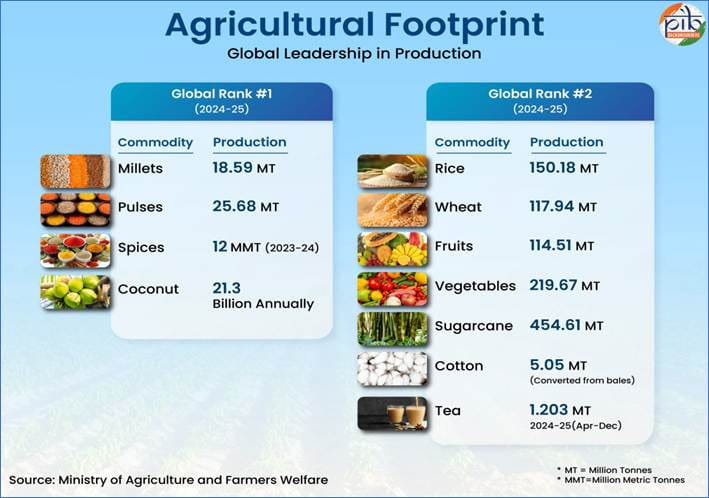
India’s agricultural sector continues to play a pivotal role in sustaining rural livelihoods, ensuring economic resilience, and safeguarding national food security. Agriculture and allied activities account for nearly one-fifth of the country’s gross value added at current prices, employ approximately 46.1 percent of the workforce, and support close to 55 percent of the population, underscoring their substantial socio-economic significance. Over the past five years, the sector has achieved an average annual growth rate of around 4.4 percent at constant prices, reflecting enhanced expansion supported by improved farm practices, technological integration, and moreresilient production systems.
India’s Agricultural Production Performance
In the agricultural year 2024-25, India recorded an unprecedented foodgrain output of 357.73 million metric tonnes (MMT), marking an increase of 25.43 million metric tonnes (MMT) over the preceding year, reflecting sustained gains in productivity, improved input management, and strengthened institutional support to farmers. The increase was primarily driven by higher production of rice, wheat, maize, and coarse cereals(including millets, designated as Shree Anna).
Horticulture has simultaneously emerged as a major driver of agricultural transformation and value addition. Total horticulture production reached 362.08 million tonnes (MT) in 2024-25, indicating a structural shift towards high-value crops. According to the second advance estimates, production increased from 280.70 million tonnes in 2013-14 to 367.72 million tonnes in 2024-25. This output comprises approximately 114.51 million tonnes of fruits, 219.67 million tonnes of vegetables, and 33.54 million tonnes from other horticultural crops. The gradual scaling of both foodgrain and horticultural production underscores India’s strengthening domestic agricultural base and its growing prominence in global agri-food systems.
India in Global Agricultural Markets
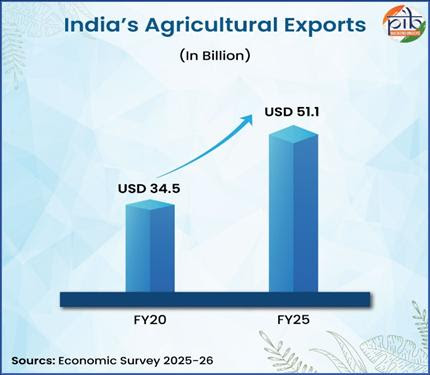
India’s agricultural exports have grown steadily in recent years. Agricultural export earnings increased from USD 34.5 billion in FY20 to USD 51.1 billion in FY25, reflecting a CAGR of 8.2 percent. In FY25, agri-food exports, including processed food products, amounted to USD 49.43 billion, accounting for about 11.2 percent of total exports. Notably, the share of processed food exportshas also risen consistently, from 14.9 percent in FY18 to 20.4 percent in FY25, indicating a progressive shift toward higher value-added within the agricultural export basket.
These trends underline the expanding role of processed and diversified agricultural products in strengthening export competitiveness while creating new opportunities across production, processing, and global market integration.
India holds a strong position in global agriculture, supported by diversified production systems and region-specific strengths across cereals, pulses, horticulture, and plantation crops. With the world’s second-largest agricultural land area, India is a global leader in farm output, ranking among the world’s top producers across several commodities, reflecting both the scale and sustainability of its agricultural production.
India’s Dominance in Cereals, Pulses, and Millets
Rice and Wheat: India ranks as the world’s second-largest producer of both rice and wheat, with output reaching 150.18 million tonnes of rice and 117.94 million tonnes of wheat during the agricultural year 2024-25. Rice production is primarily concentrated in states such as Uttar Pradesh, Telangana, and West Bengal. At the same time, Uttar Pradesh, Madhya Pradesh, and Punjab constitute the leading wheat-producing regions, reflecting the geographic concentration of cereal production within the country.
Pulses and Millets: India also leads globally in pulse production, recording an output of 25.68 million tonnes (2024-25), with Madhya Pradesh, Maharashtra, and Rajasthan serving as the principal producing states. The country also ranks first worldwide in millet production, achieving approximately 18.59 million tonnes (2024-25), largely driven by Rajasthan, Maharashtra, and Karnataka.
In terms of trade performance, Rice exports reached USD 12.95 billion in 2024-2025, while exports of pulses and millets amounted to USD 855 million and USD 59.20 million, respectively. These figures underscore the growing international demand for diversified, climate-resilient cereal crops, reinforcing India’s strategic role in global food and nutrition security.
India’s Global Position in Horticulture
Fruits and Vegetables: India is the world’s second-largest producer of fruits and vegetables, with output reaching 114.51 million tonnes of fruits and 219.67 million tonnes of vegetables in 2024-25. Fruit production is primarily concentrated in Andhra Pradesh, Maharashtra, Uttar Pradesh, Gujarat, Karnataka, and Tamil Nadu, while Uttar Pradesh, West Bengal, Madhya Pradesh, Bihar, and Gujarat lead vegetable output. Exports of fruits and vegetables amounted to USD 1,818.56 million in 2024-25, reflecting the increasing contribution of high-value horticulture crops to India’s agricultural trade and in global market integration.
Dry Onion: India also ranks first globally in dry onion production, contributing nearly 25 percent of total world output, largely from Maharashtra, Madhya Pradesh, and Gujarat.
India’s Leadership in High-Value Cash Crops
Sugarcane: In high-value cash crops, India is the second-largest producer of sugarcane, with output of 454.61 million tonnes (2024-25), mainly from Uttar Pradesh and Maharashtra.
Cotton: India ranks as the world’s second largest producer of cotton, with output estimated at approximately 5.05million tonnes (converted from bales) in 2024-25. Production is concentrated mainly in Karnataka, Maharashtra, and Gujarat, which constitute the principal cotton-growing states. On the trade front, despite global tariff-related challenges, India’s cotton exports to the USA during January-October 2025 amounted to USD 31.31 billion, indicating relative stability in export performance amid evolving international market conditions.
Tea: India ranks second globally in tea production, with output reaching 1.203 million tonnes during April-December 2024-25. Production is concentrated in Assam, West Bengal, Tamil Nadu, Kerala, and Karnataka. Tea exports during the period from April to October 2025-26 amounted to USD 605.90 million, up 15.16 percent from the corresponding period of the previous year.
Spices: India continues to lead the world as the leading producer, with total production reaching 12 million metric tonnes in 2023-24. Major producing states include Madhya Pradesh, Gujarat, and Andhra Pradesh. Spices exports reached USD 4.52 billion in FY25, underscoring India’s strong global market presence in this segment.
Coconut: India ranks first globally in coconut production, with an annual output of approximately 21.3 billion nuts. Coconut exports were valued at USD 513 million in 2024-25, reflecting steady international demand.
Coffee: India produces around 0.36 million tonnes of coffee annually, with nearly 70 percent exported to 128 countries. Karnataka, Kerala, and Tamil Nadu are the principal producing states. During April-October FY 2025-26, coffee exports amounted to USD 1,176.31 million, representing an increase of approximately 12 percent over the corresponding period of the previous year.

|
The Union Budget 2026-27 has emphasised on the promotion of high value crops, by announcing targeted support for coconut, sandalwood, cocoa and cashew in coastal regions, agar trees in the North Eastern states,and high value nuts such as almonds, walnuts and pine nuts in hilly areas. This region-specific approach reflects a policy intent to harness local agro-climatic strengths, and encourage diversification towards crops that offer higher economic returns. |
Therefore, India’s diversified commodity base and geographically balanced production systems strengthen its role in stabilising global food supply chains. The integration of improved production practices with expanding export markets reflects a transition towards resilient agriculture that boosts economic growth while promoting long-term environmental balance.
Public Policy Interventions Supporting Resilient Production Systems
India’s agricultural policy framework combines financial support, productivity enhancement, and risk management measures to strengthen farmer welfare and sectoral resilience.
Budget Allocation
The Government has significantly enhanced budgetary allocations to the agriculture sector, underscoring a long-term policy commitment to strengthening farmers’ welfare and rural livelihoods, and over the years, reflecting a consistent commitment to farmers’ welfare.

Budget allocation for the Department of Agriculture and Farmers Welfare increased from Rs. 21,933.50 crore (approximately USD 2.64 billion) in 2013-2014 to Rs. 1,27,290.16 crore (approximately USD 15.34 billion) in 2025-26, representing a substantial enhancement in public investment over the period. Building on this trajectory, the budget allocated (2026-27) of Rs. 1,30,561.38 crore (approximately USD 15.73 billion) to the Department of Agriculture and Farmers Welfare reaffirms the continued prioritization of agricultural development.
From Input Support to Resilient Growth: India’s Productivity-Led Agricultural Strategy
India’s agricultural development strategy has progressively shifted toward enhancing productivity through improved input-use efficiency, technological adoption, and the promotion of sustainable agronomic practices. Mission-oriented interventions, including the National Food Security and Nutrition Mission, the Mission for Aatmanirbharta in Pulses, and the National Mission on Edible Oils-Oilseeds and Oil Palm, along with targeted extension and institutional credit support, are driving this structural transformation toward higher productivity, reduced import dependence, and enhanced resilience within the agricultural sector.
|
The National Food Security and Nutrition Mission (NFSNM), formerly the National Food Security Mission (NFSM), is a centrally sponsored scheme to increase the production of rice, wheat, pulses, and nutri-cereals/coarse cereals in the country. The Mission for Aatmanirbharta in Pulses (2025–31)aims to achieve self-sufficiency in pulses by significantly enhancing domestic production reduce import dependence, and pave the way for an “Aatmanirbhar Bharat” in pulses. The National Mission on Edible Oils (NMEO), including the Oil Palm (NMEO-OP) and Oilseeds (NMEO-Oilseeds) initiatives, aims to achieve self-reliance in edible oil production by 2030-31. It focuses on expanding cultivation areas, enhancing production and productivity through quality seeds, enhancing technology, and increasing farm income to reduce import dependency. |
Quality Seeds and Soil Health:
|
Sub-Mission on Seeds and Planting Material initiative (SMSP) seeks to expand the supply of certified and quality seeds while improving the seed replacement rate and the standard of farm saved seeds. It also works to modernise seed production, processing, testing and storage infrastructure, and encourages the adoption of advanced techniques across the seed value chain. A Soil Health Card is issued to farmers for each landholding, detailing soil status based on 12 parameters including Nitrogen, Phosphorus, Potassium, Sulphur, Zinc, Iron, Copper, Manganese, Boron, pH, Electrical Conductivity, and Organic Carbon. Issued every two years, it guides farmers on suitable fertilisers and soil treatments to maintain long term soil health. Pradhan Mantri Krishi Sinchayee Yojana (PMKSY)aims to improve on farm water efficiency by promoting drip and sprinkler irrigation systems. It also supports small scale water storage and conservation measures to strengthen water availability for micro irrigation. |
Credit, Mechanisation and Technology:
|
Kisan Credit Card (KCC) scheme meets the financial requirements of farmers at various stages of farming. The scheme aims at providing adequate and timely credit support from the banking system under a single window with flexible and simplified procedure to the farmers for their cultivation and other needs like short term credit requirements for cultivation of crops, post-harvest expenses, investment credit requirement for agriculture and allied activities, produce marketing loan, consumption requirements of farmer household, workingcapital for maintenance of farm assets and activities allied to agriculture. |
Sustainable Agriculture, Extension, and Mission Mode Initiatives:

● Ethanol blending saved over Rs.1.44 lakh crore in foreign exchange as of August 2025
These interventions reflect a shift towards technology-driven, resource-efficient, and improved production systems that strengthen farm productivity and resilience.

Integrated Support for Farmers’ Welfare, Risk Management, and Collective Action
Securing stable farm incomes, institutionalising risk mitigation mechanisms, and strengthening cooperative networks are integral to enhancing farmer resilience and sustaining agricultural growth amid increasing climatic and market variability.
Price and Income Support:
|
Pradhan Mantri Kisan Samman Nidhi (PM-KISAN), is a Central Sector Scheme offering annual financial assistance of Rs. 6,000/- to each eligible farmer family,delivered in three equal instalments of Rs. 2,000/-, into their Aadhaar seeded bank accounts of farmers through DBT mode. Pradhan Mantri Kisan Maandhan Yojana (PMKMY) scheme aims to provide social security net for the Small and Marginal Farmers (SMF) by way of pension, as they have minimal or no savings to sustain their livelihood during their old age and to support them in the event of consequent loss of livelihood. Under this scheme, a minimum fixed pension of Rs.3,000/-per month will be provided to the eligible small and marginal farmers, subject to certain exclusion clauses, on attaining the age of 60 years. The scheme is a voluntary and contributory pension scheme, with entry age of 18 to 40 years. |
Crop Insurance Protection:
|
Pradhan Mantri Fasal Bima Yojana (PMFBY) is a crop insurance scheme aiming to provide financial protection to farmers against crop loss due to natural disasters (hail, drought, famine), pests, and diseases. PMFBY provides crop insurance at a cost-effective premium to all Indian farmers through a network of insurance companies and banks. |
Strengthening Cooperatives and Collective Systems:
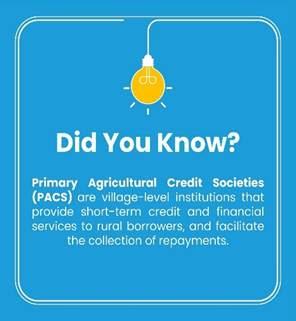
Collectively, these interventions consolidate income stability, institutional risk protection, and expand collective market access, thereby reinforcing the resilience and long-term sustainability of India’s agricultural economy.

Market Reforms, Value-Chain Modernisation, and Public Food Distribution
The strengthening of food management systems, market infrastructure, and value addition mechanisms has emerged as a central pillar of India’s farm-to-market strategy. Strategic investment in storage capacity, processing facilities, digital market platforms, and public distribution reforms is enhancing supply chain efficiency, stabilising prices, and improving farm-level remuneration. Collectively, these interventions are fostering a more resilient, transparent, and integrated food ecosystem that balances producer incentives with consumer welfare.
Market Linkages and Infrastructure:
Significant investments in market linkages and post-harvest infrastructure have strengthened agricultural value chains and improved producers’ integration with formal markets. As of 28 February 2026, 49,796 storage projects had received financial assistance amounting to Rs.4,832.70 crore, while 25,009 marketing infrastructure projects had received subsidies totalling Rs.2,193.17 crore. The e-National Agriculture Market (e-NAM) platformexpanded its outreach to 1.8 crore farmers, 2.72 lakh traders, and 4,724 Farmer-Producer Organisations (FPOs) across 1,656 mandis in 23 States and 4 Union Territories, enhancing digital price discovery and inter-market trade.
|
The e-National Agriculture Market (e-NAM) is a pan-India electronic trading portal designed to integrate existing APMC (Agricultural Produce Market Committee) mandis across the country into a unified online platform, enabling “One Nation One Market” for agricultural commodities. The platform streamlines agricultural marketing by offering single-window services such as commodity arrivals, AI-based quality assaying, e-bidding, and direct e-payment to farmers. It aims to enhance transparency, efficiency, and competitiveness in agricultural trade while expanding market access for farmers and reducing information asymmetry. |
Under the Formation and Promotion of 10,000 FPOs scheme launched in 2020, 10,000 FPOs had been registered by 28 February 2026. In the fisheries sector, collectivisation has been reinforced through the formation of 2,195 Farmers’ Fisheries Producer Organisations (FFPOs), alongside the extension of Kisan Credit Card benefits to 4.39 lakh fishers, thereby broadening institutional credit access and enhancing sectoral resilience.
Food Processing and Value Addition:
The food processing sector plays a significant role in India’s industrial landscape, accounting for 12.91 percentof organised manufacturing employment. Under the Pradhan Mantri Kisan Sampada Yojana (PMKSY),1,185 projects had been completed as of 30 November 2025, strengthening modern processing and cold-chain infrastructure. The Production Linked Incentive Scheme for the Food Processing Industry (PLISFI)approved 169 applications, mobilising investments of Rs.9,207 crore, with incentives amounting to Rs.2,162.55 crore disbursed by 31 December 2025.
Additionally, the Pradhan Mantri Formalisation of Micro Food Processing Enterprises Scheme (PMFME) supported 4,04,062 applications, facilitating 1,72,707 loans with term lending of Rs.14.19 thousand crore and extending seed capital assistance of Rs.1,277.45 crore to women Self-Help Groups as of 31 December 2025, thereby promoting decentralised value addition and inclusive enterprise development.
|
Pradhan Mantri Kisan Sampada Yojana (PMKSY) constitutes a comprehensive initiative aimed at developing modern infrastructure for the food processing sector. It seeks to establish an integrated and efficient supply chain spanning from the farm gate to retail markets. The scheme enhances farmers’ price realisation, minimises post-harvest losses, promotes value addition, and supports income enhancement. Additionally, it generates rural employment, increases processing capacity, and strengthens the export competitiveness of processed food products. The Production Linked Incentive Scheme for the Food Processing Industry (PLISFI) proposes financial incentive to modernize and enhance competitiveness of the food processing industry by manufacturing specific categories of food products having high potential for growth in output and value addition. Pradhan Mantri Formalisation of Micro Food Processing Enterprises Scheme (PMFME) is a Centrally Sponsored Scheme by the Ministry of Food Processing Industries, designed to address the challenges faced by the micro-enterprises and to tap the potential of groups and cooperatives in supporting the upgradation and formalization of these enterprises. |
Procurement and Food Security:
The Central Government procures foodgrain to ensure food security, while providing price support to farmers through Minimum Support Prices announced by the Department of Agriculture and Farmers Welfare and Co-operation. The details of the procurement of food grains are as follows:
● KMS 2024-25 (Paddy): 832.17 LMT procured; 118.59 Lakh farmers benefited.
● KMS 2025-26 (Paddy) (as on 17.11.2025): 243.48 LMT procured; 21.22 Lakh farmers benefited.
● Coarse Grains/Millets 2024-25: 11.72 LMTprocured.
Therefore, the government maintains adequate food stocks to meet buffer norms for food security, ensure regular supply through the Public Distribution System, and enable market intervention to stabilise open market prices.
Under the National Food Security Act, subsidised foodgrains have been provided to 81.35 crore beneficiaries, covering up to 75 percent of the rural population and 50 percent of the urban population.
Storage and Public Distribution System:

The implementation of the One Nation One Ration Card (ONORC) has achieved 99.8 percent Aadhaar seeding of ration cards.It has been operationalised across all 36 States and Union Territories, enhancing beneficiary portability and inclusion. Over 99 percent of the 5.43 lakh Fair Price Shops are equipped with electronic point-of-sale (ePoS) devices, facilitating the digitisation of more than 98 percent of transactions and strengthening transparency in distribution. In FY24, Rs.267.6 crore was transferred through Direct Benefit Transfer (DBT) to over 10 lakh beneficiaries, improving targeting efficiency and accountability. Collectively, these reforms reinforce market integration, reduce distribution inefficiencies, and strengthen food security within an increasingly digitised farm-to-distribution ecosystem.
|
Sustainable Development Goals Linkages India’s agricultural initiatives are closely aligned with the UN Sustainable Development Goals (SDGs), integrating national development priorities with global sustainability commitments. Productivity enhancement, public procurement and food security measures directly contribute to SDG 2 (Zero Hunger). Initiatives promoting sustainable agriculture, including soil health management, natural farming and resource-efficient practices support SDG 12 (Responsible Consumption and Production) and SDG 13 (Climate Action). Strategic Investments in post-harvest infrastructure, value addition, storage, and digital agricultural markets reinforce SDG 9 (Industry, Innovation and Infrastructure). Together, these interventions reinforce a resilient and resilient agricultural ecosystem aligned with global development priorities. |
Conclusion
India’s agricultural transformation reflects a balanced approach that combines strong production growth, expanding global market presence, and targeted policy interventions across the farm-to-market value chain. Record foodgrain and horticulture output, growing exports, and diversified commodity leadership demonstrate the sector’s sustainability and adaptability to changing economic and climatic conditions. Mission-driven support through inputs, income protection, market infrastructure, and digital food systems has strengthened productivity, improved farmer welfare, and enhanced food security outcomes. As resilient production systems continue to evolve, the expanding role of agriculture provides a strong foundation for deeper integration with allied activities, further supporting rural livelihoods, value addition, and long-term economic stability.