
Administrator
09 April 2026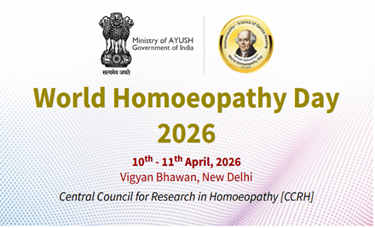
Homoeopathy, derived from the Greek words Homois(similar) and Pathos (suffering), is a system of medicine that treats diseases using remedies which produce effects similar to the symptoms experienced by the patient. This approach was formalised in 1796 by Samuel Hahnemann, the founder of Homoeopathy. His birth anniversary, observed annually on April 10 as World Homoeopathy Day, and this year’s theme is “Homoeopathy for Sustainable Health.”
He established its foundational theories, first one being “like cures like”, which holds that substances capable of producing symptoms in a healthy individual can, in carefully prepared forms, treat similar symptoms in a sick individual. The second theory, known as the “law of minimum dose,” emphasises the use of highly diluted remedies to stimulate the body’s self-healing mechanisms while minimising side effects.
Homoeopathic medicines are prepared from natural sources such as plants, minerals, and animal substances through dilution and succussion, and are administered in forms like tablets, globules, and liquids. A key feature is its individualised approach, where treatment is based on a patient’s overall physical and mental condition rather than just the disease.

In India, homoeopathy has developed into a widely practised system, contributing to preventive care, chronic disease management, and holistic well-being.
|
World Homoeopathy Day 2026: Key Highlights
|
From Tradition to Policy Priority
With nearly a quarter of a million registered homoeopathy practitioners, India accounts for one of the largest homoeopathic workforces in the world. Over the past century, the system has not only endured but has harmoniously integrated with the country’s rich traditions of natural and preventive healthcare.
This sustained acceptance has been complemented in recent years by strong institutional support. The establishment of the Ministry of AYUSH in 2014 marked a pivotal shift, bringing renewed policy focus to homoeopathy through structured interventions in research, standardisation, and global outreach. These efforts have helped transform homoeopathy from a traditionally practised therapy into a well-recognised, policy-driven component of India’s healthcare system.
|
History of Homoeopathy in India Homoeopathy was introduced in India in the early 19th century, marking the beginning of its gradual expansion. Around 1810, John Martin Honigberger, a disciple of Samuel Hahnemann, began practising in India. His successful treatment of Maharaja Ranjit Singh in 1839 significantly boosted its acceptance among both elites and the general population. Key Milestones
Post-Independence Developments In the post-independence period, the Government of India took steps to institutionalise homoeopathy:
These initiatives strengthened regulation, education, and research in the field. |
Homoeopathy Infrastructure in India
In recent years, there has been an increasing emphasis on evidence-based validation of homoeopathy. India is home to around 34 dedicated homoeopathic research centres, forming a strong foundation for systematic research. Leading these efforts, institutions such as the National Commission for Homoeopathy and Central Council for Research in Homoeopathy play key roles in advancing clinical research, drug standardisation, and interdisciplinary studies.

Government-supported forums, particularly those held around World Homoeopathy Day, are placing greater focus on data-driven outcomes, signalling a shift toward stronger scientific engagement.
Central Council for Research in Homoeopathy (CCRH)
Based in New Delhi, CCRH promotes scientific and ethical research to strengthen clinical practice and support the global acceptance of homoeopathy. Scientific research in Homoeopathy is conducted through a network of 33 institutes/units all over India.
Key Activities of CCRH:
Public Health Initiatives:
National Commission for Homoeopathy (NCH)
The NCH was established under the National Commission for Homoeopathy Act, 2020, which came into effect on 5th July 2021. With this, the Board of Governors and the Central Council of Homoeopathy, constituted under the Homoeopathy Central Council Act, 1973, were dissolved.
Key Activities / Functions of NCH:
This institutional strengthening and standardisation of Indian systems of medicine has created a robust regulatory and quality framework, which in turn has supported the expansion of educational infrastructure in the sector.
The steady growth in the number of homoeopathy colleges and seats from 2013–14 to 2024–25 reflects the impact of these regulatory reforms and the expanding capacity of homoeopathic education in India.

Pharmacopoeia Commission for Indian Medicine & Homoeopathy (PCIM&H)
The Pharmacopoeia Commission for Indian Medicine & Homoeopathy (PCIM&H), a subordinate office under the Ministry of AYUSH, is responsible for developing pharmacopoeias and formularies for Indian systems of medicine and Homoeopathy, and serves as the Central Drug Testing-cum-Appellate Laboratory to ensure the quality, safety, and standardisation of these medicines.
It was initially established as the Pharmacopoeia Commission for Indian Medicine (PCIM) on 18th August 2010 under the Societies Registration Act, 1860. With the inclusion of Homoeopathy within its mandate, it was renamed as the Pharmacopoeia Commission for Indian Medicine & Homoeopathy (PCIM&H) on 20th March 2014.
AYUSH Policies and Schemes Supporting Homoeopathy
The Government of India, through the Ministry of AYUSH, has implemented a series of targeted schemes to strengthen homoeopathy in education, research, clinical services, and public health integration. These initiatives aim to enhance accessibility, promote evidence-based practice, and build professional and institutional capacity, ensuring homoeopathy remains a safe, effective, and scientifically validated component of India’s healthcare system.
Key Schemes and Initiatives:
National AYUSH Mission (NAM)
A flagship programme aimed at integrating homoeopathy and other traditional system into mainstream healthcare by strengthening service delivery and infrastructure across public health facilities.
AYURSWASTHYA
Focused on improving the quality of homoeopathy institutions and promoting advanced research and clinical excellence.
AYURGYAN
A capacity-building initiative that supports professional development and research-oriented practice among homoeopathy practitioners. It encourages professionals to undergo professional orientation, update knowledge of teachers and doctors, and promote the use of information technology for disseminating Homoeopathy developments.
Extra Mural Research (EMR) Scheme
A flagship initiative to promote scientific validation of homoeopathy through funded research aligned with national health priorities.
Ayush Oushadhi Gunvatta evam Uttpadan Samvardhan Yojana (AOGUSY)
AOGUSY aims to regulate and enhance the quality of Ayurveda, Siddha, Unani, and Homoeopathy (ASU&H) medicines in India under the Drugs & Cosmetics Act, 1940, by promoting standardization, quality manufacturing, and regulatory compliance.
Key Goals:
Beneficiaries & Support:
Medicinal plants constitute the essential raw material base for the AYUSH systems of healthcare, covering over 7,000–7,500 species. In India, where Ayurveda, Yoga, Unani, Siddha, and Homoeopathy are widely practised, the demand for authentic, high-quality medicinal plant resources has grown, to support their expanding use. In this regard, the Medicinal Plants Initiatives (NMPB) ensure the sustainable conservation, cultivation, and supply of medicinal plants for homoeopathic medicines. By strengthening the availability of quality raw materials, it supports both healthcare delivery and the livelihoods of farmers and stakeholders. While a robust supply of quality medicinal inputs forms the backbone of AYUSH systems, their effective utilisation depends on sustained awareness and outreach efforts.
The Information, Education, and Communication (IEC) initiative enhances awareness and outreach of homoeopathy through structured communication strategies. It promotes the cost-effectiveness and benefits of homoeopathy. This is achieved by disseminating research findings, organizing health campaigns and seminars, conducting public engagement programmes, and encouraging preventive and promotive healthcare practices.
Together with the Promotion of International Cooperation in AYUSH, which advances global recognition through expert exchanges, academic collaborations, and scholarships, these efforts collectively strengthen both the domestic base and international presence of AYUSH systems.
Homoeopathy in Epidemic Preparedness and Response
Homoeopathy has emerged as a complementary tool in epidemic preparedness, using preventive, promotive, and adjuvant strategies. The Central Council for Research in Homoeopathy (CCRH) has been conducting epidemic-related research and medical relief through its 33 institutes/units across India.
|
Success Stories of Homoeopathy at the Global Level The Central Council for Research in Homoeopathy (CCRH) has played a key role in implementing homoeopathic interventions for epidemic management, both in India and internationally. Key examples include:
|
Conclusion: Tradition Meets Transformation
Homoeopathy in India reflects a unique journey where time-honoured principles seamlessly align with contemporary advancements. Rooted in a rich tradition of holistic healing, the system is undergoing a meaningful transformation driven by scientific research, strengthened regulation, and expanding educational capacity. This convergence of tradition and modernisation has enhanced both its credibility and its relevance in today’s healthcare landscape.
Institutions such as the Central Council for Research in Homoeopathy and the National Commission for Homoeopathy exemplify this transition by fostering evidence-based practice, standardisation, and professional excellence. At the same time, the integration of homoeopathy into public health initiatives and epidemic response highlights its evolving role in addressing contemporary health challenges.
Moving forward, homoeopathy in India is well-positioned to contribute to a more inclusive, accessible, and integrative healthcare system.