Administrator
01 May 2026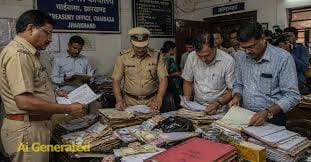
*Chaibasa Treasury Picture courtesy Facebook.com
The arrest of four persons, following a preliminary inquiry, revealed that Jharkhand has been badly jolted by one of its gravest financial scandals since the fodder scam of the 1990s.
It’s called a digital debacle perpetrated by personnel of the government in this state, where digitisation, in the absence of rigorous digital safeguards, can transform financial leakages into systemic pipelines such as the unfolding digital treasury scam.
As of now, the scam came to light through a routine treasury inspection expanding into a statewide investigation and revealing fraudulent salary withdrawals worth Rs 33 crore to Rs 40 crore—and counting—across multiple government treasuries in this state.
However, a study based on available official records indicates that, unlike traditional embezzlement cases, this digital treasury scam was executed from within the state’s own financial architecture. Government employees allegedly exploited the J-Kuber (e-Kuber) portal, Jharkhand’s integrated digital platform, for salary payments and treasury operations, to siphon off public funds over several years.
The scam suspects ' modus operandi was this. They altered employees’ records, including IDs, bank account details and dates of birth. Two, they changed the retirement dates of superannuated employees to show them as still in service. Three, they inflated pay scales or created multiple entries for the same individual. Four, they diverted funds into personal or proxy bank accounts.
In some instances, salaries were dramatically inflated—for example, Rs 43,000 being converted into Rs 4.3 lakh—and routed out of the treasury system. This was a data-layered fraud, exploiting weaknesses in the digital system itself.
Reports say the financial scale continues to evolve as audits deepen. Some hard facts are: Approximately Rs 27 crore has been identified in Hazaribagh alone. Over Rs 4 crore confirmed in Bokaro. Overall estimates range from Rs 33 crore to over Rs 150 crore across districts.
In Bokaro, one specific case revealed Rs 4.29 crore withdrawn over the years (November 2023 to March 2026) through 63 fraudulent transactions in the name of a policeman who had retired in 2016.
Additionally, more than 600 government personnel, from constables to deputy superintendent of police (DSP)-level officers, are suspected of either participating in or benefiting from these withdrawals.
Another indicator is that the emerging pattern points clearly to insider involvement. Those under scrutiny include: Police personnel, from constables to accounts staff. Treasury and accounting officials. Drawing and Disbursing Officers (DDOs).
Possible involvement of senior supervisory officers.
One key accused, Home Guard constable Shambhu Kumar, is alleged to have exploited system loopholes for over a decade. Investigators say he and his associates used illicit proceeds to purchase land in Gaya and Hazaribagh, construct buildings and acquire vehicles.
Notably, this digital treasury scam is not an external cyberattack. It is an insider-enabled fraud, where individuals responsible for validating payments are themselves part of the chain.
The scam appears to have operated over a prolonged period: Its estimated duration is
8-15 years (approximately 2011–2026). And it intensified after the rollout of the J-Kuber portal.
On April 9-10, 2026, arrests were made in Hazaribagh and Rs 15.41 crore flagged. On April 15, Chief Minister Hemant Soren ordered a statewide probe. An audit of salary records spanning 15-26 years is still on.
Investigators have claimed that the scam’s epicentre lies in Hazaribagh (Rs 27-30 crore) and Bokaro treasuries. However, irregularities have also been detected in Ranchi (around Rs 3 crore).
Investigations are on in Palamu, Deoghar, Ramgarh and Jamshedpur as well. The state government has ordered a comprehensive audit of all 33 treasuries in Jharkhand, indicating that the problem may be systemic rather than localised.
WHY?
The scam appears to be driven by a combination of greed and systemic weakness. Key enabling factors include: Inadequate multi-level verification despite rules requiring checks at several stages. Absence of regular audits or rotation of treasury staff.Weak oversight of digital records.Lack of real-time anomaly detection.
Those with insider access understood precisely where the controls were weak—or entirely absent—and exploited them over time.
The operational mechanics were relatively simple but highly effective. Consider these facts: Employee IDs and payee details were altered. Duplicate or prefixed entries were added to inflate amounts. Payments were routed to controlled bank accounts.
The fraud remained undetected because the same individuals were responsible for both data entry and validation, effectively neutralising internal checks. The breakthrough came when the principal accountant general’s team conducted cross-verification between physical records and portal data during inspections. This exposed discrepancies that routine processes had failed to detect.
Following this, bank accounts linked to the accused were frozen. Assets are under investigation and a special investigation team (SIT) is probing the financial trails.
The Jharkhand government has initiated a full-scale response. Soren and Finance Minister Radha Krishna Kishore have pledged “zero tolerance” and recovery of funds. Salary disbursements in suspect departments have been paused. Long-serving treasury officials are being transferred. Opposition parties have demanded a CBI or judicial inquiry.
The Jharkhand treasury fraud carries a familiar imprint of earlier scandals, such as the fodder scam, which relied on fabricated bills and ghost beneficiaries. However, its execution represents a decisive evolution. Where earlier scams depended on paper trails and physical manipulation, this one unfolded within the digital infrastructure of governance itself.
The fraud did not bypass the system—it operated through it. By manipulating master data, altering salary entries and exploiting reconciliation gaps, perpetrators achieved scale without immediate visibility. It is, fundamentally, the same intent—diversion of public funds—but executed with a digital toolkit that makes detection more complex, replication easier and accountability more diffuse.
This is not merely a corruption case; it is a structural warning. The scandal demonstrates that digitisation, in the absence of rigorous safeguards, can transform financial leakages into systemic pipelines. If left unaddressed, such vulnerabilities risk embedding invisible losses into the state’s financial machinery, eroding both fiscal stability and public trust.
If experts are to be believed, the digital governance must be matched with equally robust controls, real-time oversight and institutional accountability. In the absence of these in Jharkhand, where the contractor-driven system prevailed, facilitating movement of files and servers through lollies, failures in governance are no longer episodic—they become programmable.
If you value our journalism, consider making a voluntary contribution to help us continue bringing news, stories and information to our readers.
Scan the QR code to contribute

Every contribution, big or small, is appreciated.