Administrator
09 May 2026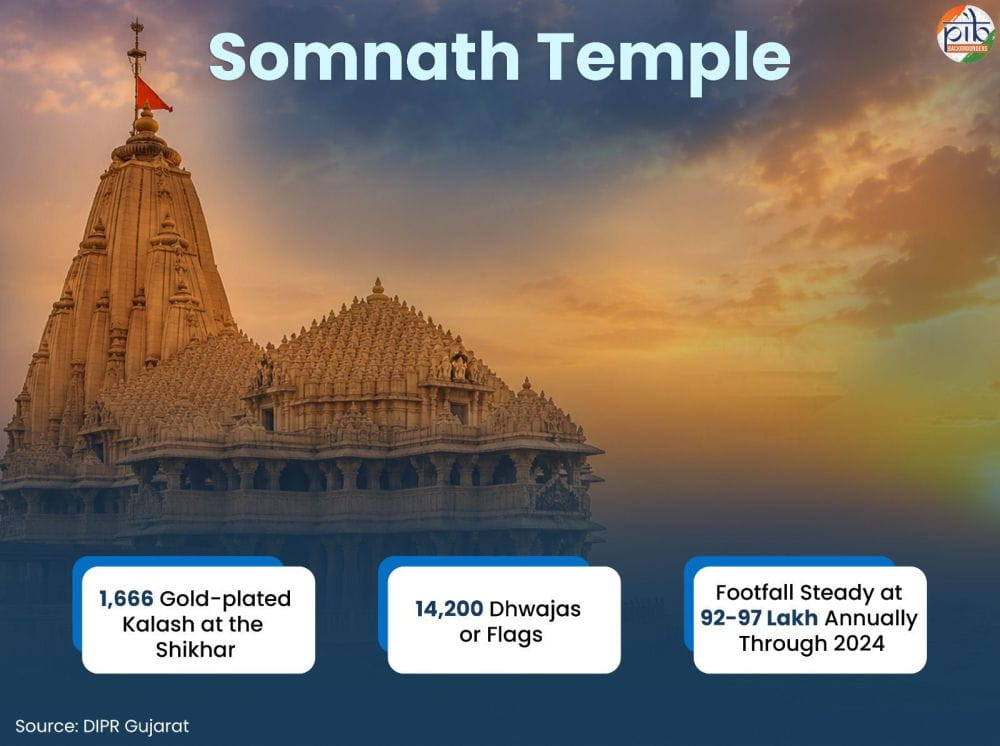
Somnath, located at Prabhas Patan along the Saurashtra coast in Gujrat, is among India’s most sacred pilgrimage centres. The temple enshrines one of the most sacred Jyotirlingas mentioned in the Shiva Purana. It is revered for the worship of Lord Shiva, Lord Krishna and Shakti.
The Dwadasha Jyotirlinga Stotram places Somnath first among the twelve Jyotirlingas. This reflects its foremost place in India’s spiritual and civilisational heritage.
Somnath temple has been repeatedly ravaged and plundered by invaders over centuries; every time devotees and rulers have rebuilt it and restored its lost glory. Somnath therefore stands as a testimony to India's unshattered faith that has risen victorious over repeated assault over centuries. It reflects the continuity of our civilisation, the depth of our faith, and the strength of our collective resolve.

Somnath, located at Prabhas Patan along the Saurashtra coast in Gujrat, is among India’s most sacred pilgrimage centres. The temple enshrines one of the most sacred Jyotirlingas mentioned in the Shiva Purana. It is revered for the worship of Lord Shiva, Lord Krishna and Shakti.
The Dwadasha Jyotirlinga Stotram places Somnath first among the twelve Jyotirlingas. This reflects its foremost place in India’s spiritual and civilisational heritage.
Somnath temple has been repeatedly ravaged and plundered by invaders over centuries; every time devotees and rulers have rebuilt it and restored its lost glory. Somnath therefore stands as a testimony to India's unshattered faith that has risen victorious over repeated assault over centuries. It reflects the continuity of our civilisation, the depth of our faith, and the strength of our collective resolve.
The Eternal Flame: Somnath Through Time and Trials
The origins of Somnath are deeply embedded in ancient Indian tradition. The site is closely linked with Lord Shiva and the worship of Chandra, the Moon God.

Over centuries, Somnath witnessed multiple phases of construction. Ancient traditions describe successive temples built using different materials, symbolising renewal and continuity.
The most turbulent phase of Somnath’s history began in the eleventh century. In January 1026, Somnath faced its first recorded attack by invaders. This marked the beginning of a long period during which the temple was repeatedly destroyed between the eleventh and eighteenth centuries.
Every time the temple was destroyed, devotees and kings came ahead to rebuild it. Prominent among these were King Kumarapala who restored the temple in the 12th Century. The King of Junagarh rebuilt it in the thirteenth century. After yet another destruction, Lokmata Ahilyabai Holkar, the Maratha queen of Indore chose to consecrate a new temple at Somnath in the eighteenth century. Thus, despite repeated destruction, Somnath never disappeared from the collective consciousness of the people.
Following Independence, Sardar Vallabhbhai Patel visited the ruins of Somnath in 1947 and resolved to rebuild the temple. His vision was rooted in the belief that the reconstruction of Somnath was essential for restoring India’s cultural confidence. Supported through public participation and national resolve, the present temple was constructed in the Kailash Mahameru Prasad architectural style.
On 11 May 1951, the temple was ceremonially consecrated by President Dr. Rajendra Prasad. 75 years later, Somnath stands rejuvenated as a symbol of national pride and spiritual endurance.
|
Veer Hamirji Gohil: Memory Beyond Chronicles The story of Somnath is shaped by brave individuals whose courage lives on through memory.
He was a regional warrior and is remembered in tradition for sacrificing his life while defending the Somnath Temple in 1299 A.D. during Zafar Khan’s invasion. He is remembered through local tradition and collective memory, rather than official historical records. His life reflects the idea of rājadharma, which means the duty to protect sacred places, society, and cultural heritage, even when victory is uncertain or support is limited. |
Somnath Swabhiman Parv
The Somnath Swabhiman Parv honours the enduring legacy of the Somnath temple. It marks one thousand years since the first recorded attack on the Somnath Temple in 1026. May 11,2026 also marks the 75th anniversary of the reopening of the Somnath Temple in 1951, when it was dedicated to the nation by India’s first President, Dr. Rajendra Prasad. He had described Somnath as a symbol of India’s spiritual strength and cultural resurgence. The reopening had marked far more than just a temple restoration. It represented the revival of India’s civilisational confidence after centuries of struggle.
The Somnath Swabhiman Parv therefore juxtaposes two significant milestones in India's history. The first milestone represents destruction. The second represents the country's deep faith and resilience in rising victorious over destruction.
Prime Minister Narendra Modi, who is also the Chairman of the Somnath Trust, will visit the Somnath Temple on 11thMay to commemorate the 75th anniversary of the temple’s reopening.

Before his visit, the Prime Minister shared his insights on the Somnath Temple. He described its journey from ruin to renewal and called it a symbol of India’s unconquerable spirit’. He paid tribute to those who preserved and rebuilt the temple over centuries. PM specially highlighted the “Vikas Bhi, Virasat Bhi”approach, which focuses on development along with heritage preservation. He also announced special pujas at Somnath for the next 1,000 days, which will honour its history. He further urged people to visit Somnath during this important period.

Earlier, in January 2026, Prime Minister Modi took part in the Somnath Swabhiman Parv celebrations at the temple on January 10-11. The event featured a 72-hour chanting of the Omkar Mantra, accompanied by sacred rituals and prayers for the nation’s welfare and prosperity. A grand Shaurya Yatra was also organised at Prabhas Patan, showcasing a symbolic procession of 108 horses in tribute to the warriors who defended Somnath through the centuries.
|
Somnath Swabhiman Parv Yatra The Somnath Swabhiman Parv Yatra, organised under the campaign “Chalo Chalein Somnath,” was flagged off from Delhi’s Safdarjung Railway Station, on 30th April 2026. The special train, carrying over 1,300 devotees, travelled to Somnath, as part of a year-long celebration marking 1,000 years of the temple’s faith and resilience. The yatra reached Somnath on 1st May, followed by a series of devotional and cultural programmes, including aarti, temple visits, and a light and sound show held over the following days. |
Somnath Temple: Grandeur, Devotion and Living Legacy
Somnath holds a sacred place as the first among the twelve Aadi Jyotirlingas of Lord Shiva. The temple complex includes the Garbhagriha, Sabha mandap and Nritya mandap. It rises in grandeur along the Arabian Sea shoreline.
The temple is crowned by a 150-foot Shikhar, topped with a 10-tonne Kalash. Its 27-foot Dhwajdand represents the temple’s enduring spiritual presence. The complex features 1,666 gold-plated Kalash and 14,200 Dhwajas, reflecting centuries of devotion and craftsmanship.
If you value our journalism, consider making a voluntary contribution to help us continue bringing news, stories and information to our readers.
Scan the QR code to contribute

Every contribution, big or small, is appreciated.
 Veer Hamirji Gohil is one such figure.