Administrator
18 June 2026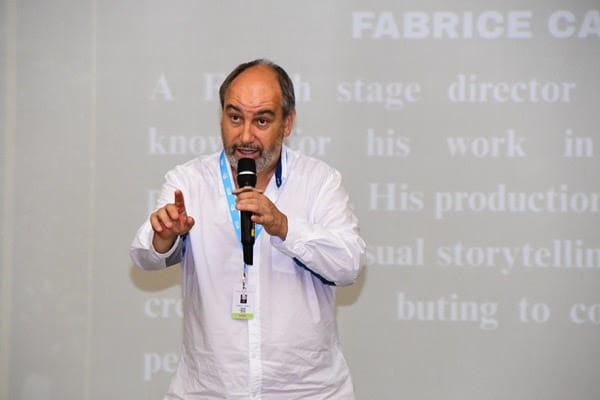
In an insightful masterclass, French theatre practitioner Fabrice Calley explored the deep connection between life, words and acting through the ideas of legendary theatre practitioner Konstantin Stanislavski. He said that acting is an attempt to recreate its full richness, where emotions emerge naturally through the different stages of human experience.
“Understand life well to act well,” Calley emphasised, explaining that Stanislavski’s approach was rooted in close observation, analysis and a deep understanding of human behaviour.
Speaking about Stanislavski’s craft, Calley highlighted his ability to create realistic scenes by studying life in detail and breaking down situations to their smallest elements.
He explained that Stanislavski found an ideal theatrical partner in Anton Chekhov, whose writings were based on situations and the subtle ways in which life reveals itself.
Calley said that creating a real scene requires a rich vocabulary because words shape perception. Giving the example of Greenland having multiple words for snow, he explained that language expands the way the mind understands the world. “Words make your mind,” he told the audience.

At the same time, Calley clarified that acting cannot depend only on words. True performance emerges from presence, observation, reaction and participation. He highlighted how Stanislavski redefined theatre by bringing greater depth and detail to the process of acting.
Through an engaging demonstration, Calley explained the importance of “active looking” and “active participation” in performance. He concluded by observing that the foundations of acting exist naturally in everyday life — “in life, we are all perfect actors.”

Fabrice Carrey is the Artistic Director of Demain le Printemps, a Franco Belarusian Soviet theatre school based on the Stanislavski System, and also Artistic Director of the International Public Association "TEATRO" in Belarus. His work is deeply rooted in the Russian/Soviet theatrical tradition and in the legacy of Konstantin Stanislavski, the Russian theatre practitioner who revolutionized 20th-century performance by pioneering a highly influential approach to actor training, preparation, and rehearsal known as Stanislavski's system. He co-founded the legendary Moscow Art Theatre in 1898. His theories on emotional truth, psychological realism, and experiential preparation laid the essential foundation for modern acting techniques, including Method Acting.
If you value our journalism, consider making a voluntary contribution to help us continue bringing news, stories and information to our readers.
Scan the QR code to contribute

Every contribution, big or small, is appreciated.