
Administrator
23 September 2026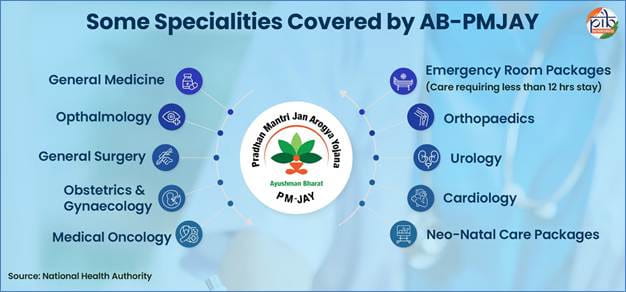
Investing in healthcare makes communities more resilient, capable, and productive. Universal health coverage is about ensuring everyone, including the most vulnerable families, gets access to affordable, quality healthcare, enabling them to live healthy and fulfilling lives.
The Government of India launched the Ayushman Bharat Pradhan-Mantri Jan Aarogya Yojana (AB PM-JAY) eight years ago on September 23, 2018, to achieve universal health coverage.
It is a public health assurance scheme and covers secondary and tertiary care. It is one of the world’s largest public healthcare schemes, with about 33% of India's population (over 48.51 crore people) already holding Ayushman cards on the scheme’s eighth launch anniversary (as of September 21, 2026).

AB-PMJAY has served people with treatment worth upto Rs. 2.03 lakh crore in about 13.25 crore hospital admissions through a network of over 38,000 empanelled public and private hospitals (as on August 31, 2026).
AB-PMJAY is one scheme under Ayushman Bharat that is promoting universal health coverage. The other schemes that are building India’s public health infrastructure are: Ayushman Aarogya Mandirs (AAM), Ayushman Bharat Digital Mission and PM-Ayushman Bharat Health Infrastructure Mission (PM-ABHIM). Led by AB-PMJAY, these four flagship schemes are strengthening India’s public health infrastructure to deliver universal health coverage.
AB PM-JAY: Saving Citizens from Medical Debt
AB PM-JAY aims to save families from catastrophic medical bills. It provides cashless healthcare services for 1,961 procedures across 27 medical specialties.

In March 2024, the government had also expanded the scheme to include about 37 lakh families of Accredited Social Health Activists (ASHAs), anganwadi workers, and anganwadi helpers. As on 21.09.26, more than 44.81 lakh Ayushman cards have been created for ASHAs/AWWs/AWHs under the scheme.
Following this, on September 11, 2024, the Government expanded the scheme to include all senior citizens aged 70 years and above, covering about 6 crore senior citizens. As on 21.09.26, more than 1.36 crore senior citizens have Ayushman Vay Vandana cards.
Empowering Vulnerable Beneficiaries
Beneficiary families are identified based on the Socio-Economic Caste Census (SECC) 2011, using defined deprivation and occupational criteria. The scheme also includes families previously covered under the Rashtriya Swasthya Bima Yojana (RSBY).
For rural areas, eligibility under AB PM-JAY is determined based on the deprivation criteria specified in the Socio-Economic and Caste Census (SECC), 2011. Eligible households include those falling under one or more of the following six criteria:
2. Urban Beneficiaries
For urban areas, the following 11 occupational categories of workers are eligible for the scheme:
3. Additional beneficiary categories covered through specific initiatives
Aiding the Ailing Elderly
Birmati, a 65-year-old woman from Haryana’s Jind district, suffered a severe fracture in her femoral neck, which connects the hip to the leg. Fortunately for her, she was able to get timely surgery and proper care worth Rs. 44,140 at a district orthopaedic and maternity hospital through the Ayushman Bharat scheme for free. The scheme has proven to be a lifeline for the economically and socially weaker sections of society, providing them with affordable, timely, quality, and accessible healthcare.
AB-PMJAY Funding Structure and Central Budgeting
AB-PMJAY is a centrally sponsored scheme. The sharing of funds between the Centre and the States is in the ratio of 60:40 for all States, except the North-Eastern States, Himachal Pradesh and Uttarakhand, and the Union Territory of Jammu & Kashmir, where the sharing ratio is 90:10. For Union Territories without a legislature, the Central Government provides 100% funding, while for Union Territories with a legislature, the Centre and the UT share the funding in the ratio of 60:40. The Union budget estimates have increased over the past few years, with a budget of Rs. 9,500 crore estimated for 2026-27.

Reducing Out-of-Pocket Health Expenditure

People are spending much less of their own money on healthcare than they used to. Government data reflects that personal health expenses have also dropped due to higher government funding and free and low-cost schemes like AB-PMJAY.
Apart from AB-PMJAY, Ayushman Bharat’s other schemes are also ensuring that people get universal health coverage.
Ayushman Arogya Mandirs: Strengthening Grassroots Primary Care

Ayushman Arogya Mandirs (AAM), the second pillar of Ayushman Bharat, make primary healthcare more accessible to people.
AAMs are community healthcare centres with medical professionals leading the frontline workers. AAMs are often upgraded from existing health centres that previously provided basic maternal and childcare services or other services.
AAMs are equipped with all the required resources, including:
AAMs go beyond maternal and child health care services. They also provide the following services: Screening and management of diseases, oral, eye, and ear-nose-throat care, and mental health support. First-level emergency and trauma care, and free essential medicines and diagnostics are also provided at these centres.
Since the Government is also expanding AYUSH (Ayurveda, Yoga and Naturopathy, Unani, Siddha, and Homeopathy) care, there are now AYUSH AAMs for people, too.

AAMs are centres for community health outreach for Community Health Workers and Accredited Social Health Activists (ASHAs). At these centres, they spread awareness of health programmes, check in on patients, and keep track of community health.
AAMs are also where citizens can connect to healthcare professionals at district, state, or national hospitals through e-Sanjeevani, which is a government-run telemedicine service.
The AAMs have recorded a cumulative footfall of over 540 crores as on date. The government is rapidly building this infrastructure.
Building Digital Health Infrastructure via ABDM
While a brick-and-mortar infrastructure forms the backbone of universal healthcare delivery, an equally robust digital public infrastructure is also essential. It helps in making healthcare delivery more seamless, efficient, and accessible. Recognising this, the Government of India launched the Ayushman Bharat Digital Mission (ABDM) in September 2021 to develop an integrated, citizen-centric national digital health ecosystem.
ABDM’s infrastructure rests on the Ayushman Bharat Health Account (ABHAs), which are digital health IDs, similar to the Aadhaar number, for every individual. People’s health records and insurance claims are integrated with the ABHA IDs. Through the ABHA IDs, individuals can connect to insurers, healthcare facilities, doctors, and other services with all their medical history intact through this one interoperable network.
As of 17 September, 2026, over 97.61 crore ABHA IDs are now operational, and over 119.95 crore health records have been linked to the accounts. Women make up 49.74% of the ABHA ID users, men 50.26%, and other genders 0.01% (as on Sept. 17, 2026). Additionally, there are over 5.78 lakh verified healthcare facilities and over 11 lakh healthcare professionals registered on the platform.
Beyond the ABHA, ABDM is a full-fledged digital health ecosystem. It brings all healthcare providers onto one single network.

PM-ABHIM: Bolstering Critical Care and Disease Surveillance
During COVID-19, the government responded swiftly through a unified, whole-of-government approach. Demonstrating a proactive commitment to transforming the national healthcare landscape across local clinics and major hospitals, the government launched the landmark PM-Ayushman Bharat Health Infrastructure Mission (PM-ABHIM) on October 25, 2021, as part of Budget 2021-22.
With a monumental budget of Rs. 64,180 crore (2021-2026), PM-ABHIM focuses on strengthening health infrastructure, bolstering disease surveillance, and expanding health research across urban and rural areas. This effort empowers India to achieve self-reliance and complete resilience in handling future health challenges.
PM-ABHIM focuses on:
Path to Universal Healthcare Coverage
AB-PMJAY expands access to quality and affordable secondary and tertiary healthcare for eligible beneficiaries, while Ayushman Aarogya Mandirs bring comprehensive primary healthcare closer to communities. ABHA (Ayushman Bharat Health Account) enables individuals to create a unique digital health identity and access their health records across participating healthcare facilities. PM-ABHIM strengthens the health system’s infrastructure and preparedness by supporting the development of health centres, laboratories, and critical care facilities from the grassroots to the district level.
Overall, these initiatives strengthen the continuum of healthcare, from primary care and digital health services to hospital-based treatment and resilient health infrastructure, advancing the goal of universal health coverage.
If you value our journalism, consider making a voluntary contribution to help us continue bringing news, stories and information to our readers.
Scan the QR code to contribute
Every contribution, big or small, is appreciated.