Administrator
06 November 2026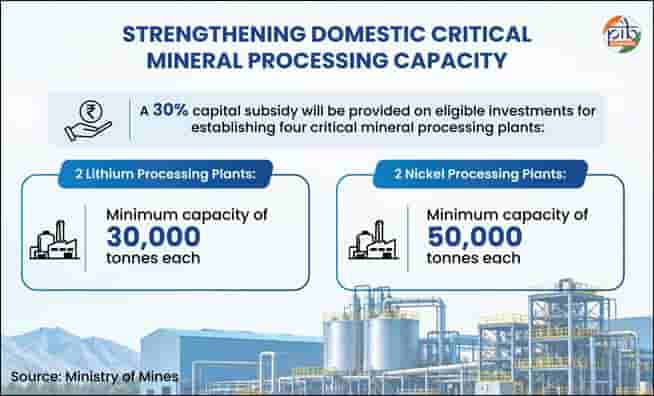
Critical minerals are essential to economic development and national security. They contribute to clean energy technologies, high-tech electronics, transport, telecommunications and defence.
Their availability is also vital to the global transition towards a low-carbon economy. Processing of these minerals remains geographically concentrated in a few countries. This exposes global supply chains to geopolitical disruptions, price volatility and potential supply restrictions. Consequently, countries identify minerals according to national priorities and take measures to secure their supply chains.
India has identified 24 critical minerals, including lithium, nickel, cobalt, graphite and rare earth elements. The country's commitment to achieving net-zero emissions by 2070 further underscores their importance. However, India's requirements for refined intermediates and high-purity materials of key minerals are met largely through imports. To strengthen India's capabilities in domestic processing and reduce external dependence, the CAPEX Support Scheme to Promote Critical Mineral Processing has been approved by the Union Cabinet on 04 November 2026.
CAPEX Support Scheme to Promote Critical Mineral Processing
The scheme provides targeted capital expenditure (CAPEX) support for establishing domestic critical mineral processing facilities. Its primary objectives are:


Financial Outlay and Support
The scheme has a total outlay of ₹2,814 crore. It will run for five years, from FY 2026-27 to FY 2030-31. The scheme offers a capital subsidy of 30% of eligible investment for setting up four processing plants. These include two Lithium plants of at least 30 kt capacity each and two Nickel plants of at least 50 kt capacity each.
Support is capped at ₹500 crore per Lithium beneficiary and ₹900 crore per Nickel beneficiary. This amounts to ₹1,000 crore for Lithium and ₹1,800 crore for Nickel, totalling ₹2,800 crore. A further ₹14 crore, or 0.5% of the outlay, is set aside for administrative expenses. The scheme will be fully funded through budgetary support from the Government of India.
Selection of Beneficiaries and Disbursement of Incentives
The scheme follows a competitive selection process. Support is then released in stages, linked to clear project milestones.
Two-Stage Selection Process
Two beneficiaries will be selected for each mineral, making four in total.
Milestone-Linked Disbursement
Incentives will be released in three tranches. Each tranche is linked to specific investment and equity milestones.
|
Tranche |
Milestone |
Cumulative Subsidy Released (% of Quoted Bid Amount) |
|
1 |
25% of committed CAPEX spent, with at least 15% of minimum required equity contributed |
25% |
|
2 |
50% of committed CAPEX spent, with at least 50% of minimum required equity contributed |
50% |
|
3 |
Plant commissioned, with 100% of minimum required equity contributed |
100% |
Timeline for Commissioning
Beneficiaries must commission the plant within three years of the Letter of Award (LoA). In any case, commissioning must be completed within five years of the LoA. If commissioning is delayed beyond three years, the remaining undisbursed CAPEX support will be subject to a tapering mechanism until the fifth year.
Governance Framework
A three-tier governance structure will oversee the scheme. It will ensure effective execution, monitoring and guidance.
|
Tier |
Body |
Key Role |
|
Apex |
Governing Council (GC), chaired by the Secretary, Ministry of Mines |
Provides strategic guidance and reviews progress. Makes final selection of beneficiaries and sanctions CAPEX support. It is also empowered to approve amendments to scheme guidelines, subject to the approval of the Union Minister of Mines. |
|
Evaluation |
Techno-Financial Committee (TFC) |
Evaluates applications on technical and financial grounds. Recommends beneficiaries to the GC. Includes technical and financial experts from R&D bodies, technical institutions and PSUs. |
|
Implementation |
Project Management Agency (PMA) |
Provides secretarial, managerial and implementation support. Carries out other tasks assigned by the Ministry of Mines. |
Why Domestic Processing Matters
Domestic processing capacity is central to India’s critical mineral security and self-reliance. The key reasons for building this capacity are outlined below:
Expected Outcomes
The scheme is expected to deliver economic and strategic benefits:
Strengthening India’s Critical Mineral Ecosystem
The scheme complements several initiatives already underway across the critical mineral value chain. Together, they now cover exploration, mining, recycling and processing.
Way Forward
The CAPEX Support Scheme to Promote Critical Mineral Processing fills a crucial gap in India’s critical mineral value chain. By supporting Lithium and Nickel processing, it will reduce import dependence and strengthen supply chain resilience. Alongside the National Critical Mineral Mission, it marks an important step towards the vision of Atmanirbhar Bharat.
If you value our journalism, consider making a voluntary contribution to help us continue bringing news, stories and information to our readers.
Scan the QR code to contribute

Every contribution, big or small, is appreciated.