Administrator
17 November 2026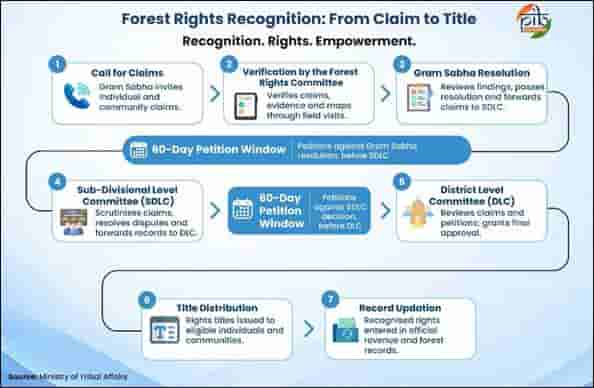
For generations, forest-dwelling communities have lived in and depended on forests for their homes and livelihood across the country, including Jharkhand.
Yet the rights of Jharkhand-based Adivasis, among many of Adivasis in India over the land they used went unrecorded when State forests were consolidated during the colonial period and after independence.
The Forest Rights Act, 2006 recognises these rights for forest-dwelling Scheduled Tribes and other traditional forest dwellers. It gives legal recognition to both individual and collective rights of these communities on forest land. The Act and its Rules provide for issuing titles to land and entering them in revenue records. The Act received the President’s assent on 29 December 2006 and came into force on 31 December 2007.
Against this backdrop, JharkhandStsteNews.com presents the Forest Rights Act,2026' objectives.
Notably, the Ministry of Tribal Affairs is the nodal agency for the Act. State Governments and Union Territory Administrations implement it. The Act is being implemented in 20 States and one Union Territory, Jammu and Kashmir.
What is a Forest Rights Title?
A title is the official document that records a forest right. It shows who holds the right, in which village, and over which land or forest, with its boundaries. Three district officers sign it for the State Government: the Divisional Forest Officer, the District Tribal Welfare Officer and the District Collector. The holder gets a certified copy. For a community title, the Gram Sabha (the village assembly) gets it. A title passes to the holder’s heirs. It cannot be sold or transferred.
Key Milestones
|
Date |
Milestone |
|
29 December 2006 |
The Scheduled Tribes and Other Traditional Forest Dwellers (Recognition of Forest Rights) Act, 2006 received the President’s assent. |
|
31 December 2007 |
The Act came into force. |
|
1 January 2008 |
The Scheduled Tribes and Other Traditional Forest Dwellers (Recognition of Forest Rights) Rules, 2008 were notified. |
|
12 July 2012 |
Comprehensive guidelines on implementing the Act were issued to State Governments and Union Territory Administrations. |
|
23 April 2015 |
Guidelines on granting Community Forest Resource rights were issued. |
|
11 February 2019 |
A direction to extend the Pradhan Mantri Kisan Samman Nidhi (PM-KISAN) to Forest Right Patta (forest rights title) holders was issued. |
|
12 September 2023 |
Guidelines for Conservation, Management and Sustainable use of Community Forest Resources (CFR) were issued. |
|
2 October 2024 |
Dharti Aaba Janjatiya Gram Utkarsh Abhiyan, a programme to close infrastructure gaps in tribal villages, was launched, with support for dedicated FRA cells at State and district levels. |
|
5 January 2026 |
Ministry guidelines on Habitat Rights for Particularly Vulnerable Tribal Groups were issued. |
|
24 June 2026 |
Ministry advisory to expedite incorporation of the Record of Forest Rights into revenue and forest records was issued. |
|
06.07.2021 14.03.2024 27.07.2026
|
The Ministry of Tribal Affairs and the Ministry of Environment, Forest and Climate Change jointly issued three advisories to enable expeditious implementation, mitigate post-claim issues and converge funds. |
Who Can Claim and What the Act Protects
The Act covers two groups. Forest-dwelling Scheduled Tribes are members of Scheduled Tribes who mainly live in forests or forest land and depend on them for their bonafide livelihood needs. Other traditional forest dwellers are those who have mainly lived in forests and depended on them for at least three generations (75 years), before 13 December 2005. Rights apply to forest land occupied before that date. For land held for a home or for cultivation, the right covers only the area actually occupied, up to four hectares.
Kinds of Rights and Titles
Three kinds of title
Individual title: for the land a family lives on or farms, up to four hectares. A married couple gets it in both their names (in the case of a single-headed household, it is registered in the name of the single head of the household).
Community forest rights title: for what a village uses together, such as grazing, fishing, water bodies and minor forest produce. The community holds the title. Any conditions are written on it.
Community forest resource title: gives the Gram Sabha or community the right to protect, regenerate, conserve and manage the forest within its customary boundary. This is the forest the village has traditionally had access to.
How a Claim Is Decided
The Gram Sabha starts the process. It is the assembly of all adult members of a village, with the full and unrestricted participation of women. The Gram Sabha elects a Forest Rights Committee of ten to fifteen members. This committee helps it receive and verify claims. At least two-thirds of the committee’s members are from Scheduled Tribes, and at least one-third are women. The Gram Sabha receives claims, verifies them and maps the land. It then passes a resolution. This resolution goes to the Sub-Divisional Level Committee (SDLC). The Act also empowers forest rights holders and the Gram Sabha to protect wildlife, forests, biodiversity and water sources.

Progress So Far
As on 31 August 2026, about 54 lakh claims had been received and 43.56 lakh (80.64%) had been disposed of, and 25.42 lakh titles had been distributed, covering nearly 238 lakh acres.

The latest State-wise data, as on 31 August 2026, shows 24.18 lakh individual and 1.24 lakh community titles.
Five States with the Most Titles Distributed, as on 31st August 2026
|
State |
Community Titles |
Individual Titles |
Total Titles |
|
Chhattisgarh |
52,636 |
4,81,432 |
5,34,068 |
|
Odisha |
9,432 |
4,64,504 |
4,73,936 |
|
Madhya Pradesh |
28,754 |
2,60,707 |
2,89,461 |
|
Telangana |
721 |
2,30,735 |
2,31,456 |
|
Andhra Pradesh |
1,822 |
2,26,667 |
2,28,489 |
|
All India (covering 20 states & 1 UT) as on 31 August 2026 |
1,24,162 |
24,18,207 |
25,42,369 |
Support for the States
Dharti Aaba Janjatiya Gram Utkarsh Abhiyan (DA-JGUA)
Under the scheme, the Ministry funds FRA cells at State and district levels for two years. These cells help settle pending claims and help the SDLC and DLC meet on time. Support also covers State FRA portals, including digital mapping of land records, servers, software and security audits. Additionally, under the Support to Tribal Research Institutes scheme, the Ministry provides ₹25 lakh per State for mapping of potential forest area.
Under DA-JGUA, the Ministry provides ₹15 lakh for each Community Forest Resource Management Plan, the plan for protecting and managing a village’s community forest, prepared by a Gram Sabha. It also provides ₹1 lakh for technical support. A joint communication of the Ministry of Tribal Affairs and the Ministry of Environment, Forest and Climate Change, dated 27 July 2026, allows these plans to be aligned with Forest Department Working Plans. These are the Forest Department’s own plans for managing forests. The Gram Sabha’s authority remains central.
In September and October 2026, the Ministry held three Regional Review Conferences, in Bengaluru, Kolkata and Srinagar, with 19 States and the Union Territory of Jammu and Kashmir. They reviewed progress and called for time-bound action plans.
Conclusion
The Forest Rights Act, 2006, gives forest-dwelling communities the legal basis to claim rights over the forests they have long lived in and protected. With 25.42 lakh titles distributed over nearly 238 lakh acres, the focus now is on three things: entering recognised rights in revenue and forest records, linking forest rights holders to livelihood schemes, and supporting Gram Sabhas to manage community forest resources.
If you value our journalism, consider making a voluntary contribution to help us continue bringing news, stories and information to our readers.
Scan the QR code to contribute

Every contribution, big or small, is appreciated.