
Administrator
14 August 2025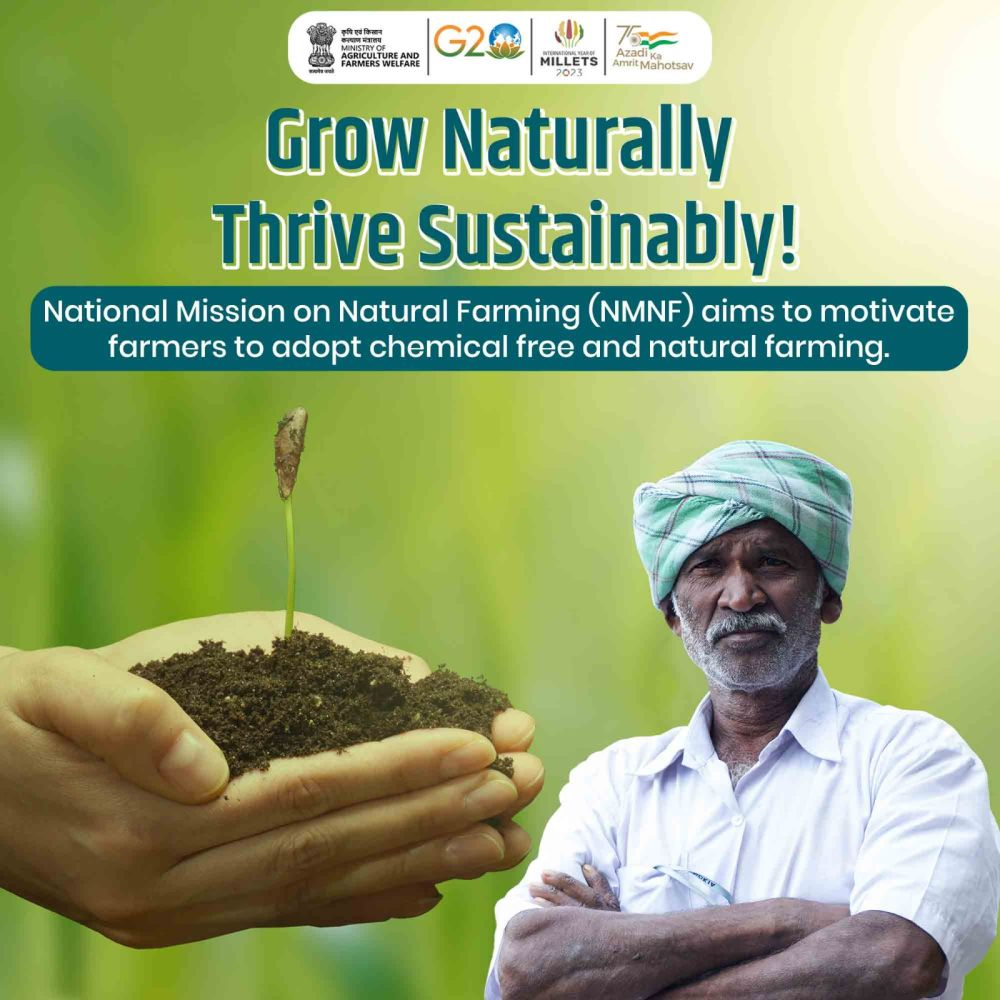
Investigations revealed that the Union Cabinet has approved the National Mission on Natural Farming (NMNF) on 25th November 2024.As a standalone Centrally Sponsored Scheme,it clearly marks a shift to strengthen agriculture practices with scientifically backed approaches towards sustainability, climate resilience and safe food.
It is aimed towards improving soil health and restoring ecosystems and reducing input cost to the farmer to achieve greater climate resilience.
The NMNF, being implemented with the proposed outlay of ₹2,481 crore (Centre’s share: ₹1,584 crore and State share: ₹897 crore), is a restructured form of the earlier Bharatiya Prakritik Krishi Paddhati (BPKP), which was implemented under the Paramparagat Krishi Vikas Yojana (PKVY) from 2020-21 to 2022-23.
The Mission has a target of initiating natural farming in 7.5 Lakh hectare (ha) area across 15,000 clusters, setting up 10,000 need-based Bio-Input Resource Centres (BRC) for easy availability of NF bio-inputs and generating awareness among 1 crore farmers on natural farming. Further, farmers are supported by a simple certification system and common national brand for naturally grown chemical free produce.
The Mission creates a favourable support ecosystem for farmers to progressively transition to Natural Farming. As natural farming is a knowledge-intensive and local agro-ecology based farming practice, it requires behavioural changes in farmers and community members.
Hence, the Mission adopts an extension strategy focussed on on-farm knowledge, which is scientifically derived from practising NF farmers’ field, and is supported with continuous hand holding of farmers. The Mission enables a decentralized cross learning ecosystemblending the traditional NF knowledge of practicing farmers and the communities with the scientific approaches evolved.

About Paramparagat Krishi Vikas Yojana (PKVY)
The Paramparagat Krishi Vikas Yojana, launched in FY 2015-16, is the first comprehensive centrally sponsored programme by the central government for the promotion of organic farming in the country. Total funds released under this programme as of December 6, 2024 are Rs. 2,170.30 crore.
Principles and Practices of Natural Farming
Natural Farming (NF) is a chemical free farming, involving livestock (preferably local breed of cow) integrated natural farming methods and diversified crop systems rooted in the Indian traditional knowledge. NF recognises the interdependence of the natural ecosystem amongst soil, water, microbiome, plants, animals, climate and human requirements.

Natural Farming principles and practices aim to enhance climate sustainability in agriculture by promoting location-specific agro-ecological practices that reduce dependency on chemical inputs and strengthen natural ecosystems. It also focuses on improving soil health and moisture content by encouraging in-situ soil organic matter generation through multi-crop systems, biomass mulching, etc. Natural farming also enhances biodiversity by fostering the presence of beneficial insects, birds and microorganisms that support natural pest control and pollination. With the improvement in soil health, natural farming practices enhance agricultural resilience, thereby helping farmers cope with extreme climate events.
Many states are already fallowing natural farming and have developed successful models. States of Andhra Pradesh, Karnataka, Himachal Pradesh, Gujarat, Uttar Pradeshand Kerala are among the leading states.
|
State |
Scheme/Initiative |
Key Features |
|
Andhra Pradesh |
Andhra Pradesh Community-Managed Natural Farming (APCNF) |
Implemented by Rythu Sadhikara Samstha, Department of Agriculture, Government of Andhra Pradesh; focuses on ecological balance and climate resilience; reduces input costs. |
|
Gujarat |
Sat Pagala Khedut Kalyaan (SPKK) and Pagala for Natural Farming (PNF) |
Implemented by the Government of Gujarat; ₹900/month subsidy for cow upkeep under SPKK; PNF provides ₹1248 subsidy for Jeevamrit kit under Gujarat Atma Nirbhar package (2020–21). |
|
Himachal Pradesh |
Prakritik Kheti Khushhal Kissan (PK3) Yojana |
Announced by the State Government in 2018–19; aims at zero-chemical farming; exceeded initial target of 500 farmers to 2,669 farmers in 2018–19; By 2019–20, 54,914 farmers adopted NF on 2,451 hectares; the target now is 20,000 hectares. |
|
Rajasthan |
Kheti Mein Jaan Toh Sashakt Kisan (Pilot Scheme) |
Launched by the State Government in 2019–20 initially in Tonk, Sirohi, and Banswada, 18,313 farmers trained; 10,658 farmers received equipment at subsidy prices (50% up to ₹600) for natural input preparation. |
Objectives of NMNF
The objectives of the NMNF are multifaceted and align with India's goals for sustainable agriculture:

These goals aim to address not just productivity but also ecological and economic sustainability in agriculture.
Features of NMNF
The scheme envisaged the formation of 15,000 natural farming clusters where each cluster shall be formed of contiguous area of about 50 ha and approximately 125 farmers. Identification of these clusters is conducted by States/UTs. New farmers can join the natural farming cluster at the beginning of each crop season.
10,000 need-based Bio-input Resource Centres will support with easy availability of NF inputs for the farmers of these clusters, thus reducing the dependency on externally purchased chemical inputs. The usage of natural inputs significantly enhances the soil fertility and promotes overall ecological balance. BRCs may be set up by practicing natural farming farmers, Primary Agriculture Credit Society/ Farmer Producer Organizations, Self Help Groups, local rural entrepreneurs etc.
Further, the scheme envisages deployment of two Krishi Sakhis/ Community Resource Persons (CRPs) in each NF cluster to guide the farmers on NF practices and to generate community wide awareness by involving Self Help Groups, Anganwadi, Gram Sabha, Krishi Vigyan Kendras, etc.
Extensive training programs on natural farming have been planned for all the stakeholders.
For the trained farmers, output-based incentive is envisaged in the scheme. This is to promote NF practices. Each farmer can initiate NF in small landholding and will be eligible for support under NMNF up to a maximum area of one acre.
All farmers, including small and marginal farmers, are eligible to avail the benefits under the NMNF. Further, the Mission Unit at Centre/ State, District and Block Level Monitoring Committees are mandated to conduct regular monitoring of farm-level indicators, farmer progression and extension of NF across all the clusters.
Real time geo-tagged & referenced monitoring of NMNF implementation shall be done through an online portal.
Krishi Vigyan Kendras
The concept of Krishi Vigyan Kendra (KVK) was framed by Professor M.S. Swaminathan, Father of Agriculture Research of India. KVKs have been functioning as a Knowledge and Resource Centre of agricultural technology supporting initiatives of the public, private and voluntary sectors for improving the agricultural economy of the district and linking the National Agricultural Research System (NARS) with the extension system and farmers.
Beejamrut
Beejamrut is an ancient organic formulation commonly used as a seed treatment in organic and natural farming in India. This low-cost formulation is primarily a product of dairy excreta (e.g., cow dung and cow urine) and forest soil, often supplemented with limestone.
Convergence and Policy Integration
For impactful outcome of the mission, convergence with various schemes of both Central and State Governments, such as the schemes of the Department of Agriculture & Farmers Welfare, Department of Rural Development, Ministry of Food Processing Industries, Ministry of Panchayati Raj, Ministry of Ayush, Ministry of Cooperation and Department of Animal Husbandry & Dairying, is envisaged.
In addition to the governments at central and state levels, convergence with existing support structures of national and international organisations is being explored for enhancing local livestock population, development of NF Model Demonstration Farms at Central Cattle Breeding Farms/ Regional Fodder Stations, providing market linkages at district/ block/ gram panchayat levels through convergence for local farmers’ markets, APMC (Agricultural Produce Market Committee) Mandis, Haats, Depots, etc. Additionally, students will be engaged in NMNF through the Rural Agricultural Work Experience (RAWE) program and dedicated Undergraduate, Postgraduate & Diploma courses on NF.
Agricultural Produce Market Committee
APMCs are state controlled markets that are setup to provide market linkages to farmers.
Progress in the Implementation of NMNF
Activities such as farmer enrollment, development of model demonstration farms, and training programshave commenced across States/UTs. The scheme guidelines were circulated on 26th December 2024 and Annual Action Plan (AAP) of 33 States/ Union Territories (UT) have been approved till March 2025. Since the approval of the scheme, in the Financial Year 2024-25, ₹177.78 lakh has been released to States/UTs as per their approved Annual Action Plans (AAPs). As on 28 March,2025, 70,021 Krishi Sakhis have been trained in soil health and natural farming practices.
Further, as of July 22, 2025:

Further, the Natural Farming Certification System is under implementation by National Centre for Organic & Natural Farming (NCONF), Ghaziabad under Participatory Guarantee System (PGS) - India. An online portal (https://naturalfarming.dac.gov.in/) has been developed for real-time monitoring of the progress of implementation of NMNF.
Initiatives by Department of Agriculture and Farmers Welfare
Conclusion
The National Mission on Natural Farming represents a transformative shift in India’s agricultural paradigm. By institutionalizing traditional, low-input farming within a modern digital and policy framework, the mission provides farmers with a viable alternative that is ecologically sound, economically viable, and socially inclusive. With strong training networks, transparent monitoring, and financial incentives, the mission is set to play a pivotal role in building a sustainable future for Indian agriculture.