Administrator
20 June 2026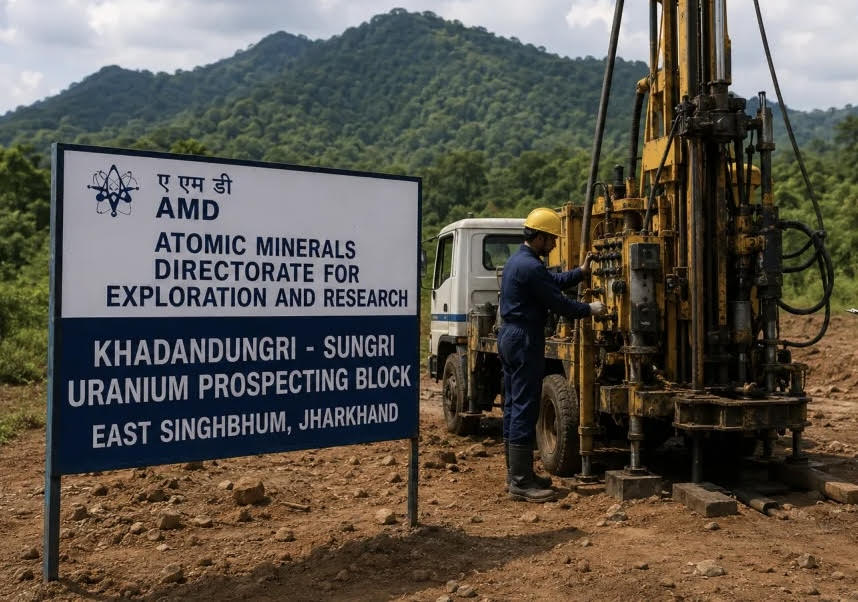
*After the New Uranium Mine was unearthed in Jharkhand’s East district, the Central Govt approved Prospecting.* Picture courtesy The Avenue Mail -avenuemail.in
Jharkhand has been witnessing Uranium mining operations actively managed nearby in Jaduguda, Musabani, and Potka in the West Singhbhum district of Jharkhand for a long.
Now, a significant new reserve of uranium has been discovered in the Khadandungri-Sungri block of the neighboring East Singhbhum district of Jharkhand.
The Uranium Corporation of India Limited (UCIL) has been mining and developing uranium for Nuclear and Atomic purpose. Prior to the discovery of Uranium, a massive deposit of 11,000 tonnes of uranium was found in the Banadungri-Simridungri area, alongside another 5,000-tonne reserve in the neighboring Rajda region.
The latest recovery of uranium mines is destined to boost India’s nuclear energy program and strategic capabilities.
The Central Government has officially granted Stage-1 approval for uranium prospecting across $0.225$ hectares of land in the region.
Out of the total designated area, $0.142$ hectares consists of forest land, while the remaining portion is agricultural land. The approval has been granted under the Forest Conservation and Development Act of 1980.
The Atomic Minerals Directorate for Exploration and Research (AMD), Regional Centre based in Khasmahal, Jamshedpur, will lead the exploration project.
The formal application for exploration was submitted by AMD Regional Director, Dr. Bhattacharya, and has now received approval from the Central authorities.
As it is, Uranium is classified as a rare metal and a strategic element crucial for powering the nation’s nuclear reactors.
Notably, unlike high-grade deposits found in Canada or Australia, which can contain up to 18 to 20% ore grade, the uranium ore in Singhbhum has been classified as very low grade.
Specific details on the Singhbhum deposits: Ore Grade: The ore extracted in Singhbhum (e.g., Jaduguda) is roughly 0.065% grade (0.065% U₃O₈, according to ResearchGate:researchgate.in.
According to official inputs, this newly discovered reserve is substantial enough to meet India’s domestic uranium requirements for the next 10 years.
The exploration plan involves drilling a total of 30 boreholes in the new block, 25 of which will be located within the forest zone. To mitigate environmental impact, the central government has laid down strict guidelines for the two-year approval window:
The executing agency, in collaboration with the state government, must plant 2,750 large trees to ensure the local ecosystem and forest cover remain unharmed.
As per a report published in Janshedpur-based English Daily- Avenue Mail- A High-Tech Surveying has to be carried forward.
The exact locations for the exploratory drilling are selected using advanced satellite imaging.
“Addressing local safety concerns, the report explicitly states that the proposed scientific methods of exploration pose no radiation threat to nearby populations or the environment.
The process involves extracting core samples using specialized 3-centimeter pipes, which are then securely transferred to specialized laboratories for testing. Once the testing is complete, the designated zone is safely restricted to prevent unauthorized access.”
This discovery marks a pivotal step forward in accelerating India’s self-reliance in nuclear power and strengthening its long-term strategic energy security.
If you value our journalism, consider making a voluntary contribution to help us continue bringing news, stories and information to our readers.
Scan the QR code to contribute

Every contribution, big or small, is appreciated.