Administrator
26 April 2026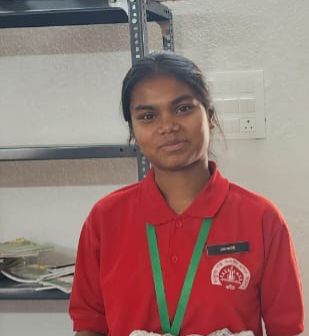
*Sandeepa Bedia
Sandeepa Kumari Bedia’s journey reflects the intersection of personal adversity and educational opportunity, offering a compelling lens into how resilience is shaped within enabling ecosystems.
Coming from a modest background—her father living with a disability and her mother working as a daily wage labourer—her path is marked by structural challenges that often limit continuity in education, especially for girls.
For Sandeepa, who is now a celebrity in Kasturba Gandhi Balika Vidyalaya, Kanke, in Ranchi district of Jharkhand, her achievement is what distinguishes her trajectory.
It is not just her academic or co-curricular ability, but her capacity to sustain aspiration despite a poor family background of economic and social constraints. In contexts where survival often takes precedence over schooling, her continued progress signals both intrinsic determination and the presence of institutional support systems that prioritize access, retention, and growth.
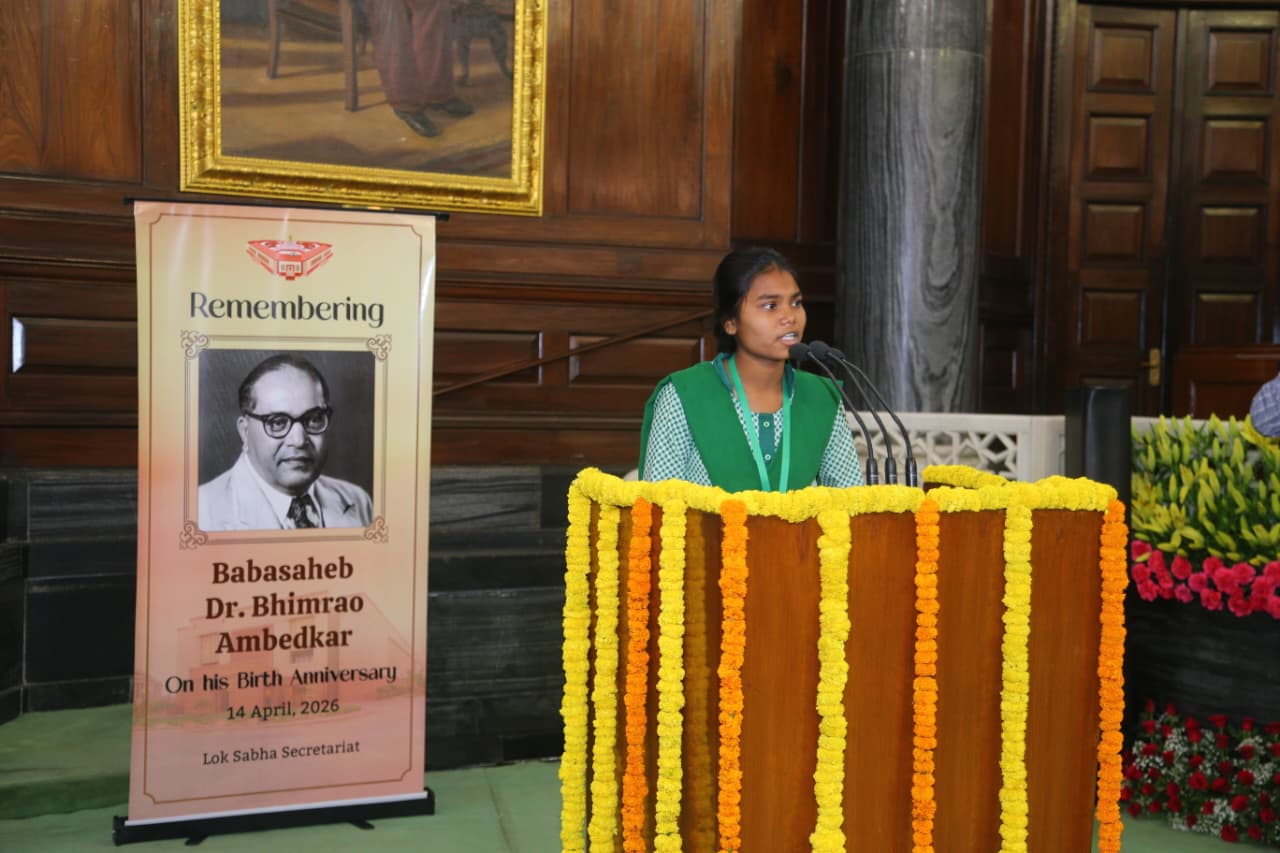
*Sandeepa Bedia speaking in the Central Hall of the (Ild) Parliament Building on the occasion of Dr.B.R. Ambedkar Birth Anniversary on the Life of Dr. B.R. Ambedkar on April 14, 2026.
A defining moment in her journey is her participation in the Ambedkar Jayanti 2026 programme. On the occasion of Ambedkar Jayanti, the event foregrounded the enduring relevance of the ideals of Dr. B. R. Ambedkar—education, equality, and empowerment. Within this framework, Sandeepa’s presence was both symbolic and substantive.
At the heart of the programme, she emerged not merely as a participant but as a representative of these ideals in action. Her journey—rooted in hardship yet driven by ambition and opportunity provided by the KGBV, a residential school of the Government of India with the fund shared on 60:40 ratio by the former and the state government respectively, where education, food, uniform and hostel were provided free of cost with a stipend of Rs 100 per month to every student —became a lived example of how education can alter life trajectories.
Sandeepa Bedia’s stage presence inside the (Old)Lok Sabha Hall marked more than personal achievement; it signified the visibility of voices that are often underrepresented.
Her participation underscored the role of the school as a nurturing and enabling space. It highlighted how structured environments can cultivate confidence, articulation, and leadership among young girls. Through her expression, she conveyed perseverance, the value of education, and a clear belief that circumstances do not define one’s future.
Analytically, this moment is significant because it situates her personal narrative within a larger ideological framework. The programme effectively connected her journey with Dr. Ambedkar’s vision—demonstrating how education continues to function as a tool for dignity, mobility, and social transformation. Her living story, therefore, moves beyond individual success and becomes part of a broader discourse on equity and empowerment.
From a gender and social perspective, Sandeepa’s visibility challenges entrenched norms. In many similar socio-economic contexts, girls face early withdrawal from education or pressures of early marriage. Her progression reflects a shift in these patterns, supported by institutional intervention and evolving aspirations.
Her story also highlights key enabling factors:
• Continuity of Education: Access to a stable learning environment that offsets economic uncertainty
• Aspirational Exposure: Opportunities to participate, perform, and be recognized beyond the classroom
• Reinforced Resilience: A system that not only acknowledges effort but actively nurtures it
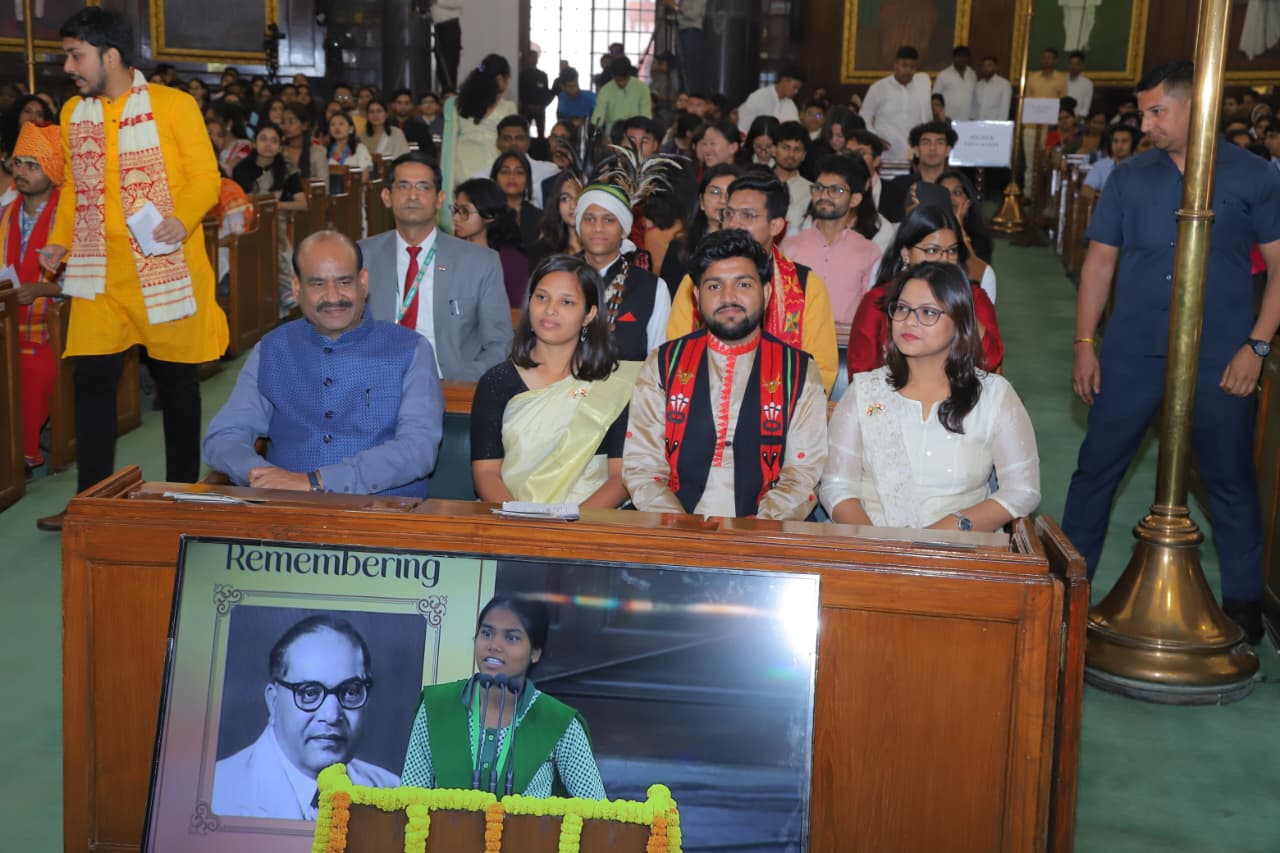
*Sandeepa Bedia spoke while dignitaries such as Honourable Speaker Om Birla heard her and later appreciated and wished her a successful life.
The conclusion of the programme—marked by hope and purpose—reinforced a critical message: that individual achievement, when supported by the right ecosystem, contributes to collective social change. Sandeepa’s journey thus stands as both inspiration and evidence—illustrating how equitable access to education can unlock potential that might otherwise remain unrealized.
In essence, her story is not only about overcoming adversity, but about redefining possibility. It reflects how opportunity, when sustained, transforms not just individuals but the narratives of entire communities. This, however, raises a fundamental question about her fate.
“Her poor father is a person with disability. Mother is illiterate and ekks out a living by selling her labour. Sangeeta is meritorious. No doubt about it…However,I don’t know where these talented girls like her will go after completing Class XII”, cribbed Anjali Ganguli, Principal of KGBV, Kanke in Ranchi district of Jharkhand, as tears rolled down her eyes inside her chamber.
*SUGGESTION: The government should formulate and implement a new scheme facilitating Campus selection for skill development on a scholarship basis, focusing on identifying meritorious students to receive specialized, industry-relevant training, to bridge the gap between academic knowledge and corporate requirements. The scheme may involve partnerships between educational institutions, government bodies, and corporations to enhance the employability of these poor girls students. Editor
If you value our journalism, consider making a voluntary contribution to help us continue bringing news, stories and information to our readers.
Scan the QR code to contribute

Every contribution, big or small, is appreciated.