Administrator
18 May 2026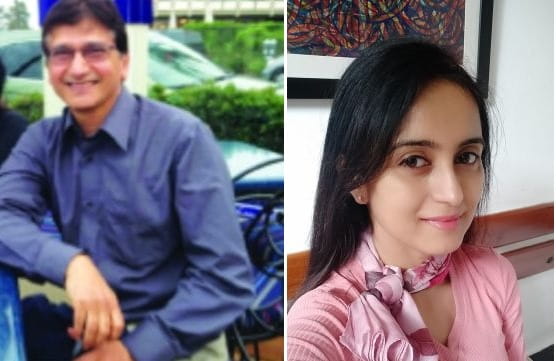
(L) Dr. Shivendu (R) Smita Dey Tarafder
His professional journey is worth a study for students who aspire to become ‘achievers’ in life.
A study conducted by JharkhandStateNews.com revealed that Dr.Shivendu’s professional career began in public service. After studying at Indian Institute of Technology,Kanpur and Indian Institute of Management, Ahmedabad, he joined the Indian Administrative Service in the Bihar turned Jharkhand cadre. For many Indians, the IAS represents one of the most prestigious careers imaginable in India.
But even while working in governance, Shivendu felt drawn toward a different kind of challenge. He was fascinated by inquiry. By asking questions that had no simple and obvious answers.That curiosity eventually led him to quit the IAS and pursue a PhD in economics at the University of Southern California.
In 2008, he made a decision that surprised many colleagues around him. He quit and stepped away from the IAS and moved fully into academia.
Today, he serves as a tenured Professor at the University of South Florida, researching the economics of emerging technologies including artificial intelligence, blockchain, and cybersecurity.Over years of teaching, he began noticing a troubling pattern. Students were working extremely hard. Yet many had no clear way to know if they were actually improving.Result?
Dr.Shivendu together with his wife and Mridula Sinha, IAS ( R),along with Arun Reddy established the startup “Globus Learn Corp.based in Tampa Florida. They have an associate company in India, Globus Learn Services India Pvt. LTD. based in Chandigarh.
Now, they have come up with two digital products: Prepzy (https://prepzy.ai) and Global R-Hub (https://globalrhub.org). In fact, these two are highly useful education platforms, Prepzy and Global R-Hub, each going viral across the world.
These two digital-education platforms were built by Dr. S. Shivendu, Arun Reddy and Mridula Sinha. Their shared goal is ambitious. They want to change how students learn, how they measure progress, and how early they begin exploring ideas that shape their future.
Smita Dey Tarafder,a reputed Content Writer, representing JharkhandStateNews.com interviewed him. In reply to her question, Dr.Shuvendu said,”You cannot fix a gap if you cannot see it.”
Excerpts of Smita Dey Tarafder- Dr.Shivendu questions - answers are as follows.
1. Origins & Formation
• Shivendu, your trajectory—from IIT to IIM to IAS and then academia and now along with that founding an edtech startup—suggests a constant pursuit of challenges and complexity. What were you really seeking at each stage?
My journey isn't a series of career changes; it is a continuous quest to solve increasingly complex problems. At each pivot, I wasn't running from a field, but toward a larger lever of impact. This path was illuminated by three pillars: my mother, a postgraduate who devoted herself to our mentorship; my father, who traveled to the US in the 1940s for his PhD and became a renowned professor; and my spouse, a top-ranking IAS officer and my guiding light for 35 years.
In my early years at IIT and IIM, I sought agency—the cognitive tools to transcend the geographic limits of my youth. Entering the IAS shifted my focus to systemic impact. Navigating the friction of public service taught me a vital lesson: policy is only as powerful as the systems that deliver it.
Transitioning to academia allowed me to master the intellectual truths of the digital economy. Now, with Prepzy.ai, I am seeking synthesis. We are building a digital bridge to democratize elite mentorship, ensuring a child’s potential is never dictated by their geography. My goal is to ensure that a student starting where I did doesn't need a "miracle" to succeed, but rather a system designed to help them thrive.
1. Inside the State
• Shivendu, during your tenure in public health administration, what structural gaps stood out most sharply?
In public health sector in Jharkhand, the sharpest gap was the disconnect between high-level policy and field or village-level reality. We had the right intent, but "last-mile delivery" failed because field level doctors and public health local workers lacked resources, real-time guidance and tools. I realized that great policy is effective only with a reliable system to deliver services to those who need it most—a gap I am now closing with technology.
• For both: Is the Indian administrative system fundamentally constrained, or is it a question of leadership within it?
The system has constraints, but the deeper issue is a growing crisis of leadership. True leadership requires intellectual and financial integrity, fairness, and genuine respect for fellow citizens. When these values fade, the sense of service disappears.
This crisis has led to a demotivated civil service that lacks interest and commitment. More dangerously, it has broken the public’s trust. A system can only function when the people believe it works for them. Without leaders who lead by example and value every citizen, even the best-designed administrative system will remain ineffective.
1. Transition & Reinvention
• Shivendu, your move to academia marks a shift from execution to interpretation. What questions were you unable to answer while inside the system?
What often times puzzled me was the 'choice' at the heart of public service. I saw gifted individuals with the rare opportunity to change millions of lives, yet manytimes those opportunities were lost to short-term personal gains or the pressures of ego.
I wanted to understand the incentives that drive these choices. This curiosity led me to a PhD in Economics. By studying “Theory of Incentives and Mechanism Design,' I wanted to learn how to build better systems—ones public service goals with the greater good of the people.
1. Technology, Trust & Systems
• Shivendu, your work on blockchain and digital systems often centres on trust. Do you see technology as replacing institutional trust or reinforcing it?
I see technology as a way to reinforce and rebuild trust, rather than replace it. In many administrative systems, trust is fragile because it depends on a single person or office to do the right thing behind closed doors.
Take, for example, a public land registry. Instead of relying only on a physical ledger that can be lost or altered, a blockchain-based system creates a transparent, permanent record that everyone can verify. Technology takes the 'guesswork' out of trust, making the system transparent and verifiable.
1. Power, Scrutiny & Narrative
• Shivendu, public service often involves navigating both impact and controversy. How do you interpret the gap between intent, outcome, and public perception?
Public perception is the foundation of trust in our administrative system. While perception is shaped by how an officer communicates and behaves, the root cause of a negative image is often a lack of genuine intent. If the intent is hollow, no amount of polished communication can hide it.
For example, when an officer appears overly subservient to the political executive rather than standing for the rule of law, the public loses faith. This conduct creates a perception of bias, leading people to believe the system serves a few rather than the many, which ultimately diminishes trust in the entire institution."
1. Partnership as a System
• You’ve both operated within high-stakes systems. How has your partnership influenced your decision-making frameworks?
• Shivendu, how has working alongside someone with a similar administrative background shaped your thinking?
Our partnership has taught us that the most durable decisions aren't made through authority, but through shared understanding. We’ve learned the futility of the 'my way or the highway' approach; it only creates resistance.
Instead, we focus on listening to all stakeholders and engaging in non-confrontational dialogue. The goal is to communicate one's view not as an order from the top, but as a stakeholder with shared benefits and costs. By moving away from 'win-lose' scenarios and creating a win-win narrative, we’ve found that you can turn potential conflict into collective shared win.
1. Building in the Present
• What motivated your shift toward education and new-age institutional ventures?
• What problem are you trying to solve today that feels more meaningful than your earlier roles?
I realized that most EdTech today is just a 'digital library' of videos—students are passive spectators and not active learners. This approach is inefficient as well as effective. My shift to EdTech was motivated by the desire to move from using technology from content delivery to integrating it into pedagogy.
I wanted to use my professional experience in public administration, deep understanding of theory of incentives, research in Information Systems, and classroom experiences as a professor to build a 'Self-Adaptive Learning to Mastery' (SAL-M) framework. This isn't just about watching a screen; it’s about using digital technology and AI to create an active, personalized path for learning and academic success for every student."
In the IAS, I managed systems; in academia, I studied them. Today, as founders of Prepzy.ai we are solving the problem of delivery of 'Last Mile' of learning. While others provide content, Prepzy.ai provides digital scaffolding—structured support that adapts to a student's unique gaps in real-time. It feels more meaningful because we are democratizing elite-level personal tutoring or mentorship.
We are ensuring that a student in a remote village has the same high-quality, research-backed path to mastery as a privileged student in a top-tier city.
1. India vs Global Systems
• Shivendu, what contrasts stand out most between governance systems in India and institutional frameworks in the US?
The contrast lies in the architecture of power. In the US, governance is built on a consultative and participative foundation where institutions—from local boards to federal agencies—are designed to demand and enforce accountability. It is a system that invites stakeholders into the room making decision-making a shared process rather than a top-down command. System empowers citizens not just the decision makers.
Equally critical is the rigorous system of checks and balances. Unlike frameworks where authority can become concentrated, the US model ensures that no single individual or office can play an "all-powerful" role. Every exercise of power is met with a countermeasure, ensuring that the system remains larger than the person within it. This institutionalized "fair play" creates a level of stability and trust that is essential for long-term growth.
1. Legacy & Continuity
• At this stage of your journey, do you think more in terms of scale, impact, or legacy?
• What would you want your work—across public service, academia, and enterprise—to ultimately represent?
At this stage, I don’t see scale, impact, and legacy as separate goals; they are the result of a single pursuit: The Democratization of Opportunities. I want my work to represent a bridge that connects every child’s innate potential to a real pathway for success.
Across public service, academia, and now Prepzy.ai, my goal has been to ensure that high-level expertise is not a luxury for the few, but a system available to the many. I want to be remembered for building an "Equalizer”a research based cutting edge technology artifact that proves that the socio-economic status of a child should never be a barrier to achieving their true potential.
Ultimately, I want my journey to show that while one person’s "miracle" story is inspiring, a system that creates thousands of such stories is what truly changes the world. My legacy won't be the positions I held, but the doors I helped open for others.
1. Closing
• If you had to define your life’s work not by roles but by an idea, what would that idea be?
My life’s work is the idea that every person, a child or an adult, deserves a bridge from their innate potential to their purpose. I have spent my journey trying to turn the 'miracle' of my own path into a reliable system that opens those same doors for others.
If you value our journalism, consider making a voluntary contribution to help us continue bringing news, stories and information to our readers.
Scan the QR code to contribute

Every contribution, big or small, is appreciated.