Administrator
26 May 2026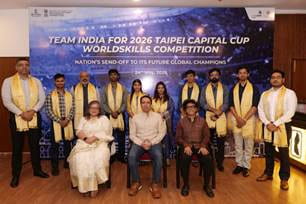
Indian contingent departed on Monday. They will participate in the international vocational and technical skills competition, 2026 called Taipei Capital Cup WorldSkills Invitational Tournament, being held in Taipei, Taiwan, from 26–28 May 2026.
The five-member Indian contingent, the future global champions, will compete with participants from around 15 countries in the tournament organised as a warm-up event ahead of WorldSkills Shanghai 2026.
The competition promotes global skills development, technical excellence, international collaboration, and workforce innovation while helping participants gain real-world competitive experience at an international level.
The occasion was attended by Smt. Debashree Mukherjee, Secretary, Ministry of Skill Development and Entrepreneurship (MSDE), and Shri Arunkumar Pillai, Chief Executive Officer, National Skill Development Corporation (NSDC), along with senior officials from the Ministry and NSDC.
India will compete in five skill categories at the 2026 Taipei Capital Cup WorldSkills Competition, with Arjun Sumathi Vijayabashkar representing the country in Mobile Applications Development, Mohamed Mafaz Poonaikannan Rabi Ahamed in Software Applications Development, Muskan in Painting & Decorating, Md Seraj in Automobile Technology, and Suresh Kumar Ganesan Meena in Digital Construction. The contingent comprises gold medal winners from the IndiaSkills National Competition 2025–26, along with candidates selected through the wildcard entry process.


This year’s edition of the competition features 10 skill categories spanning critical sectors linked to smart manufacturing and digital transformation, including Industrial Mechanics, IT Network Systems Administration, Mobile Applications Development, Industry 4.0, Automobile Technology, and Digital Construction (BIM).
India’s participation in the tournament marks an important step in the country’s preparation journey towards the 48th WorldSkills Shanghai 2026. The competition will provide Team India with early exposure to international standards and act as a crucial warm-up platform ahead of the global competition, enabling competitors to sharpen their technical skills and adapt to international standards of excellence.
If you value our journalism, consider making a voluntary contribution to help us continue bringing news, stories and information to our readers.
Scan the QR code to contribute

Every contribution, big or small, is appreciated.