Administrator
19 June 2026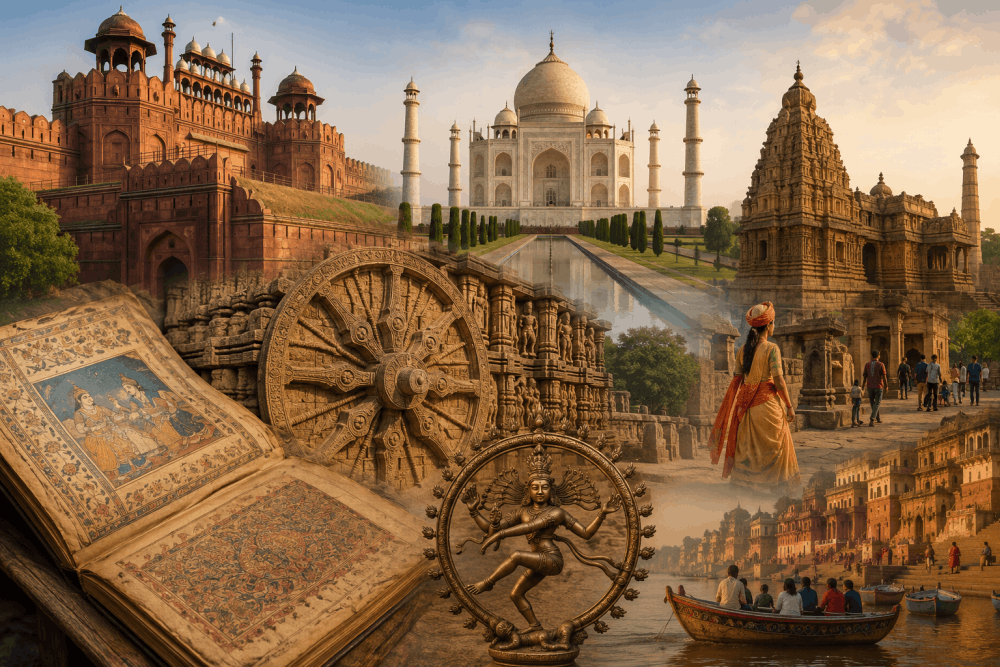
India’s cultural landscape includes monuments, antiquities, manuscripts, and historic sites. They are not just remnants of the past, but represent shared memory and continuity across generations.
Since 2014, the government has launched several initiatives to preserve and promote these cultural assets. The government has also focused on linking heritage development with economic growth while strengthening India's global cultural identity. In addition, heritage conservation has increasingly been integrated with tourism, livelihoods, and cultural diplomacy.
Adopt a Heritage
Launched in September 2017 and revamped in September 2023, the Adopt a Heritage 2.0 programme creates a framework for collaboration with private companies, public sector units, NGOs, trusts, and societies. It focuses on developing and maintaining visitor-friendly amenities at Protected Monuments of National Importance. Support is provided through Corporate Social Responsibility (CSR) and other contributions. The aim is to improve the visitor experience.

As on March 2026, a total of 30 Memorandums of Understanding (MoUs) have been signed under the Adopt a Heritage 2.0 programme.
The programme is already demonstrating visible outcomes in terms of improved site management and enhanced public engagement. This is reflected in strong visitor participation at adopted monuments, which collectively recorded a total footfall of 13.59 million visitors during FY 2024–25.
These figures indicate strong visitor interest and suggest that improved amenities, services, and on-site facilitation under the programme are contributing to better visitor experience and higher engagement at adopted heritage sites.
Pilgrimage Rejuvenation and Spiritual, Heritage Augmentation Drive (PRASHAD)
The PRASHAD scheme was launched in January 2015. The scheme develops pilgrimage and heritage tourism destinations across India. It improves infrastructure, sanitation, safety, and visitor facilities.
Key Achievements:
IIM Rohtak in its 2021 report "Evaluation of Central Sector Scheme PRASHAD" underlined the achievements of the scheme. It mentioned that the scheme has helped in increasing the visitor satisfaction, ease of travel and aesthetical aspects of the selected heritage sites. Also, the report mentioned that the scheme has led to increase in the positive overall visitor user experience.
Swadesh Darshan 1.0
Launched in 2014–15, Swadesh Darshan was the flagship scheme for integrated development of tourism infrastructure across thematic tourist circuits. The scheme focused on developing integrated tourism circuits covering heritage, spiritual, coastal, desert, Buddhist, tribal and eco-tourism destinations.
Swadesh Darshan was revamped as Swadesh Darshan 2.0to move beyond circuit-based development and adopt a destination-centric approach. The scheme now focuses on developing sustainable, responsible and globally competitive tourism destinations that provide high-quality visitor experiences.
Challenge Based Destination Development (CBDD)
Introduced under Swadesh Darshan 2.0 in March 2024, Challenge Based Destination Development (CBDD)promotes tourism development through a competitive, challenge-based framework. The initiative seeks to transform destinations into sustainable tourism hubs through holistic planning, innovation and community participation.
Archaeology and Monument Preservation
Archaeological Survey of India (ASI)
The Archaeological Survey of India (ASI) is the premier organisation responsible for archaeological research and conservation of India’s cultural heritage. ASI carries out its functions through a network of around 38 Circles, which serve as regional administrative units.

As on April 2026, India has 3,686 centrally protected monuments under ASI.
For the year 2024–25, around ₹374 crore was allocated by the government for conservation and maintenance of protected monuments.
National Mission on Monuments and Antiquities (NMMA)
The National Mission on Monuments and Antiquities is implemented under ASI. It plays a crucial role in supporting conservation by building a reliable national database of India’s built heritage and antiquities. The Mission aims to document and create an inventory of all monuments and antiquities in the country, information that directly informs planning, prioritisation and monitoring of conservation work.

HRIDAY Scheme
The Heritage City Development and Augmentation Yojana (HRIDAY) was launched in January 2015. A central sector scheme, it aimed at integrating urban development with heritage conservation. The focus was on preserving the unique character of heritage cities while improving basic infrastructure.
Special attention was given to sanitation, security, tourism, and livelihoods, while retaining the cultural identity of each city.
The scheme was implemented in 12 cities across India.
Overall, the scheme positively impacted the quality of life for residents and boosted tourism.
The mission period of the scheme ended on 31 March 2019.
|
Major Heritage Sites Redevloped
|
|
|
|
The Ram Mandir in Ayodhya, consecrated in January 2024, is supported by large-scale urban development. The city is evolving into a major spiritual destination with improved connectivity and infrastructure.
|
|
These initiatives have strengthened infrastructure at major heritage and pilgrimage sites. Accessibility and visitor experience have improved significantly. They have also contributed to the growth of spiritual and cultural tourism across the country.
Preserving Heritage Through Diplomacy and Determination
Over centuries, many sacred relics and antiquities of great religious and historical importance were taken abroad during colonial rule and foreign occupations. Additionally, many of these artefacts were lost due to illegal trafficking. Over the last 12 years, the government has intensified its efforts to reclaim these sacred relics and artefacts.
Repatriation of Sacred Relics
Major repatriation achievements include:
Sacred and cultural objects have also been returned from Australia, USA, UK, Germany, Singapore and Canada.
Global Exposition of Sacred Relics
India expanded international exposition of sacred Buddha relics to strengthen cultural and civilisational ties.
Domestic exhibitions were also organised in New Delhiand Ladakh in 2026, showcasing the reunited Piprahwa relics.
Repatriation of Antiquities
The repatriation of cultural artefacts has been significantly strengthened in recent years to restore India’s stolen heritage. As on May 2026, a total of 653 antiquities have been retrieved since 2014.

In the last five years itself, 613 cultural artefacts have been brought back to India, reflecting a major acceleration in recovery efforts.
Further, 11 objects with verified origins have been handed over to concerned organisations and institutions. 9 objectshave been given on loan to the Indira Gandhi National Centre for the Arts (IGNCA) for display. 1 object has been given to the National Museum, while 14 objects have been allotted to the Indian Institute of Heritage.
Museums and Cultural Infrastructure
Museum Grant Scheme
Museum Grant Scheme provides financial assistance for setting up new museums and for strengthening and modernising existing ones at regional, state, and district levels. It also supports digitisation of art objects and training of museum professionals. Since 2014, the government increasingly promoted immersive museum formats instead of static display only models. This included virtual and theme-based museums and Virtual Experiential Museums (VEM).
India’s First Archaeological Experiential Museum
Established in January, 2025, the Archaeological Experiential Museum at Vadnagar, Gujrat is the only museum in the world which offers an immersive archaeological experience. The museum has been developed at a total cost of ₹298 crore and spans an area of 12,500 square meters.
The museum showcases more than 5,000 artifacts, and also displays organic remains such as food grains, DNA samples, and skeletal remains.
A major highlight is the 4,000-square-meter open excavation site, where archaeological remains are visible at depths of 16–18 meters. An experiential walkway allows visitors to directly observe and understand the excavation process and findings.
|
Yuge Yugeen Bharat National Museum The Yuge Yugeen (The timeless and eternal India) Bharat National Museum is being developed as a landmark institution in New Delhi. It will be housed in the historic North and South Blocks under the Central Vista Redevelopment Project. Spread over 1,54,000 square metres, it will present India’s civilisational and cultural journey spanning thousands of years. |
UNESCO and Global Heritage Recognition
India has significantly expanded its global heritage recognition over the past decade.
India now has 44 UNESCO World Heritage Sites.
India’s UNESCO recognition now reflects both tangible monuments and living cultural traditions.
Key intangible heritage recognitions include Yoga, Kumbh Mela, Deepawali, Durga Puja, and Garba.
These recognitions have strengthened India’s global cultural diplomacy and heritage leadership.

Digitisation and Knowledge Preservation
Digitisation of Cultural Heritage (Gyan Bharatam)
The Gyan Bharatam Mission, launched in 2025, is the government’s flagship initiative aimed at preserving, digitising, and disseminating India’s vast manuscript heritage. It focuses on preserving ancient knowledge systems recorded in manuscripts. It also makes them accessible for research and public engagement through digital repositories and conservation networks.
The initiative further integrates modern technologies to safeguard these fragile manuscripts and ensure they are globally accessible.
Additionally, the National Manuscript Survey was also launched in March 2026 for identifying, documenting and creating a comprehensive national database of manuscripts.
Technology-Supported Conservation
Modern technologies/tools are being used as per requirements for proper documentation. These include Light Detection and Ranging (LiDAR) scanning, Geographic Information System (GIS) based mapping and drone-based surveys etc. In parallel, India has expanded the application of digital and spatial technologies that support accurate recording and proactive conservation planning.
In addition to these technologies, the government has begun integrating Artificial Intelligence (AI) within the broader cultural and heritage ecosystem, particularly in areas such as digitisation, documentation, and accessibility of cultural assets. AI-enabled platforms are being used to process and organise large volumes of heritage data, including manuscripts and cultural knowledge systems.
|
Preserving Culture through Technology India is using AI to preserve languages, manuscripts, and cultural heritage while improving access to education and public services.
|
Vedic Heritage Portal
The Government launched the Vedic Heritage Portal in March 2023 under the Indira Gandhi National Centre for the Arts. In the portal, India’s ancient Vedic knowledge traditions have been systematically preserved, documented, and made accessible to scholars, practitioners, and the wider public. The portal serves as a national digital repository of Vedic heritage, covering the Rigveda, Yajurveda, Samaveda, and Atharvaveda traditions. It includes extensive audio-visual material, manuscripts, and ritual documentation, with more than 500 hours of recordings integrated into the platform, along with digital learning modules and recitation archives. It also documents Vedic recensions (Shakhas) and oral traditions, strengthening efforts to preserve living knowledge systems. This initiative gains further global significance as the Tradition of Vedic Chanting has been recognised by UNESCO as Intangible Cultural Heritage, while Rigveda manuscripts are included in UNESCO’s Memory of the World Register, underscoring their universal cultural value.
Film and Audio-Visual Heritage
National Film Heritage Mission (NFHM)
In 2015, the government launched the National Film Heritage Mission which aims to preserve, digitize, and restore India’s cinematic heritage.
The mission supports filmmakers across all Indian languages. It safeguards classic feature films, short films, and documentaries, thereby preserving India’s cinematic heritage for future generations.
As of December 2025, 1,469 titles, equalling 4.3 lakh minutes of films have been digitised. These include features, short films and documentaries. The digitised and restored films are maintained by National Film Archives of India (NFAI) and are accessible through its official website on an on-demand basis.
National Museum of Indian Cinema (NMIC)
The National Museum of Indian Cinema (NMIC) was inaugurated in 2019 at a cost of ₹140.61 crore. It has strengthened the preservation and promotion of India’s cinematic heritage.
Located in Mumbai at the Films Division campus, including the restored 19th century Gulshan Mahal (ASI heritage building).
The museum presents the journey of over a century of Indian cinema. This is done through artefacts, vintage film equipment, photographs, memorabilia, interactive exhibits, and multimedia displays. The exhibits showcase the evolution of Indian cinema from the silent era to the present day.
The museum has also witnessed strong public engagement. It recorded over 17,000 visitors in May 2026, emerging as a key cultural and tourist destination in Mumbai.
Synthesis of Achievements
Since 2014, the Government has pursued a focused and sustained approach to heritage conservation anchored in the philosophy of “Vikas Bhi, Virasat Bhi.” This vision has helped transform heritage from a passive archive of the past into an active pillar of national identity, pride, and global engagement.
Over this period, India has strengthened its institutional and technical capacity for conservation, documentation, and restoration of both tangible and intangible cultural heritage. At the same time, heritage-led development has improved visitor experience and connectivity at key cultural and pilgrimage sites, integrating them more closely with India’s broader development journey.
India’s cultural footprint on the global stage has also expanded, reflected in its growing recognition as a custodian of one of the world’s richest civilisational traditions. Alongside this, sustained efforts have brought back important antiquities, reaffirming the principle that cultural heritage is not only to be preserved, but also to be reclaimed.
Taken together, these efforts reflect more than a policy direction. They represent a civilisational commitment—of a nation steadily reconnecting with its roots, strengthening its cultural confidence, and carrying forward its heritage as a source of identity, continuity, and global engagement.
If you value our journalism, consider making a voluntary contribution to help us continue bringing news, stories and information to our readers.
Scan the QR code to contribute

Every contribution, big or small, is appreciated.