Administrator
02 July 2026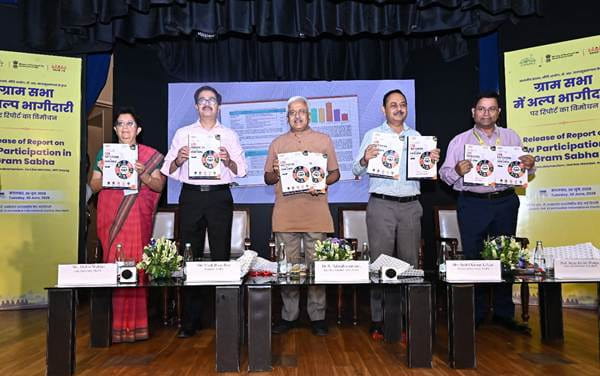
Unlike many states and UTs where Gram Sabha meetings were not popular, Jharkhand showed high and active participation by Gram Sabha members.
The credit for this goes to the origin of Gram Sabha for the village-level administration in the ancient history of Adivasis in Jharkhand.
This fact was brought to light and disclosed by the National Study Report on “Low Participation in Gram Sabha across States and Union Territories”. It was released by Dr. R. Balasubramaniam, Member, NITI Aayog.
For details, click here. To know about the findings of this two -volume report ( being provided here below) on Jharkhand Gram Sabha, click 1. here.
1.https://drive.google.com/file/d/1r7mrTVSnqdkQJms6L6GLnSwFlmZN-Xhm/view
2.https://drive.google.com/file/d/1E2K39Qk8W5U_CjbF0UJJhmYy-j2jJXEP/view
The release of this significant report was made on Wednesday (July 1, 2026) in the presence of the Secretary, Ministry of Panchayati Raj, Shri Vivek Bhardwaj. Several senior officers of the Ministry, NIRD&PR, along with academicians, researchers, and various Panchayati Raj stakeholders, were present in New Delhi.
The report has been prepared by the National Institute of Rural Development and Panchayati Raj (NIRD&PR) for the Ministry of Panchayati Raj to assess the factors influencing public participation in Gram Sabha meetings and identify measures to strengthen citizen engagement in grassroots governance.
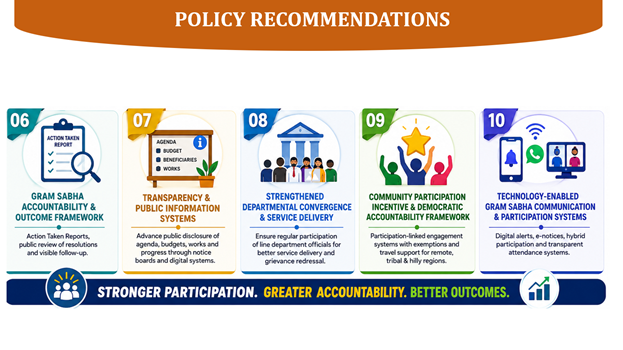
The two-volume report analyses the barriers to effective participation in Gram Sabhas and puts forward evidence-based policy recommendations and strategic directions.
It provides actionable inputs for strengthening policy frameworks, reinforcing institutional mechanisms, and promoting meaningful citizen participation in Gram Sabhas. It also gives a State/UT wise account of the factors affecting the Gram Sabha participation and the way forward while highlighting the best practices for enhancing Gram Sabha participation from 10 States.
Dr. Anjan Kumar Bhanja, Associate Professor, NIRD&PR Hyderabad, presented the findings of the study. Based on one of the country's largest field-based assessments of Gram Sabha participation, the study covered nearly 7,800 respondents across about 400 Gram Panchayats in 26 States and Union Territories including 213 Districts and PESA and Women-Friendly Gram Panchayats, providing valuable evidence to strengthen citizen participation and grassroots democracy.
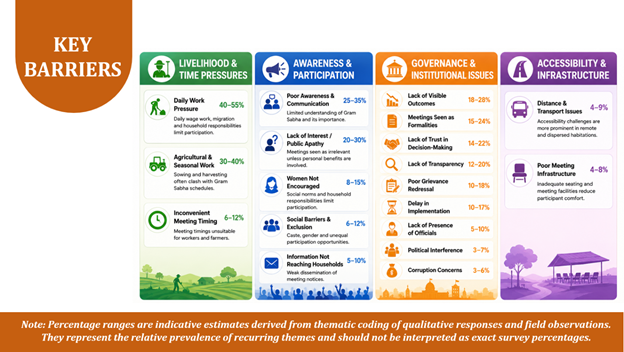

*Report on Low Participation in Gram Sabha across States/UTs : Click Below
Read Report in Brief Here
https://static.pib.gov.in/WriteReadData/specificdocs/documents/2026/jun/doc2026630907001.pdf
If you value our journalism, consider making a voluntary contribution to help us continue bringing news, stories and information to our readers.
Scan the QR code to contribute

Every contribution, big or small, is appreciated.