Administrator
14 July 2026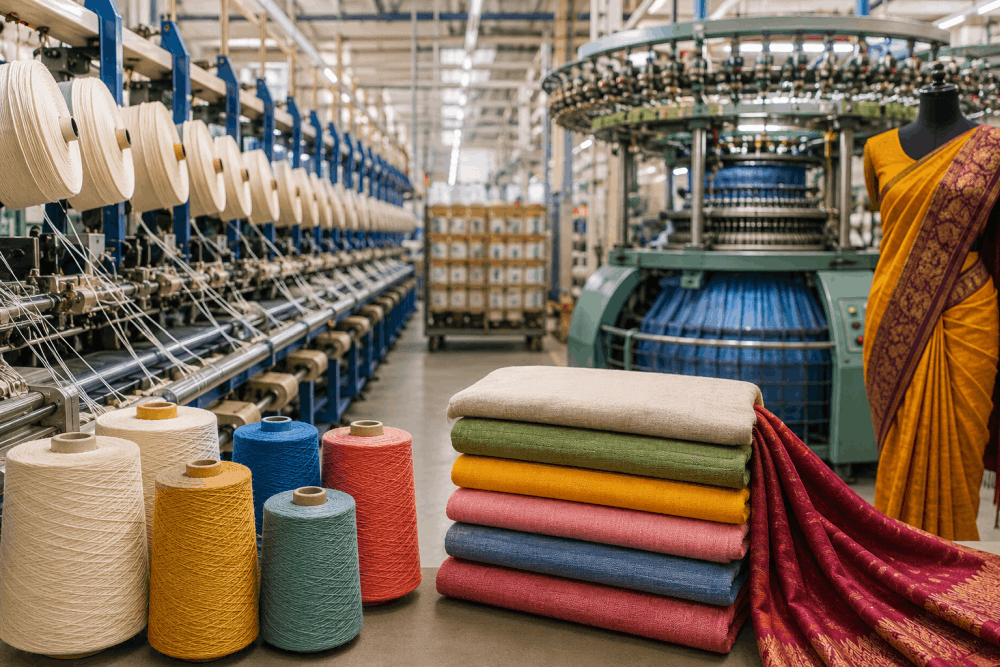
Often called the “spinning wheel” of India’s industrial growth , the textile and apparel sector is a key pillar of the manufacturing economy.
As per the National Account Statistics 2025, the sector accounts for ~2% of India’s GDP and ~11% of manufacturing GVA. India is also the world’s sixth-largest exporter of textiles and apparel, holding ~4% share in global exports.
The sector also provides direct employment to more than 45 million people, including many women and rural workers.
Given its economic scale, export linkages, and employment intensity, sustainability has become increasingly important for the sector. As global markets are shifting towards environmentally responsible production, India’s textile industry has an opportunity to strengthen its competitiveness.
Within this scope, circular production is gaining momentum across the sector. India's rich heritage of textile craftsmanship and resource-conscious production is receiving wider recognition, as global markets increasingly value products with a lower environmental footprint.
|
Circular Economy in the Textiles Sector A circular economy is an economic system where materials and resources are reused, recycled, and kept in use for longer. This helps reduce waste and emissions while promoting a more sustainable mode of production. Its core principle is to ensure circularity in the use of inputs. In the textile sector, sustainability and circularity are important for reducing the adverse effects of a supply chain. The existing materials are reused without changing their basic structure. This lowers the use of energy, chemicals, and water, while reducing environmental impact. |
Circularity Visible in India’s Textile Value Chain
Circularity in India’s textile value chain is reflected in measurable recovery, recycling, reuse and livelihood outcomes.
|
India’s Local Textile Waste Recovery Models |
|
Navi Mumbai’s Circular Textile Recovery Model: India’s first Municipal Textile Recovery Facility in Belapur, Navi Mumbai, recognises textile waste as a circular economy opportunity. The facility integrates collection, sorting, upcycling, technology and livelihoods into one circular recovery ecosystem. It has collected 30 MT of post-consumer textile waste, sorted 25.5 MT, processed over 41,000 items and developed 400+ upcycled samples. It has reached 1.14 lakh families, and supported women artisans through exhibitions and market access. |
|
Panipat as a Downstream Textile Recycling Hub:Panipat has emerged as a major textile recycling hub. As a specialised downstream processing centre, it receives a large share of pre-consumer textile waste from other clusters. The cluster handles nearly 3,500-5,250 TPD of waste and supports collection, sorting, processing, knitting and recycling. This creates strong scope for higher-value textile-to-textile recycling through improved material separation. |
|
Mongolpuri’s Cutting Waste Sorting Network:Katran Market in Mongolpuri, Delhi, shows how informal networks support textile circularity. Roadside handlers collect cutting waste from trucks arriving from Noida, Gurugram, Manesar, Jaipur and Delhi. The waste is then sorted and segregated by colour, improving its value for recycling. The market supplies over 10 TPD of sorted cutting waste to formal recycling clusters in Panipat. Thus, creating an important link between local collection and downstream textile recovery. |
Sustainability in textiles can further be understood through different stages of the production cycle. It is now influencing choices related to raw materials, manufacturing processes, quality standards, and market access across the value chain.
Input Stage: Fibre, Chemicals and Material Sustainability
The sustainability of textile production begins at the input stage. Fibre and raw material choices shape the environmental footprint of the entire value chain. Policy support is therefore being directed towards organic fibres, new-age natural fibres, and reduced use of hazardous inputs.
Promoting Organic Fibre Production

India’s push for organic fibre production is being strengthened through certification frameworks and cultivation support programmes.
|
Organic Production The focus is on preserving soil’s reproductive and regenerative capacity through proper plant nutrition and sound soil management. It follows a grassroots-level approach to sustainable cultivation. |
Since its launch, the programme has expanded from 130 blocks in 7 states to 289 blocks across 10 states. Coverage also increased from ~1.11 lakh hectares to ~2.15 lakh in 2024-25.
|
New age Natural fibres These are plant-based fibres offering eco-friendly alternatives to traditional textiles and synthetic materials. These include innovative and sustainable materials derived from plants and other natural sources. Natural fibres such as ramie, sisal and flax have significant economic and environmental value in India and global markets. They offer sustainable alternatives to synthetic fibres across the textile value chain, composites and other industrial uses. Their lower environmental impact and versatile properties create strong potential for wider use in sustainable textile production. |
The Mission aims to position India as a global leader in sustainable and high-quality fibre production. It promotes climate-smart cultivation, mechanisation, and innovation. The initiative also encourages the use of allied natural fibres as eco-friendly alternatives to synthetic materials, with a strong focus on optimising cultivation practices.
By encouraging natural and certified inputs, these measures support the first step of circularity: reducing environmental stress at material stage.
Reducing Use of Hazardous Chemicals in Textiles Supply Chain

One such pilot project is “Eliminating Hazardous Chemicals from the Textile Fashion Supply Chain in India”. It covers 400 factories across eight clusters and four fashion houses. The project is designed to mitigate 1,47,000 tCO2eq and also reduce harmful chemicals use by 10,530 tonnes.
This ongoing project aims to remove hazardous chemicals from India’s apparel supply chain, promote sustainable production practices, and reduce environmental hazards.
Reducing use of hazardous chemicals is important for circularity, as cleaner materials are easier to reintegrate into the value chain.
Production Stage: Textile Processing and Manufacturing
The manufacturing stage is central to textile sector’s environmental footprint, given its intensive use of water, energy, and other resources. Sustainable manufacturing measures are promoting cleaner infrastructure, efficient resource use, circularity, and lower emissions.
Integrated Textile Parks for Sustainable Manufacturing
PM Mega Integrated Textile Region and Apparel (MITRA) Parks are envisaged as world-class, integrated textile hubs to boost investment, employment, and exports. They are built around the ‘5F’ vision: Farm to Fibre to Factory to Fashion to Foreign. Under this approach, modern textile infrastructure is being developed with end-to-end manufacturing facilities. Sustainability is built in through Common Effluent Treatment Plants (CETPs), wastewater recycling, scientific waste management, and shared utilities.
The development of seven PM MITRA Parks has been approved with an outlay of ₹4,445 crore up to 2027-28. The seven sites have been finalised in Virudhunagar, Tamil Nadu; Warangal, Telangana; Navsari, Gujarat; Kalaburagi, Karnataka; Dhar, Madhya Pradesh; Lucknow, Uttar Pradesh; and Amravati, Maharashtra.
As on December 2025, MoUs with potential investments of over ₹27,434 crore have been signed. The required land has been fully acquired and handed over to the respective SPVs.
Green and Circular Economy Support under RAMP
As per the Economic Survey 2023-24, MSMEs accounted for over 80% of India’s textile and apparel production capacity. Several initiatives have therefore been undertaken to strengthen MSME participation, improve competitiveness and support sustainable growth.
Under the RAMP Programme, the Government has introduced the MSE-GIFT and MSE-SPICE schemes for Micro and Small Enterprises in 2023 . These schemes encourage sustainable practices through support such as interest subvention and capital subsidy.
Textile Sector under the Indian Carbon Market (ICM)
Greenhouse Gas Emission Intensity (GEI) targets have been notified for carbon-intensive sectors under the CCTS. This brings petroleum refineries, petrochemicals, textiles, and secondary aluminium under the ICM compliance mechanism. Under this framework, obligated entities, including those in the textile sector, are required to disclose their Scope-1 and Scope-2 emissions:
Entities that perform better than their assigned targets become eligible to receive Carbon Credit Certificates. These certificates can then be traded with entities that are unable to meet their targets, creating a market-based incentive for lowering emissions.
|
Carbon Credit Trading Scheme (CCTS) Notified in 2023, the Scheme provides the framework for operating the Indian Carbon Market (ICM). It aims to reduce greenhouse gas emissions by pricing emissions through carbon credit certificate trading. By attaching economic value to emission reduction, the scheme encourages industries to improve efficiency, shift to cleaner technologies and reduce their carbon intensity over time. |
Roadmap for Sustainable Textile Manufacturing
The Government has undertaken several studies and projects to support cleaner textile manufacturing. These focus on best practices and guiding improvements in water and energy efficiency, chemical management, and related processes. They include the preparation of Best Available Techniques Reference/ Comprehensive Industry Document (BREF/COINDS) documents and a roadmap for green transformation.
Tex Eco Initiative
The initiative promotes globally competitive and environmentally sustainable textile and apparel manufacturing. It aligns India’s textile industry with international sustainability standards and emerging green market opportunities.
Post-Production Stage: Waste Management
The post-production stage of textiles determines how textile waste is collected, recycled, and reintegrated into the value chain. Thus, efforts to strengthen circularity in this sector are increasingly focused on better waste mapping, recycling, and resource recovery.
|
India’s Textile Waste Recycling Potential India’s textile recycling sector is projected to grow strongly with rising demand for sustainable fashion. The sector is estimated to reach USD 3.5 billion by 2030. This rapid growth highlights significant employment potential. The sector is expected to generate nearly 1 lakh green jobs over the next five years. |
Solid Waste Management and Resource Recovery

The Solid Waste Management Rules, 2026 under the Environment (Protection) Act, 1986, came into full effect on April 1, 2026. The revised rules incorporate the principles of circular economy and extend producer responsibility. They place greater focus on efficient waste segregation and management.
They also create a structured end-use pathway for non-recyclable dry waste. Industrial units using solid fuel, including cement plants and waste-to-energy plants, are required to gradually increase the use of Refuse Derived Fuel (RDF) from 5% to 15% over six years.
|
RDF is defined as fuel made from high-calorific municipal solid waste, including textiles. This supports the diversion of high-calorific waste, including textiles, from disposal towards productive use. |
NTTM Support for Conversion of Textile Waste
Under the National Technical Textiles Mission (NTTM), several R&D projects have been sanctioned for sustainable technologies and materials. These include projects on converting textile waste, biomass, and bio-residues into advanced green materials. The focus areas include carbon fibres and functional textiles.
Effluent Discharge Standards for the Textile Sector
Environmental standards for emission and discharge from industries, including textiles, are notified under the Environment Protection Rules, 1986. Under these, the textile industries and clusters must install and operate Effluent Treatment Plants (ETPs) or Common Effluent Treatment Plants (CETPs). This ensures that effluent discharge meets the prescribed environmental standards.
Mapping India’s Textile Waste Value Chain
Released in 2026, the report “Mapping of Textile Waste Value Chain in India” provides a data-driven assessment of textile waste generation. It identifies opportunities to strengthen circularity across the textile value chain. The report also offers a practical blueprint for turning textile waste into an economic resource through recycling, upcycling, and resource recovery.
Promotion Stage: Market and Enterprise Support
Sustainability in textiles goes beyond production and waste management. It is also being supported through standards, traceability, market support, public procurement, and awareness initiatives. These measures help embed sustainable practices across the textile value chain.
Standards and Sustainability Benchmarks
Such standards can create market confidence for products made through resource-efficient and environmentally responsible processes.
Promoting Upcycled Products through Public Procurement
A tripartite Memorandum of Understanding (MoU) was signed in 2024 between the Textiles Committee, Government e-Marketplace (GeM), and the Standing Conference of Public Enterprises (SCOPE). It aims to encourage and institutionalise the public procurement of upcycled products. This is intended to create wider market access while supporting circularity in the textile sector.
Awareness Initiatives for Sustainable Textiles
It has enabled industry-focused programmes such as Circular Samvaad and the Cluster Exchange Mechanism to promote knowledge exchange and best practices.
Bharat Tex: Advancing Sustainability and Innovation in Textiles
Bharat Tex is India’s flagship global textile event. It reflects the country’s growing role in the global textile economy. It brings together the full textile value chain, from fibre and yarn to fabrics, garments, technical textiles, and sustainability-led innovations, on a single integrated platform.
Following its first two editions in 2024 and 2025, Bharat Tex 2026 is being designed as a broader industry platform. It will bring together exhibitions, knowledge sessions, reverse buyer-seller meets, and policy dialogue. The event places particular emphasis on sustainable and circular textiles, technical textiles, MSME participation, innovation, and global market access.
A Sustainable Future for India’s Textile Sector
India’s relationship with textiles is embedded as deeply in its cultural heritage as in its economic foundations. For centuries, Indian households and artisan communities have long practised reuse, repair, and resource-conscious production. These traditions closely reflect what is now described as circularity. Today, they are being reinforced through policy support for sustainable inputs, responsible production, better waste management and traceability.
These measures show how sustainability and circularity are becoming more closely linked in India’s textile sector. It connects traditional wisdom with modern industrial transformation. This is strengthening both competitiveness and environmental resilience in one of the country’s most important sectors.
If you value our journalism, consider making a voluntary contribution to help us continue bringing news, stories and information to our readers.
Scan the QR code to contribute

Every contribution, big or small, is appreciated.