Administrator
10 August 2026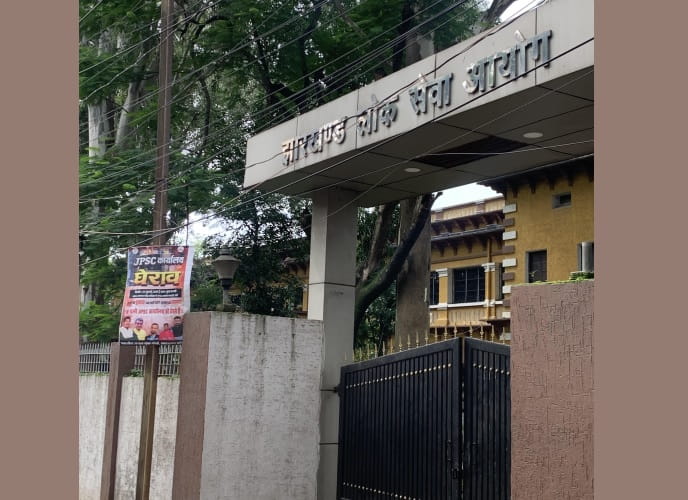
*JPSC is empty today after JPSC chairman L. Khiangte resigned on July 22, 2026, following intense scrutiny and a CID investigation into alleged irregularities and paper leaks in the 14th JPSC Civil Services examinations. Then its three Members Ajeeta Bhattacharya, Anima Hansda, and Jamal Ahmad—resigned from their posts. Governor Santosh Kumar Gangwar quickly accepted their resignations on August 9, 2026
The speed and scale of the students and job aspirants’ unrest have caught the government off guard. It sparked rounds of talks that scrambled on Sunday to douse the student anger, but in vain.
The anger erupted over JPSC, JSSC, the state government agencies in Jharkhand; over the Blacklisted Agency, Hotel Rooms and an Examination System That Is Under Scrutiny.
Nishpaksh examines the allegations surrounding the JPSC examination process, blacklisted agency TDPL, alleged OMR manipulation, recruitment rackets and the deeper institutional questions facing Jharkhand’s public recruitment system.
On The Federal Desh’s special show Nishpaksh, anchor Neelu Vyas, along with senior Jharkhand journalists Manoj Prasad and Shahnawaz Hasan, takes an extensive ground-level look at the allegations surrounding the Jharkhand Public Service Commission (JPSC), the 14th Civil Services Examination and the growing unrest among the state’s competitive examination aspirants and job aspirants. They have solid ground to peacefully protest, seeking justice.
What emerges from the discussion is not merely a dispute over one examination. It is a larger and deeply consequential conversation about the integrity of public recruitment, the credibility of institutions entrusted with selecting the state’s future administrators, and the growing frustration among young people who spend years preparing for government examinations only to find themselves confronting allegations of irregularities, manipulation, corruption and systemic failure.
The wave of public anger and discontent over the Civil Services examinations conducted by JPSC shows no sign of abating. After competitive students from various states took their grievances to Delhi’s historic Jantar Mantar, Ranchi has now become the principal centre of the protest in Jharkhand.
On Nishpaksh, the issue is examined through the experiences and observations of two senior journalists from the state of Jharkhand —Manoj Prasad, Editor of Jharkhand State News and a former journalist with The Indian Express, and Shahnawaz Hasan—who bring both the institutional and ground-level dimensions of the controversy into focus.
Students on the Streets for Days: Hunger Strikes, Fear and Allegations of Intimidation
For the students, the protest is no longer simply about an examination result or an administrative decision. It has become a question of trust.
Senior journalist Shahnawaz Hasan, describing the situation on the ground, said that candidates and competitive students from across Jharkhand have been continuously protesting for the past 17 days.
Several meritorious students, he said, have been sitting on indefinite hunger strikes and fasts. Behind the protest are demands that go to the heart of the examination process and the credibility of the investigating mechanism.
Cancellation of the 14th JPSC Examination
The foremost demand is the complete cancellation of the 14th JPSC Preliminary Examination (PT).
Students are demanding this after large-scale irregularities and alleged malpractices came to light in connection with the examination. For the protesting candidates, the question is not simply whether individual irregularities occurred, but whether the integrity of the examination as a whole can still be trusted.
Independent Investigation by CBI and ED
The students are also demanding an independent investigation by the Central Bureau of Investigation (CBI) and the Enforcement Directorate (ED).
They remain unconvinced by the special CID investigation constituted by the state government. Their argument is that if the alleged links of the matter extend beyond the state, involving an interstate network, large financial transactions and allegations relating to the land mafia and bribery, then an investigation by central agencies is necessary to establish confidence in the process and ensure impartiality.
For the protesting students, the demand for a central investigation is therefore linked directly to the question of institutional credibility.
Allegations of Intimidation and Threats in Closed Rooms
The protest has also raised another disturbing allegation: that students themselves felt the need to bring witnesses into conversations with those in power. Shahnawaz Hasan revealed that during discussions with officials and ministers, students who were part of the delegations were allegedly intimidated and threatened inside closed rooms.
According to him, this alleged atmosphere of fear became one of the reasons students felt compelled to take journalists and senior advocates with them to the negotiation table. The allegation adds another dimension to the dispute: beyond the examination process itself lies a question about whether protesting students feel safe enough to raise their concerns directly with the authorities responsible for addressing them.
Appointment of Blacklisted Agency TDPL: The OMR Sheets, the Hotels and the Alleged Examination ManipulationSenior journalist Manoj Prasad took the discussion deeper into the functioning of the Commission and the examination-conduct process.
According to his analysis, the controversy cannot be viewed merely through the narrow lens of a question-paper leak or an isolated examination irregularity. He described the matter as pointing towards what he characterised as an organised institutional crime.
Analytical Points Raised by Manoj Prasad
Contract Given to an Agency on the Blacklist
At the centre of the discussion is TDPL, the agency entrusted by the JPSC Board and selection committee with the responsibility for conducting/editing the Preliminary Examination.
The allegation becomes particularly significant because, according to the discussion, TDPL had already been blacklisted in neighbouring states such as Uttar Pradesh and Bihar in connection with irregularities and scams involving various recruitment examinations.
The question raised is therefore straightforward but consequential: how did an agency that had already faced blacklisting elsewhere come to be entrusted with such a sensitive responsibility by a state public service commission?
Two-Level Manipulation in OMR Sheets
The allegations go beyond the appointment of the examination agency. According to documents seized during the investigation and by the CID, major irregularities allegedly took place in the scanning of candidates’ Optical Mark Recognition (OMR) sheets.
The account presented on the programme alleges that rooms in three-star and two-star hotels were used as bases, where OMR sheets that candidates had left blank were allegedly filled in and marks were subsequently manipulated. If established, such allegations would raise fundamental questions about the chain of custody of examination material, the safeguards surrounding OMR sheets and the systems meant to ensure that a candidate’s answer sheet cannot be altered after the examination.
Crores-of-Rupees Market and Transfer of Land
The financial dimension of the allegations is equally significant.
According to the discussion, candidates were allegedly asked for amounts ranging from ₹25 lakh to ₹40 lakh in exchange for providing undue advantage in the examination. In several cases, it has also emerged that the alleged transactions were not confined to cash.
Land documents were allegedly taken as bribes in some instances. These allegations point towards a system in which a government examination—intended to provide a merit-based route into public service—could potentially become a high-value market for influence and access.
Constitutional Flaws: Articles 315–316 and the Culture of ‘Ganesh Parikrama’
The Nishpaksh discussion then moves beyond the immediate JPSC controversy to a much broader constitutional and institutional question: who gets to lead India’s public service commissions, and what safeguards govern those appointments?
Manoj Prasad referred to Articles 315 and 316 under Part XIV, Chapter 2 of the Constitution of India. According to his analysis, the constitutional framework does not prescribe sufficiently concrete, transparent and minimum educational or administrative criteria for the appointment of chairpersons and members of the Union and State Public Service Commissions.
This, he argued, creates a structural vulnerability in institutions whose very purpose is to ensure fairness, merit and credibility in public recruitment.
Political Appointments: In the absence of criteria defined by the Constitution of India,
State governments and Chief Ministers have the authority to appoint individuals of their choice who were below the age of 62 as chairpersons or members of the Commission.
The concern raised in the discussion is that, in the absence of stronger qualification and selection safeguards, merit and competence can potentially take a back seat to political considerations.
Manoj Prasad referred to this culture as one of ‘political loyalty’ and ‘Ganesh Parikrama’—a system in which those who demonstrate political proximity or loyalty may find themselves better positioned for such appointments than those selected solely on the basis of professional competence and institutional suitability.
The issue, therefore, is larger than any one appointment. It concerns the independence, credibility and institutional character of the commissions themselves.
Temporary and Inexperienced Leadership
Another concern highlighted in the discussion is the short tenure of some commission chairpersons.
Several retired bureaucrats, it was pointed out, are appointed as chairpersons for terms of merely one to two years. The argument is that such short tenures may leave little room for meaningful institutional reform. Instead of having the time to understand structural weaknesses, redesign processes and build durable systems, leadership can become focused on completing formalities or may find itself caught up in controversies before substantial reforms can take shape.
The concern is ultimately about continuity: institutions responsible for determining the careers of thousands of young people require leadership capable of thinking beyond short administrative tenures.
A Dark Page in History
The record of JPSC itself becomes part of this larger concern.
In the 26 years since the formation of Jharkhand, JPSC has, according to the discussion, managed to conduct examinations only about seven to eight times, whereas the process is required to be conducted every year. For generations of aspirants, such delays are not merely administrative statistics.
A government recruitment examination is tied to age limits, years of preparation, financial investment and the possibility of building an entire career. When examinations are repeatedly delayed, cancelled or caught in controversy, the consequences extend far beyond a calendar.
Rot in the System: From Teacher Recruitment to Clerk Recruitment, ‘Job Shops’ Everywhere
The anger, however, does not end with the JPSC Civil Services Examination. Senior journalist Shahnawaz Hasan said that the discontent among students is rooted in a much wider experience of recruitment examinations across Jharkhand.
Whether it is the recruitment of primary and secondary school teachers, examinations for clerks and stenographers, or other technical examinations conducted by the Jharkhand Staff Selection Commission (JSSC), he said, allegations of irregularities and corruption have repeatedly surfaced.
He described the situation as one in which ‘job shops’ have emerged, with alleged bids ranging from ₹5 lakh to ₹20 lakh. For a student who has spent years preparing for a competitive examination, such allegations strike at the very premise on which the system rests: that knowledge, preparation and merit should determine who gets an opportunity.
The human cost is equally serious. According to Hasan, many talented students who have spent years preparing for examinations have crossed the age of 50–55 and have become victims of depression, with their futures now appearing uncertain and increasingly bleak.
Behind every delayed examination, disputed result or alleged irregularity is therefore a personal story—years of preparation, financial sacrifice, family expectations and an age limit that continues to move in only one direction.
The Way Forward: Will the Hemant Soren Government Show Political Will?
The discussion ultimately returns to the question of what happens next. At the conclusion of the programme, anchor Neelu Vyas argued that the problem cannot be resolved simply by changing chairpersons or making arrests. If the weaknesses are institutional, then the response must also be institutional.
Until comprehensive reforms are undertaken at the highest level, individual action may address individual cases without necessarily addressing the conditions that allow such controversies to recur.
The question before the Hemant Soren government, therefore, is not merely how it responds to the current protest. It is whether it can demonstrate the political will to undertake deeper reforms in a recruitment system on which the aspirations of an entire generation depend.
Key Requirements
Political Will
The ruling party JMM and the opposition BJP must rise above partisan politics and take firm steps in the interest of meritorious young people. The credibility of public recruitment cannot become a matter of political convenience. For students who spend years preparing for competitive examinations, the system must provide something more fundamental than promises: a demonstrably fair opportunity.
An Autonomous and Capable Commission
The JPSC Board must have individuals of high qualification, integrity and administrative competence, appointed through an impartial process. The independence and credibility of the Commission depend not only on the authority vested in it, but also on the quality and integrity of those entrusted with exercising that authority.
Transparent and Digital Process
Future examinations must be conducted through strict policies and a foolproof, transparent mechanism.
Every stage—from the appointment of examination agencies and printing and handling of examination material to the custody and scanning of OMR sheets, evaluation, data management and declaration of results—requires systems that minimise human intervention, create verifiable digital trails and make manipulation difficult.
Because for the students of Jharkhand, this is no longer simply about one examination. It is about whether a public recruitment system can still command public trust. And for a generation that has invested years of its life in the promise of merit, fairness is not an administrative courtesy.
It is the very foundation of the promise.
If you value our journalism, consider making a voluntary contribution to help us continue bringing news, stories and information to our readers.
Scan the QR code to contribute

Every contribution, big or small, is appreciated.