Administrator
20 August 2026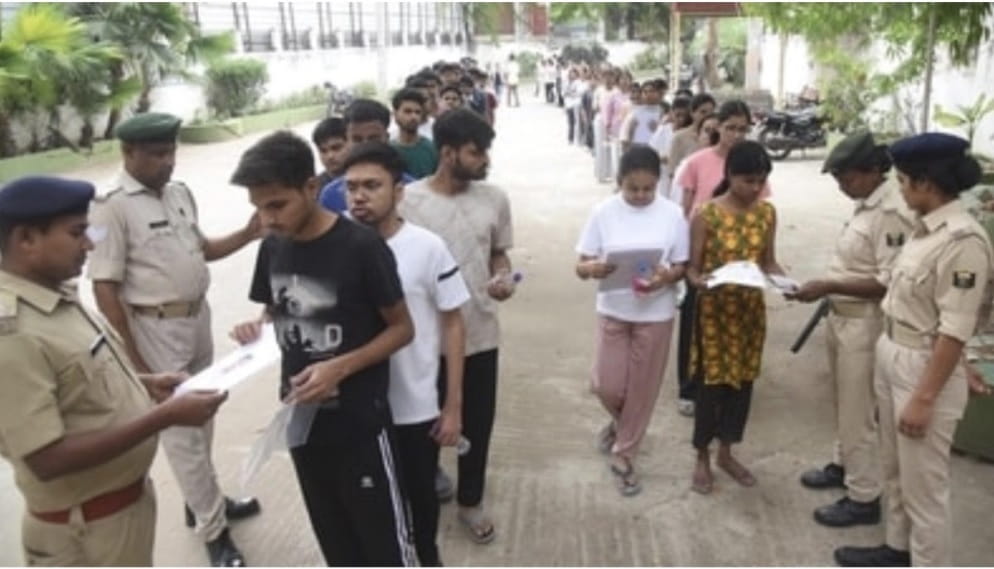
Representational Pic
The Centre has defended the security architecture of the National Eligibility-cum-Entrance Test (NEET-UG) before the Supreme Court, describing the present system as ‘foolproof’ and difficult to breach, while acknowledging that parts of the process continue to involve human intervention. The submission came during a hearing on petitions seeking structural changes to the way NEET is conducted, including a demand to shift the examination to computer-based testing (CBT). At stake is more than the security of a question paper. NEET determines access to medical education for millions of aspirants, making the integrity of its examination process inseparable from the credibility of the selection itself.
HOW THE CENTRE SAYS THE SYSTEM WORKS
Solicitor General Tushar Mehta, appearing for the government, explained to the Court how a NEET question paper is prepared and secured. Using a hypothetical Physics paper containing 100 questions, he described a multi-layered process. Several moderators first create a bank of 500 questions. A separate group of moderators then selects 100 questions each and prepares four different question papers.The Director General of the National Testing Agency (NTA) subsequently selects two of those four papers. From there, the process moves into a tightly controlled physical chain. The selected papers are placed in sealed boxes and sent to two separate printing presses, where printing takes place under CCTV surveillance and CISF security.
THE DIGITAL KEY AT THE CENTRE OF THE PHYSICAL SECURITY
The Centre told the Court that even opening the sealed box is subject to an additional layer of control. The person responsible for the box possesses a digital key. The box can be opened only after the printing-press owner contacts the NTA Director General and receives the required code. Once the box is opened, the government says no outsider is permitted inside the printing facility, while the entire process is video-recorded. Even the printing-press operator, according to the Centre, does not know which examination centre will ultimately receive the papers. The question paper and OMR sheets are subsequently sealed in a sealed envelope.The government’s argument is straightforward: security does not depend on one barrier, but on multiple controls operating at different stages.
THE QUESTION THAT CANNOT BE AVOIDED
Yet the Court is examining these safeguards against a backdrop in which NEET’s examination architecture has already come under serious scrutiny. The present hearing follows the NEET-UG 2026 paper-leak controversy, after which the examination conducted on May 3 was cancelled by the NTA and a re-examination ordered for June 21. The episode triggered widespread concern among candidates and renewed questions about the security of the examination process. That is why the phrase ‘foolproof’ carries significance beyond the mechanics of printing and transporting papers. A system can have multiple safeguards on paper. The question is whether those safeguards remain intact at every human point of contact.
THE HUMAN FACTOR
The Centre itself acknowledged that there are human interventions in the NEET process. That admission sits at the heart of the larger examination-security challenge.Technology can control access. CCTV can record movement. Digital keys can restrict entry. Sealed containers can protect physical documents. But people design the questions, handle the material, operate the presses and administer the examination. The security of the system therefore depends not only on its architecture, but on whether every individual operating within that architecture follows it without compromise.
THE NTA EXPERTS UNDER THE SCANNER
The question becomes particularly important because three Pune-based experts appointed by the NTA have emerged at the centre of the paper-leak investigation. They are:
• Manisha Gurunath Mandhare — Botany and Zoology
• Prahlad Vithalrao Kulkarni — Chemistry
• Manisha Sanjay Havaldar — Physics
According to the Hindustan Times report, Mandhare was involved in four stages of question-paper preparation at the NTA building in Delhi. All three experts were able to see the four master sets, internally identified as Kailash, Shivalik, Set 2 and Set 3. That detail places the human element directly within the security conversation. The issue is not simply whether the final paper was protected after it was printed. It is also who had access to its contents before that point, at what stage, and under what controls.
FROM PAPER SECURITY TO INSTITUTIONAL REFORM
The Supreme Court is considering petitions seeking broader reforms to the NEET system, including the proposal to move the examination to CBT mode. The Court has also sought details on steps taken towards implementing recommendations of the Radhakrishnan Committee and the Nandan Nilekani committee, placing the present hearing within a larger examination-reform process. This makes the proceedings significant beyond the immediate question of whether the current paper-security mechanism is sufficiently robust. The Court is looking at whether reforms can be institutionalised, rather than introduced only in response to the latest controversy.
THE MEMORY OF 2024 STILL HANGS OVER THE SYSTEM
The current assurance also has to be viewed against the Supreme Court’s earlier scrutiny of NEET. In its August 2024 judgment, the Court found that the material before it did not establish a systemic leak or widespread malpractice sufficient to invalidate the examination as a whole. At the same time, it expressed serious concern over the manner in which the NTA had organised the examination, including security lapses at centres in Patna and Hazaribagh. The distinction matters. The Court did not conclude that the entire NEET system had been compromised in 2024. But it did make clear that operational lapses in a national examination of this scale cannot be dismissed as incidental.
THE REAL CURRENCY IS TRUST
The NEET examination is ultimately built on something that cannot be sealed in a box or protected by CCTV: the candidate’s belief that the examination is fair. For an aspirant who spends years preparing for a medical entrance examination, the credibility of the process matters as much as the question paper itself. A secure examination is therefore not merely one in which a paper is protected from theft. It is one in which candidates can reasonably believe that no individual, institution or breach of procedure can give another candidate an unfair advantage.
THE COURT’S QUESTION IS BIGGER THAN ‘CAN THE PAPER LEAK?’
The Centre has placed before the Supreme Court a detailed account of safeguards designed to make a breach difficult.The Court, meanwhile, is examining whether the examination system needs deeper institutional reform. Those positions are not necessarily contradictory. A system can be difficult to breach and still require improvement. A system can have multiple safeguards and still need stronger accountability. And a system can be technically secure while losing the confidence of the people it is meant to serve. The ultimate test of NEET’s security is therefore not whether the system can call itself foolproof. It is whether the next generation of medical aspirants can trust it to be fair.
If you value our journalism, consider making a voluntary contribution to help us continue bringing news, stories and information to our readers.
Scan the QR code to contribute

Every contribution, big or small, is appreciated.