Administrator
22 August 2026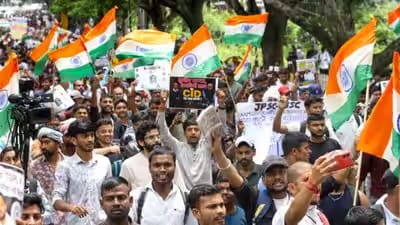
Student protesters are up in arms even as the court has protected appointments pending further orders.
For the student protesters who pushed the government towards cancellation, the judicial intervention raises a different question: what happens to the demands they believed had been accepted?
The state police and the student protesters confronted each other on Friday evening when the latter sought to burn effigies of the Chief Minister Hemant Soren and Congress leader and Leader of Opposition Rahul Gandhi in Ranchi, Hazaribagh, Giridih and Palamau. They alleged that by notifying cancellations of jobs and exams conducted by JPSC and JSSC the Soren government has indulged in ‘deceit’ or ‘betrayal’.
In any case, The Jharkhand recruitment controversy seems to have entered a new and more complicated phase after the High Court stayed the state government’s decision to cancel the 11th to 13th JPSC Civil Services examinations and the appointments arising from them, along with the Food Safety Officer recruitment.
The court’s interim order has put a judicial check on the government’s sweeping action against recruitment examinations. It directed the reinstatement of candidates whose appointments had been cancelled and held that regular appointments could not be disturbed without following due process and the principles of natural justice.
The matter has been listed for further hearing on September 15. The order offers relief to the selected candidates. But for the students who had spent weeks protesting alleged irregularities, it has reopened a question they believed the government had already answered.
A Government Decision Born Out of Protest
The government’s cancellation drive followed nearly 25 days of student agitation over alleged irregularities in recruitment examinations conducted by JPSC, JSSC and an outsourced testing agency. The protests had demanded action against examinations that students alleged were compromised. The government subsequently moved to cancel 22 recruitment examinations, while putting six processes on hold and ordering investigations into 17 others. The cancellations were presented as part of an effort to address concerns over the integrity of the recruitment system. For the protesting aspirants, this was a significant concession. The agitation was subsequently called off after the government agreed to several of their demands. The expectation, therefore, was that the cancellation decision would stand while investigations and reforms proceeded.
The High Court’s intervention has now complicated that understanding.
The Court Protects 342 Appointees
The immediate beneficiaries of the order are 342 candidates selected through the 11th to 13th JPSC Civil Services examinations, who were already serving in government posts. The government had cancelled their appointments following findings emerging from a CID investigation into alleged irregularities and the role of TSR Data Processing Private Limited (TDPL) in the examination process. The candidates challenged the blanket cancellation. Their argument was that even if irregularities were established, individual responsibility had to be determined rather than treating every successful candidate as equally implicated. They also questioned whether sufficient evidence had been placed before the government to justify cancelling the entire examination and the appointments flowing from it. The High Court has, for now, accepted the need to protect their appointments while the legal challenge is heard. That is an interim position, not a finding that the examinations were free of irregularities.
Why Students Feel Let Down
The political and social impact of the order lies elsewhere.Student leaders now accuse the government of backtracking on assurances given during the agitation. Their grievance is not simply with the High Court. It is with what they perceive as a change in the government's position after their protest was withdrawn. Student leader Ravindra Paswan has accused the government of failing to adequately defend the cancellation before the court and said the students' struggle would now enter a new phase. He has also announced further protests, including plans for demonstrations across the state.That accusation is the protesters’ position, not a judicial finding. But it captures the new political fault line: the government’s decision to cancel examinations helped end the agitation; the court’s stay now risks reviving the very distrust that had fuelled it.
Two Groups, Two Ideas of Justice
The dispute has now acquired two competing claims of fairness. For the protesting students, justice means ensuring that an examination suspected of serious irregularities does not determine public appointments. They fear that allowing the appointments to continue could undermine the credibility of the recruitment system and disadvantage candidates who competed without any alleged benefit from malpractice. For the selected candidates, justice means not losing their jobs because of alleged wrongdoing in which they were not personally involved. They argue that if irregularities occurred, the actual impact and individual responsibility should be established before appointments are cancelled. The High Court’s interim order has protected the second claim. It has not rejected the first.
The Stay Does Not End the Investigation
The distinction is crucial. The High Court has not given a clean chit to the JPSC examinations, nor has it brought the government's investigations to an end. The allegations surrounding the recruitment process remain under scrutiny.What the court has done is place a legal restraint on the immediate consequences of the government's cancellation decision, particularly where candidates had already been appointed. The government must now defend its action before the court while the investigations continue.
A New Test for the Government
The government is now caught between two imperatives. It must demonstrate that its response to alleged examination irregularities is strong enough to protect the integrity of public recruitment. At the same time, it must explain how that response can withstand judicial scrutiny when it affects candidates who have already been appointed. And there is a third challenge: maintaining the trust of the students whose agitation prompted the government's action in the first place. That may prove just as difficult. If the protesters conclude that cancellation was promised to secure an end to the agitation but cannot now be effectively defended, the confrontation could return to the streets. Student leaders have already indicated that they intend to intensify their campaign.
The Next Phase Will Be Decided on Two Fronts
The immediate legal milestone is September 15, when the state government and JPSC are expected to respond before the High Court. But the political test is already underway. The court will examine whether the government’s cancellation of examinations and appointments can stand in law. The students will be watching whether the government continues to stand firmly behind the action it took after their prolonged agitation.And the appointed candidates will be watching whether the judicial protection afforded to them becomes permanent. For now, the controversy is no longer simply about alleged examination irregularities.
It is about whether a recruitment system can be cleaned up without compromising due process — and whether a government can respond to a student movement decisively without losing its credibility with either side.
The High Court has paused the government’s action. The investigations continue. And the student movement, which had stepped back after securing what it saw as a major concession, is once again confronting an unsettled question: was the battle won, merely paused, or only moved to another arena?
Source:https://indianexpress.com/article/explained/jharkhand-hc-stays-jssc-cgl-cancellation-10841814/
If you value our journalism, consider making a voluntary contribution to help us continue bringing news, stories and information to our readers.
Scan the QR code to contribute

Every contribution, big or small, is appreciated.