Administrator
02 September 2026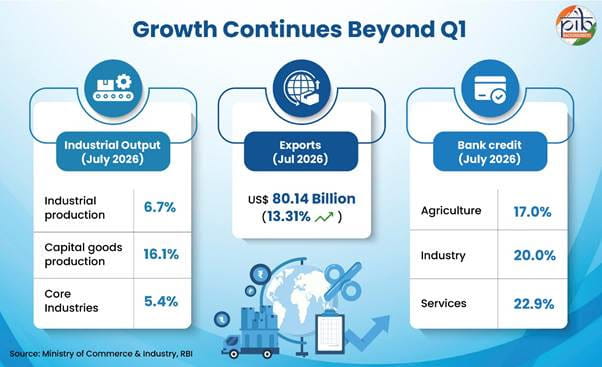
Following U.S. President Donald Trump's remark last year that India’s economy is a “ dead economy”, Leader of the Opposition and Congress leader Rahul Gandhi had said, “ Mr. Trump has stated a fact”. This was inside the Lok Sabha on July 31, 2025.
Now, the economic data released by the Union Finance Department has proved both U.S. President Trump and LoP Gandhi wrong.
A study into these economic data indicates that India had entered 2026-27 amid persistent geopolitical tensions and uncertainty around global trade. Despite these external pressures, real GDP grew by 7.8% in Q1 2026-27. However, agricultural growth was reported to be less than 4 %.
In fact, the outcome marked the highest Q1 real GDP growth during the four-year period from 2023-24 to 2026-27. This has been supported by buoyant domestic demand and gains in manufacturing and services.
Records showed that the International Monetary Fund (IMF) has also highlighted India’s role in the global economy. In July 2026, it described India as one of the world’s fastest-growing economies and a key engine of global growth.
India’s sovereign credit assessment further reflects this confidence. In August 2026, S&P Global Ratings affirmed India’s ‘BBB/A-2’ sovereign ratings with a Stable Outlook. This followed the upgrade of its long-term rating to ‘BBB’ in 2025, after an 18-year gap.
A Stronger Start to 2026-27
Growth Accelerates in the First Quarter

Economic growth strengthened in the first quarter (Q1) of 2026-27. This outcome has exceeded the Reserve Bank of India’s estimate of 7.0% for the quarter.
|
Gross Domestic Product (GDP) is the value of final goods and services produced in the domestic economy in an accounting period. |
|
Gross Value Added (GVA) measures the individual contribution of producers, industries or sectors to the economy. |
Revised Estimates Strengthen the Growth Picture
Real GDP has been revised upwards for the previous three financial years. The revisions show that the first-quarter performance follows a stronger growth trajectory than previously estimated.
|
Table-1: Revised Real GDP Growth Estimates |
||
|
Financial Year |
Earlier Estimate |
Revised Estimate |
|
2023-24 |
7.2% |
7.3% |
|
2024-25 |
7.1% |
7.2% |
|
2025-26 |
7.7% |
7.8% |
|
Source: Ministry of Statistics & Programme Implementation (MoSPI) |
||
|
Basis of the Revised Estimates The annual revised estimates reflect the use of new price and production indices with base year 2022-23. This includes the Output Producer Price Index (PPI) and Banking Services Price Index (BkSPI). Updated administrative data from different sources were also incorporated. To read more on National Account Statistics revisions, please refer to: Counting What Counts: Strengthening India’s National Accounts and Core Economic Statistics |
Composition of Growth Drivers
Trends Across Key Expenditure Components
Economic activity in the first quarter was supported by a sharp rise in investment, firm household consumption and stronger exports.
|
Table-2: Key Expenditure Components of Real GDP |
|||
|
Component |
Interpretation |
Q1 2025-26 |
Q1 2026-27 |
|
Gross Fixed Capital Formation (GFCF) |
Domestic funding of investment |
5.8% |
11.9% |
|
Private Final Consumption Expenditure (PFCE) |
Spending by households on goods and services |
6.8% |
7.1% |
|
Exports |
Goods and services supplied to the rest of the world |
6.0% |
12.0% |
|
Source: Ministry of Statistics & Programme Implementation (MoSPI) |
|||
Growth Extends Across Major Sectors
The strength in expenditure was also reflected on the production side, with the tertiary and secondary sectors expanding at a faster pace.
|
Table-3: Key Manufacturing Categories Record Notable Gains (Year-on-year IIP growth (%)) |
||
|
Manufacturing category |
Q1 2025-26 |
Q1 2026-27 |
|
Electrical Equipment |
9.7 |
27.0 |
|
Other Transport Equipment |
3.8 |
19.5 |
|
Computer, electronic and optical products |
8.8 |
12.4 |
|
Machinery and equipment |
6.6 |
9.1 |
|
Source: Ministry of Statistics & Programme Implementation (MoSPI) |
||
Recent Indicators Signal Continued Momentum

Industrial Activity Remains Firm
Strong Export Performance
Credit Expands Across Major Sectors
Bank credit growth strengthened across major sectors in July 2026.
Recent Policy Measures Supporting Growth
Policy measures introduced during 2026 have complemented these economic trends, spanning manufacturing, energy security, trade and investment, and agriculture.
Manufacturing and Industry
Energy Security
Trade and Investment
Agriculture: Farm Income and Production Support
These measures build on a decade of policy initiatives including Make in India, Production Linked Incentive (PLI) schemes, PM-KISAN, the Export Promotion Mission and others.
Conclusion
India’s economic performance at the start of 2026-27 reflects broad-based momentum across key areas of the economy. Investment has accelerated, household consumption has remained firm, while manufacturing, services and exports have provided additional support.
More recent indicators show that this strength has carried beyond the first quarter. Continued government support through various policy measures has also helped maintain the pace of economic activity.