Administrator
17 September 2026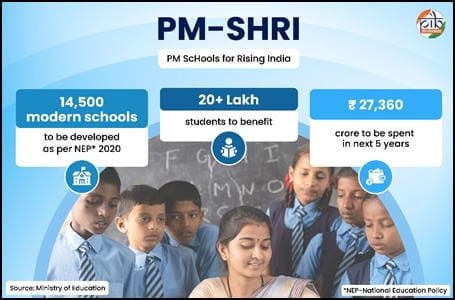
PM SHRI has upgraded at least 413 selected schools in Jharkhand.These schools are spread across 308 block in all 24 districts to act as model educational institutions under the National Education Policy (NEP) 2020.
This includes 363 state government schools, 25 Kendriya Vidyalayas (KVs), and 25 Jawahar Navodaya Vidyalayas (JNVs).
The project covers all 24 districts, with Palamu having a high concentration (around 28 schools), followed by Garhwa and Ranchi.
As it is, selected PM SHRI School campuses receive funds for modern smart classrooms, ICT and science labs, library upgrades, aesthetic campus beautification, and child-friendly physical infrastructure.
These PM SHRI schools showcase change in India which is witnessing a significant transformation in its school education system. It appears to be marked by a growing emphasis on quality, equity, inclusion, and future-ready learning.
In the country, with 14.71 lakh schools serving more than 24.69 crorestudents, the education system is increasingly focused on enhancing learning outcomes and creating enabling environments that support the holistic development of every learner.
Notably,NEP 2020 furnishes the overarching framework for this transformation, while the PM SHRI initiative operationalizes its vision at the school level, translating policy intent into institutional practice.
Launched on 7 September 2022, the Pradhan Mantri Schools for Rising India (PM SHRI) Scheme is a Centrally Sponsored Scheme implemented by the Department of School Education and Literacy, Ministry of Education.
The scheme seeks to qualitatively strengthen existing schools and develop them as exemplar institutions demonstrating the effective implementation of the National Education Policy (NEP) 2020. With a total project cost of ₹27,360 crore, the scheme focuses on strengthening more than 14,500 existing schools as exemplar institutions.
These schools are envisioned to provide safe, stimulating, and welcoming learning environments, supported by quality infrastructure, appropriate learning resources, and diverse learning experiences.
As of July 2026, 13,092 schools have been selected as PM SHRI Schools across States and Union Territories, including schools under the Kendriya Vidyalaya Sangathan (KVS), Navodaya Vidyalaya Samiti (NVS) and National Council of Educational Research and Training (NCERT). This represents around 90% of the envisaged target. The scheme is expected to benefit more than 20 lakh students directly.
Secretary (SE&L), at the Ministry of Education, is constituted for final selection of schools. Schools must meet minimum standards such as a pucca building, barrier-free access, safety measures, separate toilets, drinking water, hand-washing facilities, electricity, ID cards for teachers, enrolment at Elementary and Senior Secondary levels must be more than the State average enrolment and library or sports facilities. For the Challenge Method, schools in urban areas are required to secure a minimum score of 70 percent, while schools in rural areas require a minimum of 60 percent. The assessment covers infrastructure, learning outcomes, pedagogy, PM POSHAN, vocational education, green initiatives, and stakeholder commitment.
Schools as Models for Wider Change
PM SHRI represents a paradigm shift from an infrastructure-centric approach to school development towards the establishment of holistic, inclusive, equitable, and future-ready learning institutions. The initiative operationalises the vision and priorities of the National Education Policy (NEP) 2020by emphasising quality and competency-based learning, continuous teacher professional development, technology-enabled education, and the creation of a safe, inclusive, and enabling school environment.
As exemplar institutions, PM SHRI Schools are envisaged to demonstrate and disseminate innovative educational practices that can be adapted and replicated by neighbouring schools, thereby contributing to broader systemic improvements in school education. The overarching objective is to foster capable, confident, creative, and responsible learners, equipped with the knowledge, skills, and values required to participate meaningfully in a more equitable, inclusive, and future-ready India.
If you value our journalism, consider making a voluntary contribution to help us continue bringing news, stories and information to our readers.
Scan the QR code to contribute
Every contribution, big or small, is appreciated.