Administrator
08 October 2026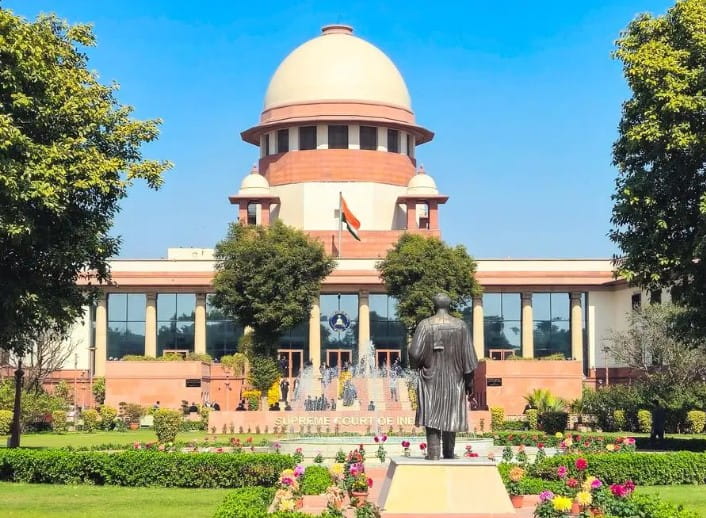
Responding to a contempt petition filed by the Union Government, challenging the Jharkhand government’s 2025 regulation as well as the appointments of two IPS officers, Anurag Gupta and Tadasha Mishra, as DGP, the Supreme Court today (October 8) sought a response from Jharkhand DGP Tadasha Mishra.
The court observed that the state’s rules governing the appointment of its DGP appeared to conflict with the court’s earlier directions on police appointments.
The Jharkhand government, meanwhile, told the court that it was willing to reconsider the rules.
On the floor of the top court, a bench comprising Chief Justice of India (CJI) Surya Kant and Justices Joymalya Bagchi and V Mohana was hearing a contempt petition by the Centre against the “Selection and Appointment of Director General and Inspector General of Police, Jharkhand (Head of the Police Force) Regulation, 2025”, notified by the state government on January 8, 2025.
The bench said the rules appeared to be “in the teeth of” the Supreme Court’s earlier judgment in the Prakash Singh case, which laid down a framework for the appointment and tenure of the DGPs.
Senior advocate Kapil Sibal, representing the Jharkhand government, told the court that the state was prepared to revisit the rules.
The court also decided to give Tadasha Mishra an opportunity to respond to the challenge, noting that she could be affected if the regulations were ultimately set aside.
Notably, the Union Government had approached the Supreme Court challenging the Jharkhand government’s 2025 regulation as well as the appointments of IPS officers Anurag Gupta and Tadasha Mishra as DGP.
Solicitor General Tushar Mehta, appearing for the Centre, told the court that the Union government had repeatedly informed Jharkhand that the rules were inconsistent with the directions issued by the Supreme Court in the Prakash Singh judgment.
Mehta said, “if any other state has brought such rules, irrespective of the party in power, then it must go.”
The Centre has sought directions requiring Jharkhand to follow the procedure prescribed by the Supreme Court for appointing a DGP and a declaration that appointments made under the 2025 regulation are illegal.
The Union government has also asked the court to direct the state to implement the directions issued in the Prakash Singh case in full. Alternatively, it has sought a declaration invalidating DGP appointments made under the disputed regulation.
Bird’s Eye View on dispute over DGP appointments-
According to the Centre’s challenge, Jharkhand relied selectively on the SC’s directions by providing DGPs with a two-year tenure while not following the prescribed process for selecting the police chief.
The top court’s viewpoint in the Prakash Singh case clearly makes it apparent that a state government has to appoint its DGP from a panel of three officers shortlisted by the Union Public Service Commission. The panel is to be prepared on the basis of service record, seniority and experience.
The selected DGP is ordinarily entitled to a minimum tenure of two years, regardless of the officer’s date of superannuation.
The Centre has argued that the court’s directions must be followed as a whole rather than adopting individual parts of the framework.
Incidentally, records revealed that two Jharkhand cadre IPS officers- Anurag Gupta and Tadasha Mishra’s appointments were challenged. In both these cases, the Centre has specifically questioned the appointments of Anurag Gupta and Mishra.
Gupta was appointed DGP on February 2, 2025, despite having roughly three months of service remaining at the time, according to the Centre’s plea.
Mishra was appointed on December 30, 2025, a day before her scheduled retirement. The Centre said this followed an amendment to the state’s regulation that removed the requirement that a candidate have at least six months of service remaining.
The Centre had earlier raised concerns over Jharkhand’s failure to forward its proposal for appointment of the DGP to the UPSC.
The plea also referred to proceedings before the Supreme Court concerning the issue and the court’s direction of May 19, 2026, requiring the state to file a compliance affidavit.
The Prakash Singh proceedings relate to the Supreme Court’s continuing oversight of police reforms. Since 2006, the court has issued directions aimed at strengthening institutional independence, ensuring transparent appointments, and providing stability in the tenure of senior police officers.
If you value our journalism, consider making a voluntary contribution to help us continue bringing news, stories and information to our readers.
Scan the QR code to contribute

Every contribution, big or small, is appreciated.