Administrator
19 July 2026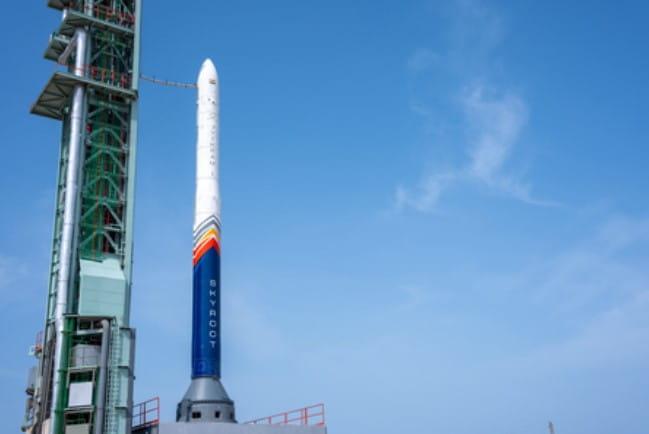
India’s space sector is undergoing a historic transformation through the Government of India’s forward-looking reforms. As Skyroot Aerospace launched Vikram-1, India’s first privately developed orbital rocket on July 18,2026, the country’s growing private space ecosystem has demonstrated the impact of these reforms.
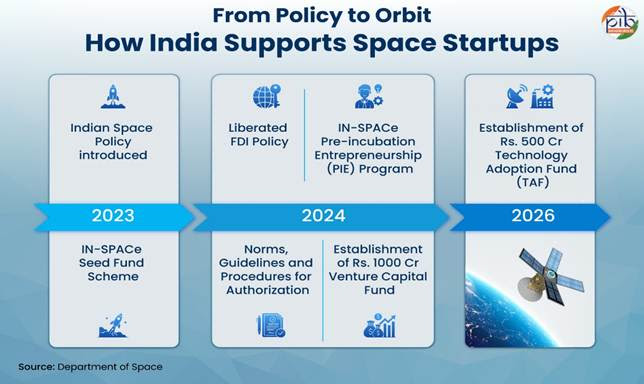
The Indian Space Policy 2023 has opened the entire space value chain to private participation, fostering innovation, investment and enterprise across the space ecosystem. Indian industry is now participating in satellite manufacturing, launch services, space applications and downstream services.
The impact of these reforms is already visible in the numbers. India’s space startup ecosystem has grown from just one startup in 2014 to over 400 in 2026, reflecting the rapid expansion of private participation and innovation across the space sector.
Government reforms are also accelerating the growth of India’s space economy. Valued at approximately USD 8.4 billion today, the sector is projected to grow five-fold to USD 40–45 billion by 2030. It is further aimed to reach USD 100 billion by 2040. Sustained Government support, enabling regulations and strong public-private partnerships continue to drive this growth, positioning India as a global hub for space technology, manufacturing, innovation and commercial space activities. Read More on Building India's Space Future: INDIA'S SPACE ODYSSEY
|
Mission Aagaman: Vikram-1
|
Key Reforms Enabling Private Participation in India's Space Sector
The Government of India has taken profound steps by introducing key reforms in the space sector to expand private sector participation and unlock new opportunities for innovation.
Indian Space Policy 2023
The Government notified the Indian Space Policy 2023, allowing Non-Government Entities (NGEs) to take part across the entire space value chain. This move opened doors for private players to space-related activities in India. The policy aims to drive innovation in technology, encouraging fresh ideas and advancements within the sector. Alongside this, the policy also encourages international collaboration, fostering partnerships that support peaceful exploration of space. Collectively, these steps mark a significant shift toward a more open and inclusive space ecosystem in India.
Single-Window Space Regulator
The Indian National Space Promotion and Authorisation Centre (IN-SPACe) is acting as an autonomous single-window agency to authorise and promote space activities by Government entities and NGEs. Strengthened by the Indian Space Policy 2023, IN-SPACe also provides a stable and predictable regulatory framework and facilitates end-to-end industry participation, Additionally, it enables access to ISRO facilities, technologies and technical expertise, and streamlines approvals through transparent guidelines. As of June 2026, IN-SPACe has registered over 4,500 organisations, issued 133 authorisations, and signed 106 Memoranda of Understanding.
Additionally, as of February 2026, IN-SPACe facilitated USD 150 million in investments into Indian space startups during CY 2025, with the top 10 startups securing a confirmed order book of the same value. By June 2026, IN-SPACe had also facilitated 118 technology transfer agreements and signed 189 Joint Project Implementation Plans (JPIPs), Technology Partnership Agreements (TPAs) and Business Partnership Agreements (BPAs), accelerating technology commercialisation and industry collaboration.
Catalysing Private Investment

Commercialisation of India's Space Programme
The Indian Space Policy 2023 defined the role of NewSpace India Limited (NSIL) as ISRO's commercial arm. NSIL manufactures and procures space systems on commercial principles. It also delivers end-to-end space solutions to both Government entities and NGEs. NSIL further expands private participation through PSLV productionisation and small satellite technology transfer. It also supports satellite services while marketing space products and spin-off technologies.
Over the years, NSIL has witnessed a tenfold increase in revenue, reflecting its expanding commercial footprint in the global space sector. As of December 2025, over 70 Technology Transfer Agreements had enabled the transfer of ISRO-developed technologies to industry, accelerating their commercialisation.
As of July 2026, NSIL has launched a total of 141 satellites, including 138 international/customer satellites and 3 Indian satellites,reinforcing India's position as a trusted global launch service provider.
Liberalised FDI Policy for Space
The Foreign Direct Investment (FDI) policy for the space sector was liberalised to make it more investor-friendly. The revised policy permits up to 74% automatic FDI in satellite manufacturing and operations, 49% automatic FDI in launch vehicles and spaceports, and 100% automatic FDI in the manufacturing of satellite components and subsystems. The reform is expected to accelerate investments, promote technology transfer and collaborative research, and further improve the ease of doing business in India's space sector.
|
Sector/Activity |
Sectoral Cap |
Entry Route |
|
Satellites-Manufacturing & Operation |
100% |
Up to 74%: Automatic Beyond 74%: Government route |
|
Satellite Data Products |
||
|
Ground Segment & User Segment |
||
|
Launch Vehicles and associated systems or subsystems |
100% |
Up to 49%: Automatic Beyond 49%: Government route |
|
Creation ofSpaceports for |
||
|
Manufacturing of components and systems/ sub-systems for satellites, ground segment and user segment |
100% |
Up to 100%: Automatic |
These reforms reflect the government’s commitment to building a stronger, more dynamic space ecosystem that encourages enterprise, accelerates growth, and strengthens India’s global standing.
From Policy to Progress
Government reforms have unlocked innovation, private participation and commercial opportunities across India’s space ecosystem. These reforms have translated into tangible outcomes in launch services, indigenous technology development, public-private partnerships and technology transfer.
This collaborative ecosystem is shaping India's emergence as a global space technology hub.
The Road Ahead
India's space sector stands at the threshold of a new era, driven by Government-led reforms and a vibrant private ecosystem.
The Indian Space Policy 2023, liberalised FDI norms, and dedicated funding initiatives have opened the entire space value chain to any potential players. These reforms have fostered a dynamic ecosystem marked by growing startups, indigenous innovation, and expanding commercial activities. Moreover, as Vikram-1 prepares for liftoff under Mission Aagaman, it would represent more than a technological milestone.
It reflects the growing confidence and capabilities of India's private space industry. The journey from ISRO-led missions to a thriving space ecosystem demonstrates the success of the Government's reform agenda. With sustained policy support, public-private partnerships, and technological innovation, India is well positioned to emerge as a leading global space power and a key driver of the future space economy.
If you value our journalism, consider making a voluntary contribution to help us continue bringing news, stories and information to our readers.
Scan the QR code to contribute

Every contribution, big or small, is appreciated.